

270-Degree RGBW Neon Flex: Visible Outlines or Recessed Lighting? A Mounting Decision Guide
A bright neon sample can become a narrow stripe inside a channel. Learn when wide-view RGBW neon suits an architectural outline and how to test visibility, diffusion and mounting before ordering.
Why a glowing sample can disappear after installation
A hotel reception outline may look continuous on a workbench yet disappear when guests approach from the side. The cause can be the channel lip, a return in the joinery or the way the emitting face points. Buying more LEDs does not remove a physical obstruction.
For architectural outline lighting, decide whether people should see the luminous body or only its reflection. A visible line needs useful side visibility along the walking route; a concealed cove intentionally hides the source. Mark front, side and low viewing positions on the drawing, then judge the sample from those positions rather than only straight ahead.
270 degrees describes viewing, not the bend or the finished effect
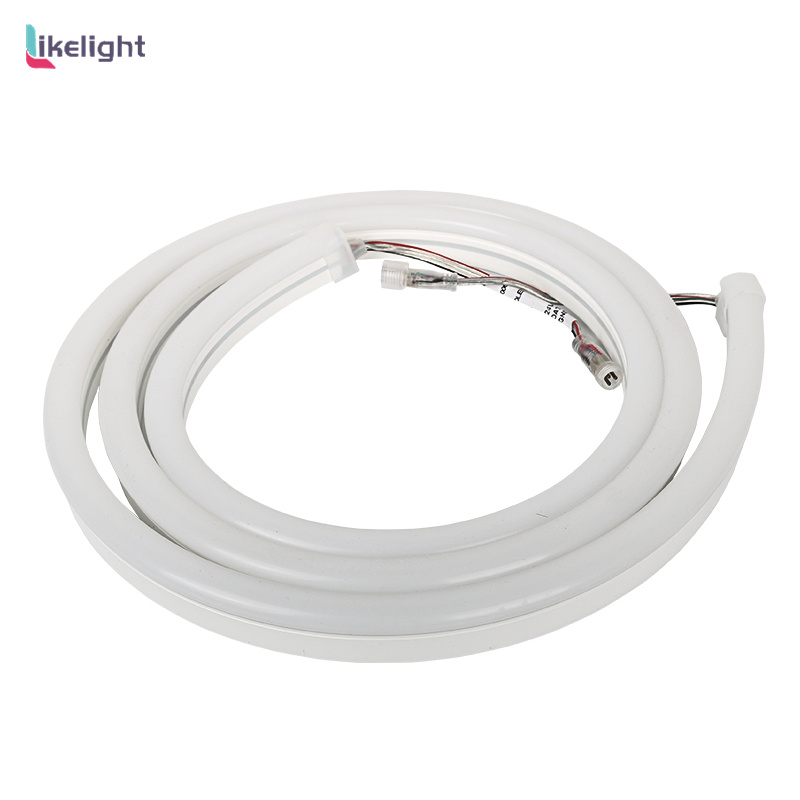
This model is described with a 270° viewing angle. That is a reason to evaluate it for an exposed contour seen from several directions, not a promise of equal brightness at every angle. A bracket or recess can still mask the useful emitting surface. The number also says nothing about allowable twisting or bending radius.
The published density is 60 LEDs/m: 1000mm ÷ 60 ≈ 16.7mm nominal LED pitch. Diffuser construction, viewing distance and nearby reflective surfaces determine whether that internal spacing remains visible. Compare a straight section and a representative curve at the intended dimming level; neither pixel density nor cutting length can be derived from LED density.
Choose RGBW for the lighting task, then specify its operation
RGBW provides a white component alongside the RGB colors. It is worth evaluating when a retail outline changes between colored branding and a white daytime appearance. However, white color temperature, color rendering and output are not stated here, so the sample should be compared with surrounding white lighting before a color match is promised.
DC12V is published, but power per metre is not. Without that input, length alone cannot determine current or power-supply quantity. After the selected version has a confirmed wattage, calculate length × watts per metre and divide by 12V for theoretical load current. Segment feeds by accessible installation areas; the longest permitted feed and reserve allowance belong to the final electrical design.
Separate whole-line color changes from moving pixel effects
A smooth color change along an entire sign and a chase moving around individual letters need different control capabilities. RGBW describes colors, while an addressable configuration also needs defined control segments and a compatible data interface. The current product facts do not identify that architecture.
Use an effect reference to settle this distinction before ordering: request a full-line fade for one brief, or a moving segment for the other. The selected controller must reproduce that effect with the actual sample. Do not assign DMX channels, pixel counts or a controller model from RGBW alone.
Test the profile, curve and termination as one assembly
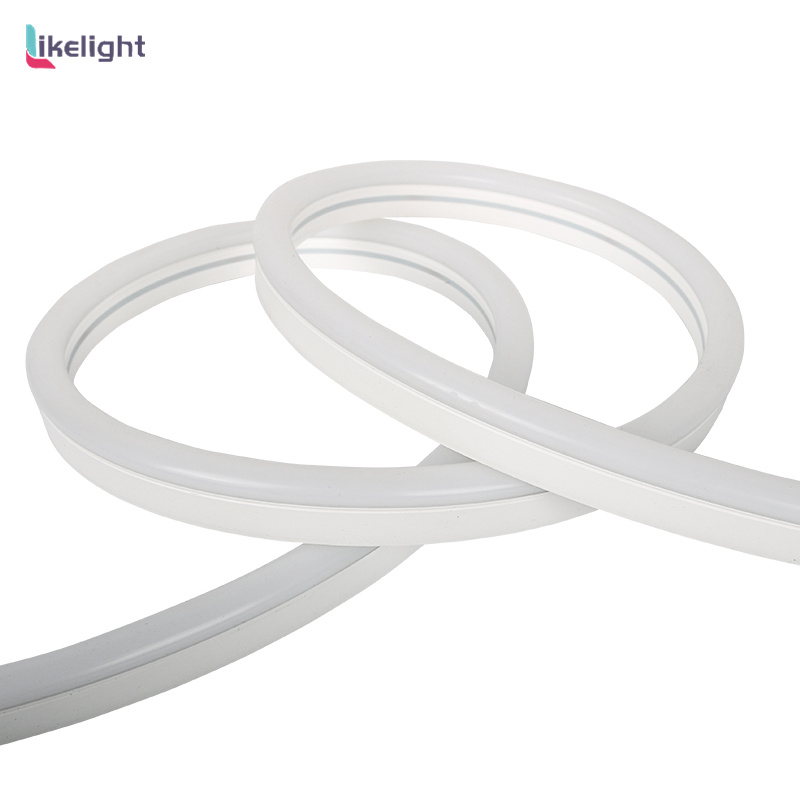
The catalogue uses 12–25mm dimensional wording, which is not a complete cross-section drawing. A profile purchase needs the actual width, height, clip engagement and cable-exit envelope. Build one straight section, one tight project curve and one termination in the proposed support; the minimum bend radius and bending direction must come from the approved product drawing.
At each viewing position, compare the bare sample with the supported sample using the same color and brightness setting. If only the supported sample develops a dark edge, change the support or orientation before considering LED density. For exposed locations, assess end caps, joints and drainage together; no specific IP rating is established by this product evidence.
Match the visible result to the mounting decision
| Project condition | Preferred evaluation | Reason |
|---|---|---|
| Visitors approach from several directions | Test the exposed 270° configuration | The support must preserve side visibility |
| Source should be hidden in a cove | Evaluate reflected light, not emitter visibility | A recess serves a different visual objective |
| Visible dots or dark edges | Compare bare and mounted samples | Diffusion and obstruction are different causes |
| Exposed outdoor contour | Obtain the protection configuration first | No IP rating is established for this version |
| Long installation | Obtain wattage, then divide into feed zones | DC12V alone does not define circuit load |
| Moving chases around letters | Demonstrate the exact control configuration | RGBW does not establish addressability |
Where LIKELIGHT's wide-view RGBW neon is a useful candidate
LIKELIGHT L-NH-1225 brings together RGBW, DC12V, 60 LEDs/m and a published 270° viewing angle. For a visible sign contour or architectural accent, the practical value is the opportunity to test a luminous line from several approach directions without choosing an unnecessarily hidden mounting arrangement.
It is a stronger candidate for exposed decorative outlines than for a brief demanding a precisely controlled wall beam or confirmed pixel animation. That is an application judgment, not a guarantee: approve the actual support, viewing route and white-light appearance. Outdoor use, power planning and control selection still require the specific configuration rather than assumptions from the neon category.
| Model | L-NH-1225 |
|---|---|
| Color configuration | RGBW |
| Supply | DC12V |
| LED density | 60 LEDs/m |
| Viewing angle | 270° |
| Dimensional wording | 12–25mm; dimensioned cross-section required |
| Not specified | Power, IP rating, control architecture, white CCT and CRI |
Make the sample answer the project question
- Contour drawing and lengths by installation area
- Front, side and closest viewing positions
- Visible-line or concealed-reflection reference
- Required colors, white appearance and animation
- Support cross-section, curves, cable exits and environment
- Sample quantity, required delivery and controller information
These inputs let LIKELIGHT evaluate the optical line, support geometry and control requirement together, then develop a power and connection proposal around the confirmed version. A representative mounted sample is more informative than a loose roll alone.
FAQ
Does 270° mean the neon can bend through 270°?
No. It is viewing-angle information. The permissible bend direction and radius are separate mechanical specifications.
Will 60 LEDs/m always look continuous?
No. About 16.7mm is the nominal internal LED pitch. Diffusion, viewing distance and mounting obstruction determine the visible line.
Can RGBW neon run pixel chases?
Only if the ordered version and controller support segmented control. The RGBW label alone does not establish that capability.
Can I order the mounting channel from the 12–25mm wording?
Use a dimensioned drawing instead. Width, height, clip engagement and cable clearance must all fit the support.