

How to Select a DMX512 RGB Linear Pixel Light for Architectural Projects
A practical B2B guide to selecting a DC24V DMX512 RGB linear pixel light by viewing distance, pixel spacing, power planning and installation conditions.
Start with the visual effect and viewing distance
Architectural outlines, columns, entrances and landscape lines often need chasing, gradients or coordinated colour flow rather than close-range video detail. Start by defining where people will view the installation and what they need to recognise from that position.
For this model, 8 pixels/m gives an approximate 125 mm pixel pitch. That scale can suit medium- and long-distance segmented effects, but viewing distance, mounting height, animation content and the building surface still determine whether the result reads as intended.
What 48 LEDs/m and 8 pixels/m mean for this model
The published configuration is DC24V with 48 LEDs/m and 8 pixels/m. The LED density supports the linear luminous appearance, while the pixel density determines the number of controllable visual segments along the bar.
A 125 mm pixel pitch is not a universal answer for every facade. It is better suited to colour movement, gradients and segmented chasing than to close-up fine graphics. Where the audience is near the fixture or the project needs intricate content, compare a higher-density pixel product at the real viewing distance.
DC24V power planning and voltage drop
The product page lists a maximum consumption of 11.52W/m. Using that published value, the theoretical current is about 0.48A/m: 11.52W/m divided by 24V. This is a circuit-planning starting point, not a fixed consumption for every brightness level, colour combination or programme.
For a 100 m layout, 100 m x 11.52W/m equals 1152W; 1152W divided by 24V equals 48A. This is the total theoretical load only. A building project should distribute power by zone, with cable size, feed locations, protection and power margin designed for the released layout. Zonal circuits also make future fault isolation and maintenance more manageable.
With comparable cable length and line resistance, voltage drop can be understood as current multiplied by line resistance. At the same power, the lower current associated with DC24V usually reduces the absolute line-voltage loss, but cable gauge, connectors, fixture PCB and feed position still affect the result. Verify the loaded voltage at the end of each installed circuit.
DMX512 control and address planning
This is a DMX512 product, so the approved drawing should define the fixture mode, channel use, address allocation, data direction and controller-port arrangement. In a common RGB mode, one pixel often uses three DMX channels; the final channel count must follow the actual fixture mode and controller configuration.
A DMX address unit does not automatically define a cutting unit. Describe cutting only where the product page, data sheet or PCB marking identifies the position; otherwise, use the product-marked copper pads for cutting or connection.
Module layout, installation and protection
The published bar size is 1000 x 50 x 45 mm. A repeated one-metre module can simplify facade layout and quantity calculation, but bracket positions, cable exits, corners, shielding and service access must fit the actual structure before fabrication begins.
The page publishes CE and RoHS information. It does not publish a complete site-installation protection design. For exposed work, evaluate the final product configuration together with end treatment, connectors, cable exits, drainage and the maintenance route instead of treating the fixture body as the whole installation.
Quick selection table
| Close viewing or detailed animation | Compare a higher pixel-density option when the effect needs fine graphics, text or video-like detail at close range. |
|---|---|
| Facade outlines and colour flow | For this model, 8 pixels/m can be evaluated for segmented chasing, gradients and colour movement seen from medium or longer distances. |
| Dry indoor installation | Plan the 1000 x 50 x 45 mm module layout, cable exit direction, brackets and service access with the actual structure. |
| Outdoor or exposed installation | Confirm the final fixture configuration and design the ends, connectors, cable exits, drainage and maintenance route as one system. |
| Long linear areas | Use the published 11.52W/m maximum value as the starting point, then divide the project into maintainable power circuits. |
| DMX512 project control | Freeze fixture mode, channel use, address allocation, data direction and controller-port planning on the approved drawing. |
Where the LIKELIGHT configuration fits
LIKELIGHT L-R-10048-DMX can be evaluated for facades, hotels, entertainment venues, stages and landscape features that need repeatable linear modules, DMX512 zone programming and dynamic colour seen from medium or longer distances. Its 48 LEDs/m can support a relatively continuous linear appearance at an appropriate viewing distance, while 8 pixels/m balances segmented movement with the scale of the control plan.
It is not the first choice when the core requirement is near-view, high-resolution graphics. Submit the expected viewing distance and an effect reference so the pixel pitch, control plan and physical layout can be assessed together.
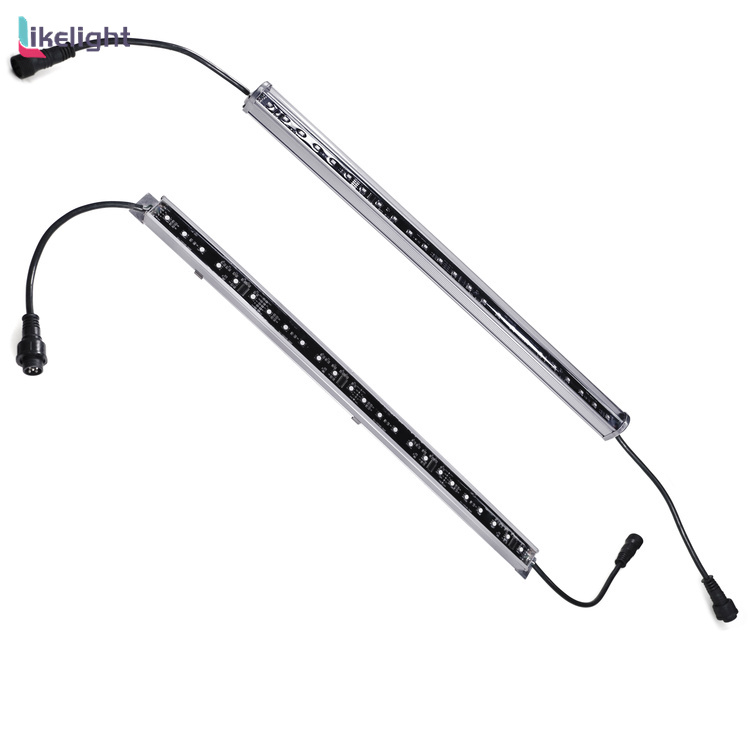
| Model | L-R-10048-DMX |
|---|---|
| Light source | SMD5050 RGB LED |
| Input voltage | DC24V |
| LED density | 48 LEDs/m |
| Pixel density | 8 pixels/m |
| Control | DMX512 |
| Published power | 11.52W/m maximum |
| Beam angle | 180 degree |
| Mechanical size | 1000 x 50 x 45 mm |
| Published certification | CE, RoHS |
Information to prepare before quotation
- Total installation length and length of each zone
- Main viewing distance and installation height
- Target animation, colour flow or reference image
- Installation environment and required protection level
- Controller model, fixture mode and wiring plan
- Cable exit direction, connector arrangement, sample and delivery requirement
These details allow pixel density, power circuits and connection method to be evaluated together for the real project rather than treating one light bar as a complete installed system.