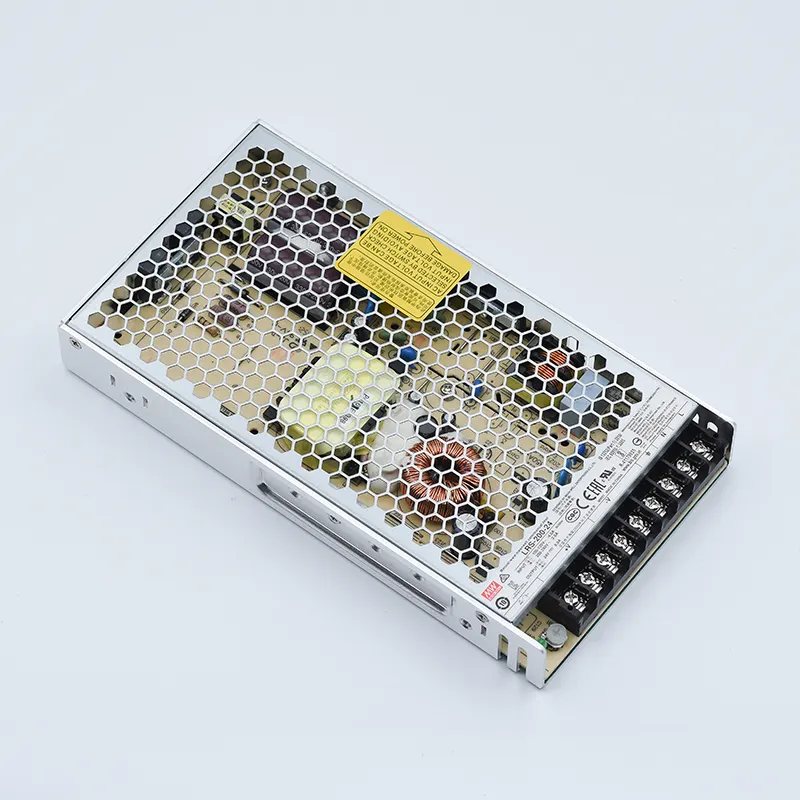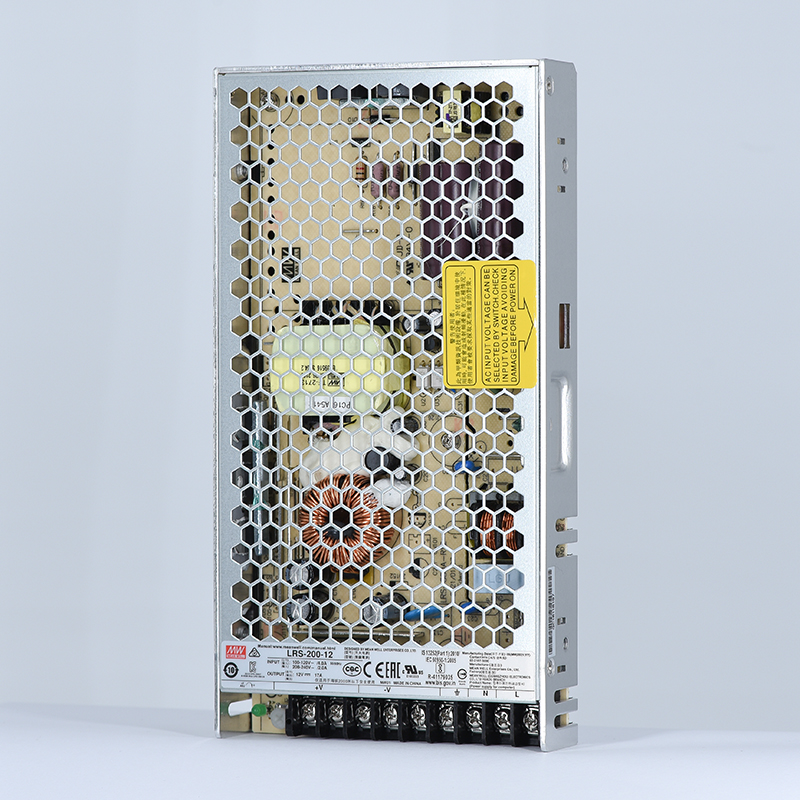


LRS-200 Input Voltage: Check the Site Before Ordering
Buying the same 24V LED power supply for several shops? Confirm each shop's actual AC circuit first. A switch-selected LRS-200 can be considered only when that circuit fits a published input range and qualified staff verify the setting before power is applied. If the circuit or setting is unknown, hold installation rather than trying it.
Why 24V on the output does not settle the input
AC is the building supply entering the unit; DC is the low-voltage supply leaving it for the LEDs. On the standard LRS-200, the 115/230 selector chooses between two AC input windows. It does not turn a 12V output model into a 24V model. MEAN WELL lists 90–132VAC and 180–264VAC by switch, not one continuous 90–264VAC range.
| Confirmed site condition | Published input window | Order decision |
|---|---|---|
| Within 90–132VAC | 115 setting | Candidate only with exact-model and setting checks |
| Within 180–264VAC | 230 setting | Candidate only with exact-model and setting checks |
| Outside both, or not established | Neither verified | Choose another documented supply or establish the circuit first |
One 24V load, two different site circuits
Hypothetical comparison: Shop A has an electrician-confirmed nominal 120VAC circuit; Shop B has 208VAC. Since 90 ≤ 120 ≤ 132, A falls in the lower window. Since 180 ≤ 208 ≤ 264, B falls in the upper window. Both may require 24V DC output, but their input-setting records must differ. A 277VAC circuit falls outside both windows: do not order this model for that input.
These comparisons screen nominal voltage, not the complete installation. Have the electrician check expected variation and frequency against the exact specification as well. Compare the load with the manufacturer's input-voltage and temperature derating curves. A country name, plug type or successful demonstration at another site does not establish the new circuit.
Make the setting travel with the order and the spare
- Before the quote: identify the destination site and have its electrician document the actual circuit, expected AC range and required DC output. Use those details to select an exact model, not merely a series name.
- In the offer: request the exact SKU and valid output options, the applicable specification, dimensional and wiring drawings, and a written site-to-input-setting schedule. This prevents an otherwise correct 24V unit being assigned to the wrong circuit.
- For the sample and delivery: ask for model/nameplate and unpowered setting records tied to the identified unit. Qualified personnel must verify the actual setting before energizing, following the manufacturer's instructions. Do not ask warehouse staff to expose or adjust energized equipment. MEAN WELL warns that a 115 setting on a 230VAC input can damage the supply.
- For acceptance: agree who checks the unit, site and setting together, and retain the result with the cabinet record. Unclear or mismatched units stay out of installation. A photo documents a condition; it does not replace the installer's check.
- For the complete price: separate supplies, enclosure and mounting, wiring and protection, qualified installation checks, sample acceptance and matched spares in the BOM, meaning the list of supplied items and work. Request lead time and spare availability. Compare that installed scope, not just the unit price.
- When moving a spare: recheck the receiving site's circuit and the unit's setting even if the DC output matches. Keep site identification with the spare so a repair does not silently transfer the previous site's assumption.
Where the LIKELIGHT LRS-200 listing fits
LIKELIGHT's listing offers LRS-200 output choices including 5V, 12V and 24V. For a confirmed 24V LED cabinet, request the exact LRS-200-24 documentation and a representative sample proposal, with the destination circuit attached. This is an enclosed component supply: it still needs a suitable final installation, access and ventilation. It is not a choice for a 277VAC circuit or for a job that needs automatic wide-range input without a selector. Input suitability alone does not approve load capacity or local compliance.