


P55 LED Pixel Curtain OEM Specification: Freeze Node Count, Power Density and Control Zones
A custom curtain quotation is unreliable until pitch, facade area and control zones describe the same layout. Use the published 18x18mm UCS5603 node, DC12V, 0.72W and P55 option to calculate a traceable planning baseline before sampling.
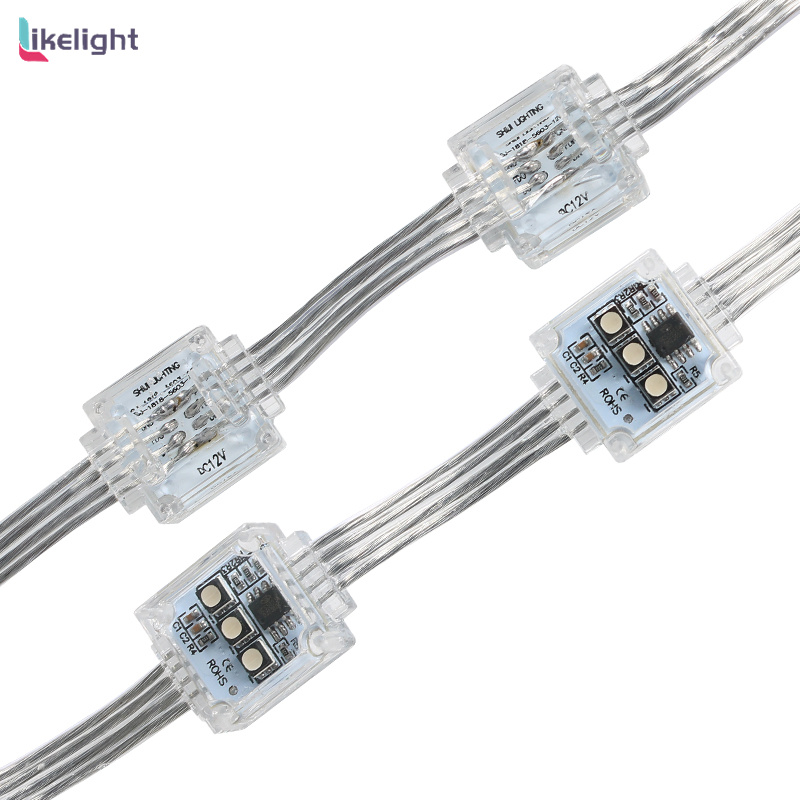
This guide uses this LIKELIGHT product's published 18×18mm, UCS5603, DC12V, 0.72W per node, P55 or customized pitch and IP67 facts to compare P55 with a 100mm planning scenario.
Published product parameters
Published values are separated from the theoretical planning calculations below.
| Published item | Product-page value |
|---|---|
| Node/model | 18×18mm / L-C-1818 |
| LED and control | SMD3535 RGB / UCS5603 |
| Electrical | DC12V / 0.72W per node |
| Pitch | P55 or customized |
| Protection | IP67 option stated on page |
Calculate theoretical load from 0.72W per node
The page rates each node at 0.72W and DC12V, giving 0.72W ÷ 12V = 0.06A theoretical current. A regular P55 grid is about 238W/m²; the 100mm case is about 72W/m².
These are theoretical planning values, not a final power-supply selection. RGB content, brightness, program, line loss and project margin affect the electrical design; large curtains need zoned circuits and loaded-voltage tests.
Organize UCS5603 cascade control and zones
UCS5603 uses cascade-pixel architecture. Define pixel order, data direction, controller-port allocation, zones and content mapping rather than treating each node as an independently configured DMX address.
Total pixels increase with curtain area. Controller compatibility, nodes per port, refresh requirement, failure scope and upper-protocol mapping must be confirmed from the final control system, not inferred from one pixel.
IP67 nodes do not waterproof the complete curtain
The page lists IP67, a -20°C to 60°C operating range and 50000 hours for the stated configuration. The final order must still match the actual encapsulation, cable and environment.
Ends, branches, power boxes, support structure, drip paths and service access form the outdoor system. Node IP67 does not protect an unsealed field connection or replace structural and maintenance planning.
Decide between lighting effects and image detail
Facade outlines, color flows, low-resolution text and abstract graphics need different pixel density. Distant viewers mainly see rhythm and form; close viewers need a smaller visual step and stricter content trials.
The page lists P55 or customized pitch, but pitch alone cannot guarantee image quality. Viewing distance, facade size, background transmission, content and orientation must be tested with a representative sample.

How much does P55 differ from 100mm spacing?
For a regular grid, P55 gives about (1000 ÷ 55)² ≈ 330.6 nodes/m²; a 100mm planning grid gives 100 nodes/m². P55 therefore uses about 3.3 times as many nodes, affecting resolution, data, connectors, labor and service points.
The 100mm case explains the design tradeoff; it is not a confirmed order configuration. Corners, boundaries, irregular areas and zones change final quantity, so quotation requires a dimensioned pixel layout.
Where the LIKELIGHT P55 curtain fits
This model combines an 18×18mm node, SMD3535 RGB, DC12V, 0.72W and UCS5603, with P55 or customized pitch listed. It can suit facade color animation, atriums, stage backgrounds and decorative grids where transparency matters.
It should not be used for close-view high-definition text or video without a content sample, or where zoned power, structural fixing and connector service are impossible. Compare a smaller pitch or another display system when recognition dominates.
Prioritize this solution when
- Facade animation or transparent decorative grids
- P55 or custom pitch can be sampled against real content
- Zoned power and connector service are available
Re-evaluate the system when
- Close-view high-definition video is expected without a trial
- Power cannot be divided into serviceable zones
- Structure, drainage or connector access is unresolved
Project information required for quotation
Send facade dimensions, a pixel layout, P55 or candidate custom pitch, viewing distance, content reference, transparency target, zones, controller, feed positions, structure, exposure, connector direction and schedule.
LIKELIGHT uses these inputs to calculate node count, theoretical power density, control zones, circuits and installation work before sampling and final configuration release.
- Dimensioned facade and pixel layout
- Candidate pitch and viewing distance
- Animation or video reference
- Transparency target and zones
- Controller and feed positions
- Structure, exposure, connectors and schedule
Frequently asked project questions
Does P55 mean a 55mm node?
No. P55 describes center spacing; the published node body is 18×18mm.
How much theoretical power does P55 require?
Using 0.72W per node and a regular grid gives about 238W/m² before project-specific allowances.
Is UCS5603 the same as DMX512?
No. It is cascade-pixel control; DMX or Art-Net applies only when the selected controller maps pixels through those upper protocols.
Does IP67 make the complete facade waterproof?
No. Ends, branches, power boxes, cable exits, drainage and installation remain part of the protection design.
Can pitch be customized?
The page lists P55 or customized pitch; final spacing, cable and structure must be frozen from the project drawing and sample.