


RGB LED Wall Washer or Wall Grazer? How Mounting Distance and Surface Texture Change a Facade
A facade decision guide for separating broad RGB wall washing from close-set grazing, then testing setback, overlap, surface response and IP65 interfaces.
Quick answer
- Wall washing seeks a broad, blended field; grazing places light close to the surface to reveal texture and shadow. They are different project goals.
- This page publishes DC24V, RGB full color, IP65 and a wide wash with a typical 120–180° viewing-angle statement, but it does not provide an IES file, rated power, fixture length or control method.
- Do not calculate fixture spacing from the 120–180° statement as though it were a verified photometric beam angle. Test setback and overlap on the real facade material.
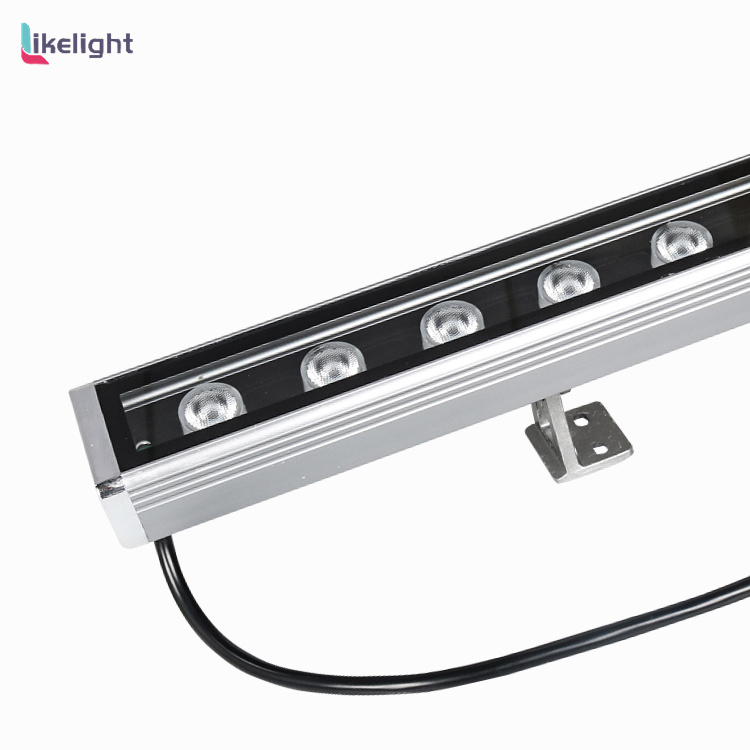
Published product evidence
| Model | L-W-10024RGB-24V |
|---|---|
| Color | RGB full color |
| Input | DC24V |
| Published optical wording | Wide wash; 120–180° viewing angle (typical) |
| Protection | IP65 |
| Working temperature | -20°C to +60°C |
| Storage temperature | -30°C to +80°C |
| Published applications | Building facades, architectural accents and landscape decoration |
Decide whether the facade should look smooth or textured
A wall wash spreads color across a vertical surface and tries to blend adjacent fields. A wall graze sits closer to the wall and creates shadows that reveal stone joints, ribs or relief. Choosing the wrong effect can make a smooth hotel facade look striped or flatten the texture of a heritage wall.
Define the nighttime objective first: uniform brand color, soft gradient, highlighted columns or visible material texture. Photograph the surface in daylight and record its color, reflectance and relief because dark, glossy and deeply textured walls respond differently to the same fixture.
Viewing angle, beam angle and wash width are not interchangeable
The page uses the phrases wide wash and 120–180° viewing angle (typical). That supports a broad-view product position, but it is not sufficient to calculate a precise illuminated width, candela distribution or fixture spacing.
For a construction layout, request the actual optical configuration or photometric file, then test the proposed aiming angle and setback. Until those data are confirmed, treat any coverage sketch as a sample plan rather than a guaranteed result.
Separate optical mock-up from electrical release
DC24V is published, but rated watts per metre or per fixture and the fixture length are not. The page therefore supports voltage selection but not a reliable total-load, current or supply-count calculation.
Build the electrical schedule only after power and module length are approved. Divide long facades into service zones, record cable routes and joint locations, and measure loaded voltage at the last fixture in each zone during the brightest intended scene.
RGB color does not identify the control protocol
RGB describes color capability, not whether the product uses DMX512, SPI, PWM or another interface. The current evidence does not publish a protocol, addressing method or channel footprint.
The control schedule must state the final driver or controller, dimming method, signal topology, connector pinout and desired scenes. This prevents a color-capable sample from arriving with an interface that cannot join the building-control system.
Setback, overlap and field joints decide the installed result
For washing, move the sample far enough from the wall for adjacent fields to overlap without bright scallops. For grazing, move it closer only when texture and shadow are intentional. Brackets, parapets, drainage and maintenance access can change the usable aiming range.
IP65 is published for the product, but end treatments, connectors, cable exits and junction boxes remain separate interfaces. Aim water away from joints, avoid trapped drainage paths and confirm whether maintenance is possible without removing facade panels.
Project decision table
| Project condition | Recommended direction | Why |
|---|---|---|
| Smooth facade and uniform brand color | Start with a wall-wash mock-up and overlapping fields | The objective is continuity, not hard shadow |
| Stone ribs or relief should be visible | Compare a close-set graze mock-up | Shallow incidence reveals texture |
| Only 120–180° viewing wording is available | Do not calculate spacing from it | Viewing wording is not an IES distribution |
| Outdoor facade with exposed joints | Assess IP65 product and every connection separately | The installed system includes more than the luminaire |
| Power and length are unpublished | Hold the electrical schedule | DC24V alone cannot determine load |
| RGB control method is unknown | Freeze protocol and dimming interface on the sample | Color capability does not identify signal architecture |
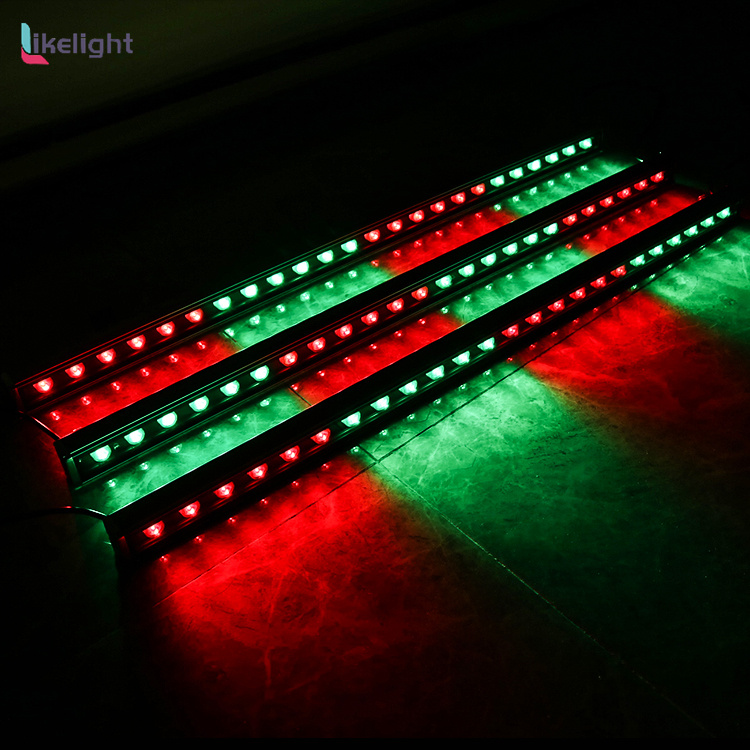
Where the LIKELIGHT DC24V RGB wash configuration fits
LIKELIGHT model L-W-10024RGB-24V is a candidate for RGB facade accents and landscape color fields where a wide wash and DC24V architecture match the mock-up. The page also lists IP65 and a -20°C to +60°C working range.
It is not ready for final quantity, supply or control release without fixture length, rated power, optical distribution and control interface. It should not be specified as a texture grazer solely because it can be mounted close to a wall; the intended surface effect must be tested.
Good fit when
- Broad RGB facade accents validated by a surface mock-up
- Landscape and architectural zones using a DC24V plan
- Projects that document setback, overlap, joints and access
Re-evaluate when
- Photometric layouts based only on the typical viewing-angle phrase
- Power calculations made without rated watts and fixture length
- Control schedules that assume RGB means DMX512
Information needed for a project quote
- Facade elevation, material and surface photographs
- Wall height, fixture setback and aiming constraints
- Target wash or graze effect and color references
- Total run and service-zone lengths
- Required controller or building-system interface
- Joint exposure, sample quantity and deadline
These inputs let LIKELIGHT evaluate optical mock-up conditions, service zones, control compatibility and outdoor interfaces before fixture quantity and electrical design are released.
FAQ
Is 120–180° the beam angle for spacing calculations?
The page calls it a typical viewing angle. Use confirmed photometric data and a mock-up for spacing.
Can this RGB wall washer be controlled by DMX512?
The reviewed page does not publish a protocol. Confirm the final controller and channel interface.
Can DC24V determine the number of power supplies?
No. Rated power and final fixture length are also required.
Does IP65 make every field joint suitable outdoors?
No. End treatments, connectors, cable exits and junctions need their own protection design.