


Why 40mm DMX512 Facade Pixels Show the Wrong Colors: Addressing and Commissioning Guide
A commissioning guide for separating DMX channel errors, physical pixel-order mistakes and outdoor connection faults in a 40mm RGB facade grid.
Quick answer
- If every point lights but colors or effects are shifted, check DMX mode, start address and physical point order before replacing hardware.
- The page confirms a 40mm RGB point with six LEDs, DMX512, 120° beam and IP68; it does not publish voltage, power or channels per point in the current evidence.
- The title says RGB while model L-C-406-DMXRGBW contains RGBW, so the final color/channel mode must be frozen before programming.
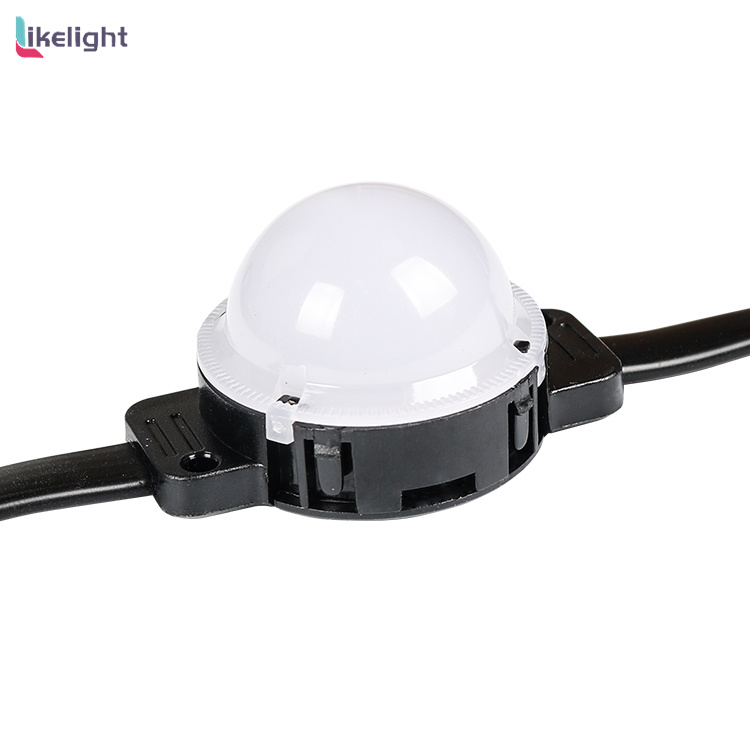
Published product evidence
| Model | L-C-406-DMXRGBW |
|---|---|
| Published color | RGB SMD LEDs |
| Control | DMX512 |
| Diameter | 40mm |
| LED quantity | 6 LEDs (page title) |
| Beam angle | 120° |
| Protection | IP68 |
| Published temperature | Working -20°C to 60°C; storage -30°C to 80°C |
Read the symptom before changing addresses
A completely dark zone points first to power, signal continuity or a disabled output. A grid that lights in the correct colors but in the wrong positions points to physical order or mapping. Correct positions with swapped colors point to channel order or fixture mode. Treating all three symptoms as an address problem wastes commissioning time.
Use a simple test sequence: all red, all green, all blue, then a single moving white point. The color frames expose channel-order errors; the moving point exposes reversed strings, skipped nodes and controller maps that do not match the facade drawing.
Freeze RGB or RGBW before building the channel schedule
The product title and summary identify a 40mm DMX512 RGB pixel with six LEDs. The published model code ends in RGBW, however, so the source evidence contains a configuration ambiguity. The purchase specification must state the final color version and operating mode rather than relying on the model suffix alone.
The 40mm diameter is the visible lens size, not the project pitch. Pixel spacing must be set by viewing distance and content. A 120° beam supports a broadly visible point, but it does not determine how many pixels are required for a logo or media pattern.
Do not calculate power from a value the product page does not publish
The reviewed product record does not publish operating voltage or watts per point. Therefore a reliable current, power-supply quantity or voltage-drop calculation cannot be made from this page alone. Those values must be added to the approved datasheet before the electrical drawing is released.
Commissioning can still verify the power architecture: energize one zone at a time, compare loaded voltage at the first and last point, record supply and fuse assignments, and repeat the full-output test. A voltage problem usually follows electrical distance and load, while a mapping problem follows point order.
Use DMX universe math only after confirming channels per point
DMX512 provides 512 control slots per universe. In a common three-channel RGB mode, 120 points would occupy 360 slots. In a four-channel RGBW mode, the same 120 points would occupy 480. Both examples fit one universe, but 150 RGBW points would need 600 slots and therefore more than one universe.
These are planning examples, not a claim about this model's unpublished channel mode. Confirm channels per point, start-address method, fixture order, universe boundary and controller output. Then label each physical string and keep the final patch table with the project file.
IP68 at the pixel does not diagnose a failed outdoor string
The page publishes IP68 for the product. Outdoor reliability still depends on cable entries, connectors, terminations, strain relief, drainage and the way the node is fixed. A wet connector can create intermittent data faults that look like programming errors.
Inspect the fault by substitution: exchange a known-good short section, connector or controller output without changing the program. If the fault moves with hardware, investigate the connection. If it remains at the same mapped address, investigate patching and content data.
Project decision table
| Project condition | Recommended direction | Why |
|---|---|---|
| Colors correct, positions wrong | Check point order and mapping | The physical sequence does not match the controller map |
| Positions correct, colors wrong | Check channel order and RGB/RGBW mode | A fixture-mode mismatch shifts color data |
| Entire zone dark | Check power and DMX continuity first | No response is not automatically an address fault |
| Intermittent outdoor flicker | Substitute connectors and inspect sealing | Moisture faults can imitate data errors |
| More than one universe | Document universe boundaries and labels | Patch errors increase at boundaries |
| Unknown voltage or power | Stop electrical release until documented | The current page does not publish these values |
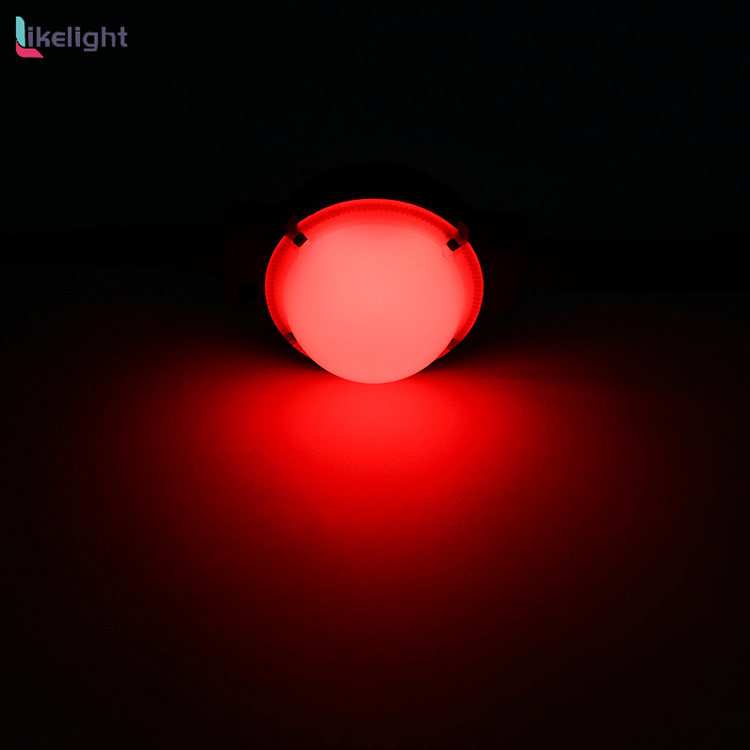
Where the LIKELIGHT 40mm DMX pixel is a strong fit
LIKELIGHT model L-C-406-DMXRGBW is a candidate for direct-view facade dots, outlines and media grids that need a visible 40mm point, wide 120° viewing and DMX512 integration. Its six-LED RGB description and IP68 rating provide a clear optical and environmental starting point.
It is not ready for final controller and power design until RGB/RGBW mode, voltage, rated power, channel footprint, connector pinout and point spacing are approved. A sample string should be commissioned with the intended controller before bulk production.
Good fit when
- Direct-view facade dots and large media grids
- Projects with documented DMX patching and physical point maps
- Outdoor systems that validate connectors as well as the IP68 node
Re-evaluate when
- Projects whose RGB/RGBW mode is not frozen
- Electrical designs based on unverified power values
- Fine text or close-view content without a pitch simulation
Information needed for a project quote
- Facade drawing with point coordinates and spacing
- Final RGB or RGBW mode
- Controller model, universes and channels per point
- String order, data direction and connector pinout
- Approved voltage, watts per point and supply zones
- Outdoor joint method, sample quantity and deadline
These records let LIKELIGHT reproduce the controller patch, physical order and outdoor interfaces on the sample before the project reaches site commissioning.
FAQ
Why do all pixels light but show the wrong colors?
The most likely checks are channel order, fixture mode and controller patching, not the LED count.
Does 40mm mean 40mm pixel pitch?
No. It is the product diameter. The facade drawing defines center-to-center spacing.
How many DMX channels does each point use?
The current evidence does not publish the mode. Confirm RGB or RGBW and the exact channel footprint.
Is IP68 enough for an outdoor facade?
It is the published node rating. Connectors, cable entries, drainage and field joints remain part of the installed system.