

12x12mm LED Neon Flex: Freeze Bend Direction, Voltage and Cut Unit Before Shop Drawings
A 12x12mm profile does not define how the neon bends, cuts or is powered. Use the published density and voltage range to shortlist a version, then release shop drawings only after a marked sample confirms bend plane, cut unit, connector and loaded electrical data.
The procurement error is approving a profile name while leaving the actual bend plane, cut unit, power version and connector undefined. Those omissions reappear as impossible corners, dark joints or incompatible field wiring.
Published product facts
| Published item | Value |
|---|---|
| Model | L-NH-1212-2835-24V |
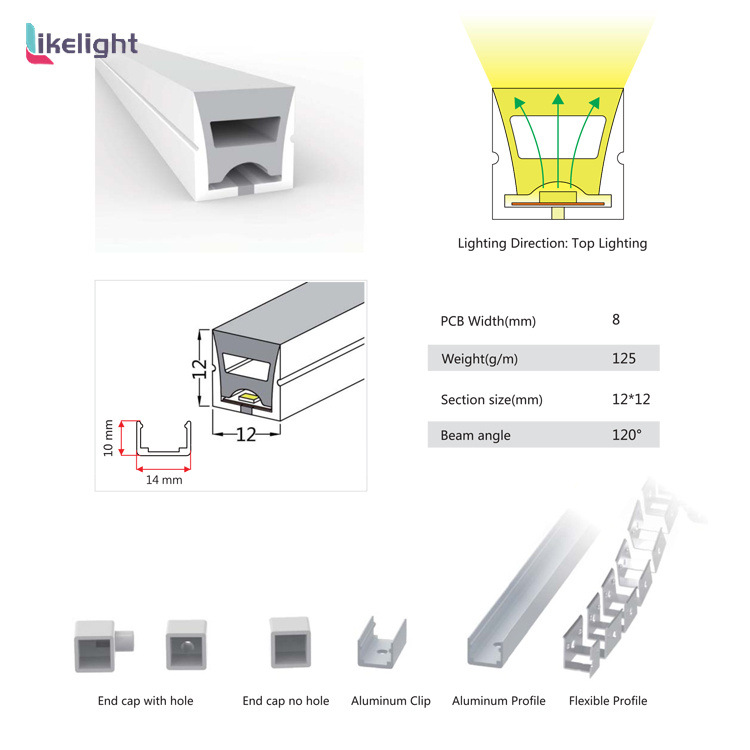
| Cross-section | 12x12mm |
| Material | Silicone |
| LED package | SMD2835 |
| Density options | 30 / 60 / 72 / 96 / 144 LEDs/m or customized |
| Voltage options | DC5V / DC12V / DC24V |
| Color/control options | Single color / RGB / digital / addressable |
| Protection information | IP65 / IP66 / IP67 / IP68 listed; ordered construction required |
| Temperature | Working -20°C to +60°C; storage -30°C to +80°C |
Release one marked bend-and-cut sample
Ask for one sample carrying arrows for light face and permitted bend plane, marks for every actual cut point, and the ordered voltage and color/control version on its label.
Form the smallest project curve without twisting, cut only at a marked point, terminate it with the proposed connector and run a loaded test. The page does not publish minimum radius, cut length or power, so the approved sample and data sheet must supply them.
| Sample check | Release evidence |
|---|---|
| Optical line | No visible dots or dark joint at viewing distance |
| Geometry | Permitted bend plane and approved project radius |
| Fabrication | Actual cut unit, end cap and connector |
| Electrical | Voltage, measured W/m and loaded end voltage |
Do not combine every published option into one assumed SKU
The page presents 30/60/72/96/144 LEDs/m, DC5V/DC12V/DC24V, and single-color, RGB, digital or addressable choices. These are family options, not proof that every density exists with every voltage and control type.
Freeze one row containing density, voltage, color/control architecture, silicone section, IP construction, cut unit and connector. For a digital version, the IC and controller compatibility must be named before sampling.
Use nominal pitch to shortlist density, not to promise a dot-free line
The listed densities equal nominal pitches of 33.3, 16.7, 13.9, 10.4 and 6.9mm. Smaller pitch can reduce visible stepping, but silicone optics, viewing distance and the distance from LED to light face still decide uniformity.
Compare at least two candidate densities in the same extrusion and color at the real viewing distance. LED pitch is not the cut unit or minimum bend radius; both remain separate release values.
Judge the luminous line on the real curve
A straight bench sample can hide the two failures that matter on site: the inside of a curve can brighten while the outside separates, and a joint can become darker than the continuous run. Review both on the actual mounting radius and surface.
Approve the line from the normal viewing route with the intended color and ambient light. Density is only one variable; extrusion optics, bend plane, fixing intervals and connector shadows can dominate the result.
Resolve the IP option before describing the outdoor system
The page lists IP65, IP67 and IP68 options and separately shows IP66. These values should not be presented as if one finished reel has every rating. The actual silicone construction, end treatment, connector and cable exit must be tied to the ordered version.
Even where a higher protection option is selected, joints, end caps, feeds, drainage and mounting remain part of the complete installation. The page publishes -20°C to +60°C working and -30°C to +80°C storage ranges; final connectors, drivers and adhesives also need to suit the project environment.
Separate static, RGB and addressable control packages
Single-color needs a suitable constant-voltage supply and switching or dimming method. Analog RGB needs multi-channel wiring for a shared section, while an addressable version additionally needs the published IC, data direction, pixel grouping and compatible controller.
Do not place the word digital on the order without those fields. Freeze the controller, sample program, connector pinout and restart behavior with the exact neon version before production.
Where this LIKELIGHT 12x12mm neon flex fits
The page identifies exhibition decoration, luminous characters, theaters and clubs. The compact 12x12mm silicone body and selectable LED density make it a candidate for letters, decorative outlines and integrated details where the tested light line, bend direction and mounting channel match the drawing.
It is not ready to specify for tight curves, long single-feed routes, underwater use or a named digital protocol from the current page alone. Those conditions require the missing radius, cut unit, W/m, run design, exact IP construction and control IC to be confirmed on the product sample.
Suitable when
- Letters and outlines verified with the actual diffuser
- Projects that can lock voltage, density and control version
- Installations with planned ends, connectors and service access
Re-evaluate when
- Tight bends without a published radius or bend direction
- Long runs without W/m and feed calculations
- Underwater or named-protocol claims based only on the current page
Information required before quotation and sampling
Send the artwork or outline drawing, straight and curved run lengths, minimum curve radius, viewing distance, channel dimensions, required light uniformity, selected density, DC5V/DC12V/DC24V preference, single-color/RGB/digital effect, controller information, feed locations, IP target, cable exits, connector direction and schedule.
These inputs allow LIKELIGHT to compare density, optical line, electrical circuits, control version and terminations as one system. The approved sample should record W/m, cut marks, bending direction, minimum radius, connector construction and control compatibility before bulk production.
- Artwork and run lengths
- Curves, channel and diffuser dimensions
- Viewing distance and line-uniformity target
- Density and DC5V/DC12V/DC24V preference
- Single-color, RGB or digital effect and controller
- IP target, feeds, connectors, sample and schedule
Frequently asked questions
Does 144 LEDs/m guarantee a dot-free line?
No. Silicone optics, viewing distance, channel and diffuser depth also determine the result.
Can LED spacing be used as the cut length?
No. Cut only at marks confirmed on the selected PCB or specification.
Which voltage gives the longest run?
The page does not provide W/m or run limits, so the exact version must be calculated before that decision.
Is every version IP68?
No. Several ratings are listed; the ordered construction and complete terminations determine protection.