


How Many 60mm RGB Cabochon Lights Does a Ferris Wheel or Casino Sign Need? Layout and Power Guide
A project method for turning visible outline length, viewing distance and a published 4.32W DC24V cabochon load into point quantity and power zones.
Quick answer
- Start with the outline length and a tested center-to-center pitch; the 60mm body diameter is not the project pitch.
- At the published 4.32W and DC24V, one point represents a theoretical 0.18A load. One hundred points equal 432W and 18A before losses and design reserve.
- The page does not publish the control architecture, so controller addressing and data capacity must not be inferred from the word pixel.
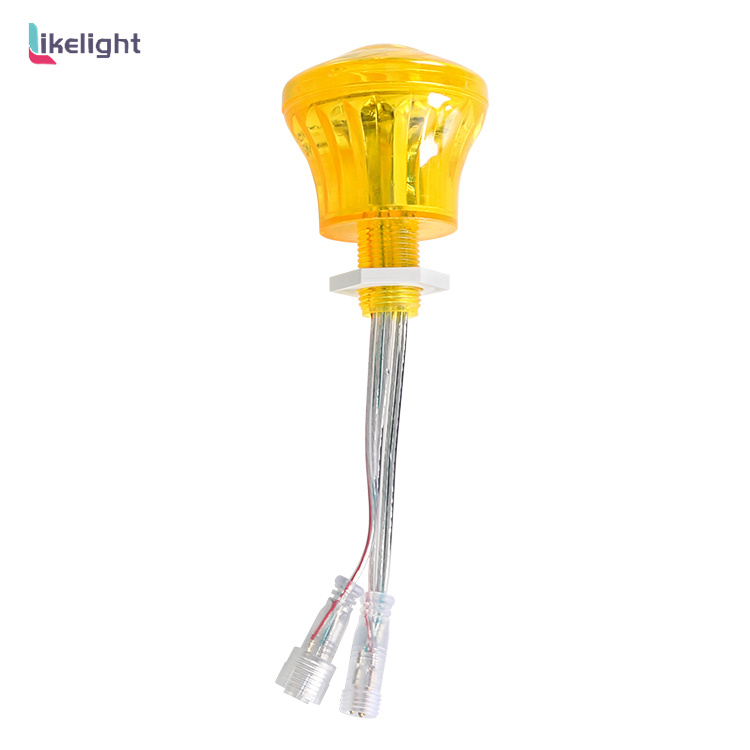
Published product evidence
| Model | L-D-6018-Yellow Cover |
|---|---|
| Body | 60mm E14 cabochon |
| Light source | 18 SMD5050 LEDs, RGB |
| Input | DC24V |
| Rated power | 4.32W per point |
| Protection | IP66 |
| Published applications | Amusement parks, casino signs, Ferris wheels and outdoor decoration |
| Published lifetime | 50,000H |
Point count begins with the visible outline, not the catalogue photo
A Ferris-wheel ring, ride panel or casino letter can use the same 60mm lamp but require very different quantities. Measure the illuminated centerline for every ring, spoke, letter and border, then separate zones that must animate or be serviced independently.
Choose a trial pitch from the main viewing distance and content. A larger pitch can work for distant outline rhythm; a smaller pitch gives smoother curves and letter edges but raises point count, power and cabling. Approve the pitch with a full-scale night sample rather than a screen rendering alone.
Convert center pitch into a defendable quantity
For a straight run, an initial estimate is illuminated length divided by center pitch, with endpoint treatment added by the drawing. A 30m ring at a hypothetical 300mm pitch is about 100 points; at 200mm it becomes about 150. These pitch values are design examples, not published product limits.
The lamp body is 60mm, so the mounting plate, E14 holder, cable bend and replacement access must fit around each center. The physical diameter prevents impossible close packing, but it does not establish the best visual spacing.
Use 4.32W per point to size zones before choosing supplies
From the published values, 4.32W ÷ 24V = 0.18A theoretically per point. One hundred points equal 432W and 18A; 150 points equal 648W and 27A before supply losses, cable losses and design reserve.
These totals are a load-planning start, not a single-feed instruction. Divide a wheel, sign or ride into accessible circuits, keep each supply and protective device mapped to its physical zone, and verify voltage at the electrically farthest point while the intended effect is running.
Do not design the controller from an unpublished protocol
The reviewed page calls the product an RGB pixel light but does not publish its IC, protocol, channels, addressing method or points per controller output. Therefore DMX universes, SPI pixel counts or automatic-program behavior cannot be assigned from the title alone.
Freeze the controller model, signal type, data direction, connector pinout and point order on the sample specification. A moving-point test should follow the physical drawing so reversed strings or incorrect maps are found before the structure is closed.
IP66 is a product fact, while the installation remains a system
IP66 is published for this model. Outdoor performance still depends on the E14 holder, cable entries, branch joints, strain relief, drainage and the orientation of the yellow cover. A protected lamp cannot compensate for an open splice behind the panel.
Plan replacement from the front or rear before drilling the structure. Ferris-wheel and ride applications also need cable restraint that follows moving or vibrating members without placing the connector under tension.
Project decision table
| Project condition | Recommended direction | Why |
|---|---|---|
| Close-view letters or tight curves | Mock up a smaller center pitch | More points improve edge sampling but increase load and wiring |
| Distant Ferris-wheel or ride outline | Test a wider pitch at the real viewing distance | The visible 60mm lens can carry the outline rhythm |
| Thirty metres at 300mm pitch | Start near 100 points, then resolve endpoints | 30m ÷ 0.30m = 100 |
| Outdoor panel or moving ride | Design holders, joints, drainage and restraint together | IP66 does not rate every field connection |
| One hundred published loads | Budget 432W and 18A before reserve | 100 × 4.32W; 432W ÷ 24V |
| Control protocol not documented | Stop addressing design and test a sample system | The page does not identify the control architecture |
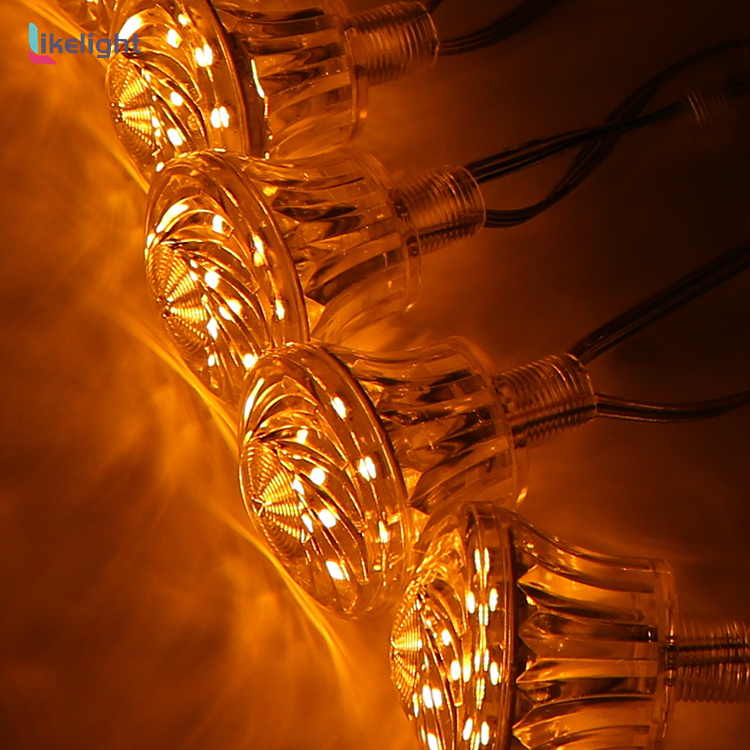
Where the LIKELIGHT 60mm cabochon configuration fits
LIKELIGHT model L-D-6018-Yellow Cover combines a visible 60mm cabochon, 18 SMD5050 LEDs, RGB color, DC24V input, 4.32W rated power and IP66 protection. It is a relevant candidate for large decorative outlines where the lamp itself should remain visible.
It is not ready for control-system release until protocol, point order, connector pinout and controller capacity are confirmed. It is also a weak fit for close-view fine graphics unless the chosen pitch is validated with the real lens and mounting background.
Good fit when
- Ferris-wheel rings, ride outlines and large casino letters
- Projects that want a visible 60mm cabochon aesthetic
- Installations divided into serviceable power and control zones
Re-evaluate when
- Controller schedules based on an assumed protocol
- Fine close-view graphics without a pitch mock-up
- Outdoor structures whose holders and field joints are not protected
Information needed for a project quote
- Dimensioned outline drawing and zone lengths
- Primary and closest viewing distances
- Proposed center pitch and total point count
- Controller model and target effects
- Holder, cable, connector and replacement direction
- Sample quantity, packaging and deadline
These inputs allow LIKELIGHT to check point count, theoretical load, zone boundaries, mounting access and control compatibility as one system before the sample is approved.
FAQ
Is 60mm the recommended point spacing?
No. It is the published body diameter. The center pitch comes from the drawing, viewing distance and sample.
How much current do 100 points require?
At the published rating, the theoretical total is 18A at DC24V before losses and reserve.
Which controller should be used?
The current page does not publish a protocol. Confirm the final control architecture and connector pinout on the sample.
Does IP66 cover the E14 holder and field joint?
Not automatically. Those interfaces must be included in the complete outdoor design.