

MEAN WELL HLG LED Driver Selection: Separate 90–305VAC Input from 24V or 48V Output
A drawing calls for a “24V LED fixture,” but the power supply label says 90–305VAC. That can look like a mismatch. It is not: one value usually describes the DC output to the light, the other the AC input to the driver. Keep the two sides separate before selecting a model.
30-second selection answer
- For a 24V constant-voltage fixture: Start with a 24V DC output version, then calculate total load current. A mains input range alone does not prove compatibility.
- For a constant-current luminaire: Match the required LED current and operating-voltage window. A 24V constant-voltage supply is not a substitute.
- For dimming: Freeze the full model suffix and interface before quotation. “Dimmable” in a series title does not identify the interface on a specific unit.
To screen a candidate, send the luminaire label's output type, voltage/current and total watts. A full drawing is not needed for the first check.
Which side does 90–305VAC describe?
A driver has an input side and an output side. LIKELIGHT's HLG page lists 90–305VAC as the AC input range and separately lists DC12V, DC24V and DC48V output choices. These figures describe mains input and low-voltage DC power to the light; they are not interchangeable.
Read the fixture label or manual first. “24V DC constant voltage” calls for a regulated 24V DC output. A specified current, such as 700mA, together with an LED voltage window points to constant-current drive. The words “LED driver” alone do not tell you which one is required.
- Constant voltage (CV): The supply holds a set DC voltage for fixtures designed to operate from that voltage.
- Constant current (CC): The supply holds a set current, and the LED string must stay within its stated voltage range.
HLG is a family, not one electrical configuration
MEAN WELL describes HLG as a constant-voltage plus constant-current family. That does not mean every exact model operates in both modes or shares the same suffix. The official HLG-240H table, for example, lists a 24V model with output up to 10A; other output voltages have different current limits.
Suffixes also affect control. The official series documentation distinguishes blank, A, B, AB, C and other options. Do not infer that any HLG unit provides the dimming interface your project uses just because the family includes dimmable versions. Match the complete model, wiring diagram, datasheet revision and control signal.
- Specify the complete model: Include the HLG wattage family, DC output voltage, suffix and required dimming function—not just “HLG 24V.”
- Common mismatch: A constant-current luminaire paired with a constant-voltage model, or a dimming controller that does not match the chosen suffix.
Use watts to estimate current—not to approve wiring
For a constant-voltage load, a first-pass current estimate is total watts divided by output volts. Assume a 24V CV lighting load rated at 120W: 120W ÷ 24V = 5A. This indicates an approximate 5A load; it is not, by itself, a final model recommendation.
Next check branch count, cable length and size, connector loss, ambient temperature, derating curves and dimming conditions. A long feeder can lose voltage at the far end and affect output. The remedy may be shorter branches or another feed point, not simply a higher-wattage supply.
- Assumption: 24V constant-voltage load, 120W total nameplate load; line loss and design margin are not included.
- Result: The theoretical operating current is 5A.
- Buying implication: Compare the exact model's rated output, derating, protection and wiring plan. Set margin from the project rules rather than treating a rule of thumb as a product specification.
Dimming is not pixel control
An HLG supply converts AC input to the DC power required by a luminaire and may offer different dimming options. It is not an SPI pixel controller and will not create individually addressed colour effects by itself. Addressable lighting also needs a compatible controller, data protocol and wiring plan.
For ordinary dimming, match the exact supply interface to the controller output. Include the controller model and signal type in the quotation request. If dimming is not needed, specify that too; it avoids paying for or receiving an unintended suffix.
- Constant-voltage fixture: Check output voltage, load current and dimming interface. The controller's position in the circuit must follow the fixture and controller instructions.
- Constant-current fixture: Match drive current, LED voltage window and any dimming interface; wattage alone is not enough.
Compare the installed system, not only the supply price
Models of similar wattage can differ in output voltage, current, dimming, dimensions, wiring and protection. Enclosure space, cable entry, heat conditions, mounting location and service access all affect installed cost. Similar wattage does not make two drivers interchangeable.
The LIKELIGHT page lists an operating range of −25 to +70°C and storage from −40 to +85°C, alongside several output options. Confirm protection rating, temperature derating and dimming from the exact model's datasheet. Outdoor use also depends on junctions, cable glands, enclosure and orientation; a family-level description is not an installation guarantee.
- Good candidate to review: The luminaire input type is known, output voltage and load match, and the exact model documentation covers control and installation.
- Do not order yet: The fixture's CV/CC requirement is unknown, or the space and dimming method are still undecided. Establish the load requirement before choosing wattage.
A practical first-pass calculation
Outcome: a 24V CV HLG model can enter the shortlist, but the 5A calculation does not approve a purchase. Confirm the complete model, wiring, derating, control and installation conditions first.
This is a screening calculation from nameplate watts at nominal DC voltage; it excludes cable loss, thermal derating and design margin.
Assumption: 24V constant-voltage fixture, 120W total nameplate load. This screens current only; it excludes cable loss and design margin.
-
1. Estimate load current
Calculation or check
120W ÷ 24V = 5AWhy it matters
5A is the theoretical load current, not a model number. -
2. Screen the output
Calculation or check
Choose a 24V CV output and check the exact datasheet current and rated power.Why it matters
The official HLG-240H-24A specification lists 24V and up to 10A; still check suffix, derating and project conditions. -
3. Check distribution and control
Calculation or check
Review cable run, conductor size, branches, dimming interface and mounting environment.Why it matters
If voltage drop or control mismatch is the issue, revise the distribution/interface plan rather than merely increasing supply wattage.
Choose by condition
| Your condition | First direction |
|---|---|
| The luminaire requires constant current and specifies current/voltage limits | Match an exact CC model; do not substitute a 24V CV supply. |
| The fixture is marked 24V DC constant voltage | Start with 24V output and estimate current from total watts. |
| Dry indoor location with accessible maintenance | Compare dimensions, wiring space, dimming and system cost. |
| Supply is outdoors or in a damp location | Verify the exact suffix's protection rating and design glands, enclosure and drainage. |
| Long feeder or multiple parallel sections | Calculate each branch and voltage drop; consider shorter branches or local feeds. |
| Dimming or intelligent control is required | Confirm the suffix/interface; pixel data control needs a separate controller. |
Applying the decision to LIKELIGHT's HLG listing
LIKELIGHT lists HLG-185/240/320/480/600H families, DC12V, 24V and 48V options, and a 90–305VAC input range. It also lists operating and storage temperatures. This is a useful starting point, not a complete cross-table of every wattage and output combination.
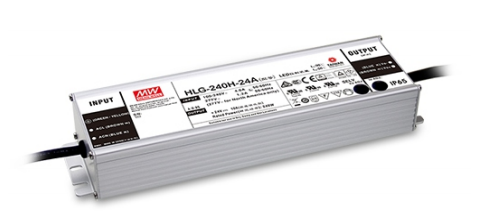
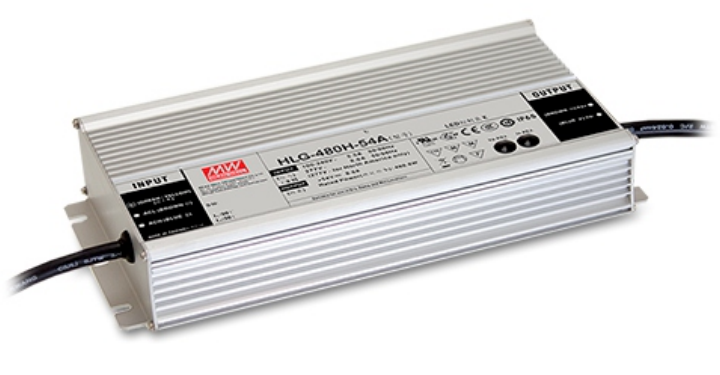
The manufacturer datasheet narrows the choice to a specific unit. For example, HLG-240H-24A is rated 24V and up to 10A; HLG-480H-54A is 54V and up to 8.9A. They are not interchangeable because both belong to HLG. Match the luminaire first, then verify current, CV/CC behaviour and suffix functions against the exact datasheet.
| Item | Value |
|---|---|
| Series on LIKELIGHT page | HLG-185H, 240H, 320H, 480H and 600H |
| Input listed by LIKELIGHT | 90–305VAC (AC input) |
| DC output options on page | DC12V, DC24V and DC48V; MEAN WELL lists models across 12–54V |
| Model examples | HLG-240H-24A: 24V, up to 10A; HLG-480H-54A: 54V, up to 8.9A |
| Temperature on LIKELIGHT page | Operating −25 to +70°C; storage −40 to +85°C |
Before you request a quote
- Luminaire requirementA safely readable label showing CV or CC, voltage/current and total watts.
- Local mainsDestination country and nominal site AC supply.
- Load and branchesFixture quantity, watts or length per branch, cable run and parallel circuits.
- ControlController model and dimming method, or state that dimming is not required.
- InstallationIndoor/outdoor location, temperature, available space and service access.
- Delivery targetQuantity, requested timing and the sample configuration to evaluate.
Ask the quotation to list the exact candidate model, its datasheet, wiring/dimensional information, branch assumptions, sample plan, complete-system scope, spares and lead time. Any missing specification should be identified before the family name is treated as an orderable model.
FAQ
Does 90–305VAC mean the unit outputs 90–305V?
No. It is the AC input range. DC output is set by the exact model, such as 24V or 54V.
Can a 54V HLG supply power a 24V fixture?
Do not connect a 54V output to a 24V-rated fixture. Match the luminaire's rated input to the supply output.
Does a 5A load automatically fit a 10A supply?
Not automatically. Check load type, derating, wiring loss, protection, branches and control.
Are all HLG models dimmable?
Do not assume so. Dimming function and interface depend on the full model suffix and its datasheet.
MEAN WELL HLG series specifications
Start with a model check
Send the fixture label, quantity and total watts, destination country, and whether dimming or control is required. LIKELIGHT can check candidate HLG models and wiring information, then discuss a representative sample. Confirm the complete model and installation conditions before ordering.