

Square or Round RGB Pixel Lights for a Commercial Sign? Compare Fit Before You Quote
Square or Round RGB Pixel Lights for a Commercial Sign? Compare Fit Before You Quote
A sign can carry the right animation and still look wrong because the points are too prominent, the mounting ears do not fit, or the quoted string does not match the electrical design. For a new sign face, choose the visible point format on a real panel before fixing the quantity.
LIKELIGHT offers two distinct RGB strings worth comparing: the 26 × 18 mm square L-C2618-UCS1903 at DC5V and the 30 mm round L-C-30ICRGB-1903 at DC12V. Both list UCS1903 pixel control, but the housing, LED arrangement, voltage, power and protection entries differ. One cannot be substituted for the other on an approved drawing.
The practical choice
If the face layout calls for compact rectangular nodes and the fabricator can accommodate the 26 × 18 mm body, sample the square 5V version. If the design deliberately shows round 30 mm nodes or uses visible decorative borders, sample the round 12V version. The choice must be made on the real sign material at normal viewing distance; neither published size specifies the cutout or finished appearance by itself.
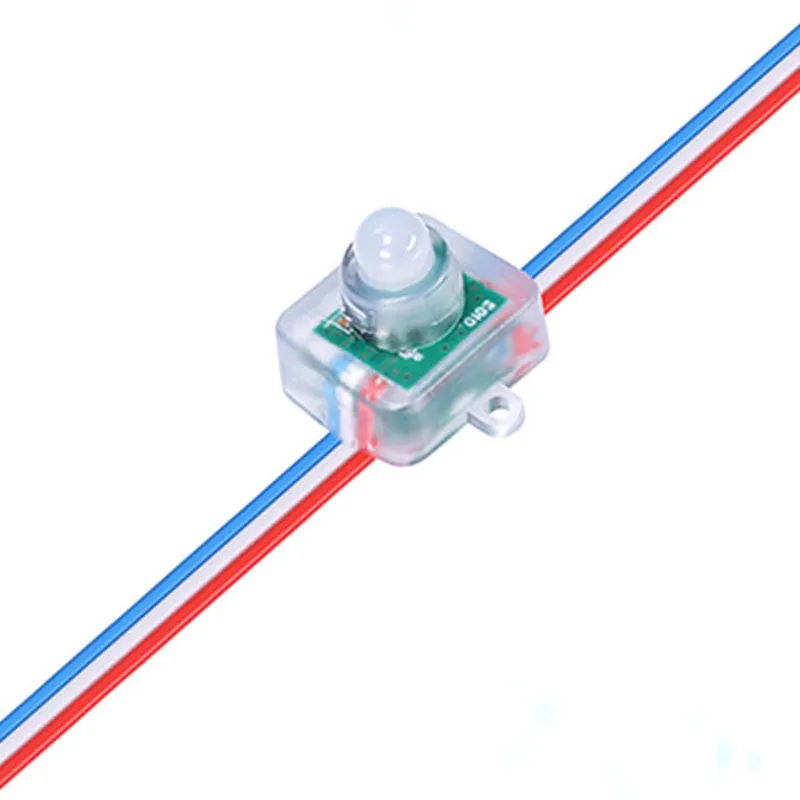
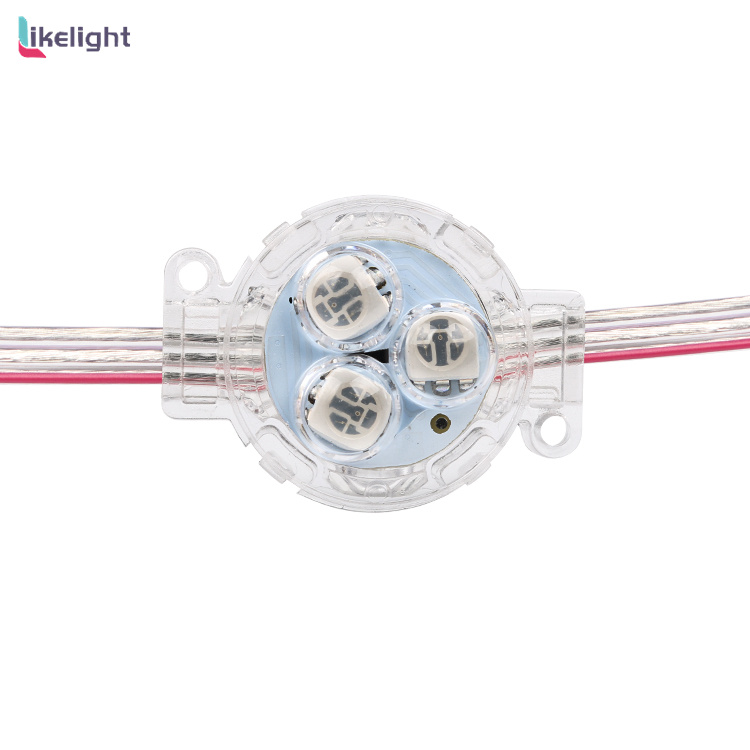
Two exact products, two separate purchase lines
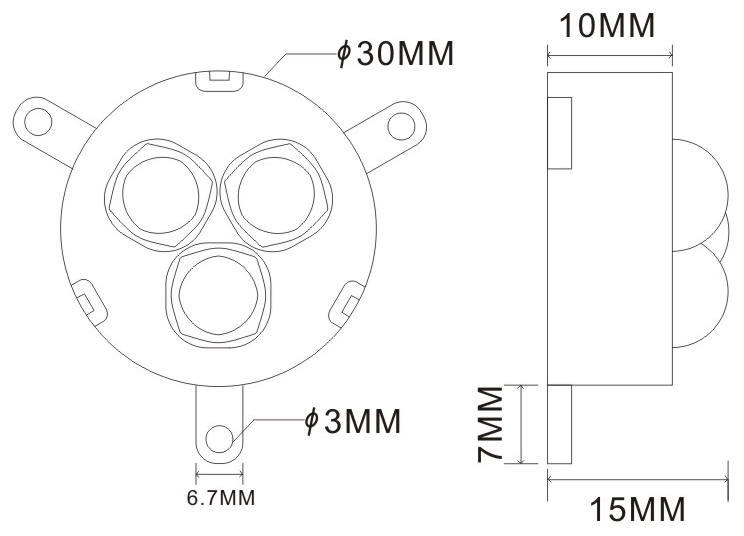
What the sign maker needs from the dimension drawings
The round product drawing marks a Ø30 mm main body and shows mounting ears with small holes. It does not give every centre-to-centre fixing dimension needed to drill a finished sign. The square page identifies a 26 × 18 mm format, but its illustration also does not establish a complete aperture and fixing plan for the ordered revision.
Ask the fabricator and LIKELIGHT to agree a cross-section: front-face opening, behind-panel clearance, cable route, fixing method and access to replace one point. A short strip of three to five points mounted on the actual face reveals whether the visible dot size and spacing suit the artwork. Do this before cutting a full batch of panels.
The same IC name does not make the systems interchangeable
UCS1903 means the RGB points are addressed through a pixel-control path. It does not prove that the two strings share the same connector pinout, colour order, controller file or allowable chain length. The square model is published at 5V; the round model is published at 12V. Their power supplies and distribution must be specified separately.
A comparable quote should state the exact point model, count and confirmed pitch; the matching controller and effect file; DC supply and feed locations; cable length, connectors and any electrical box. Outdoor IP67 or IP66 entries describe the listed lights, not the completed joints, cable exits, supply or enclosure. Ask for the chosen system's connection drawing and protection details.
Judge the sign from where customers actually see it
For a storefront wordmark, place sample points in a straight segment and a tight curve. View them in daylight and in the intended night scene. For a large decorative border, include a corner and the longest visible gap. These observations tell you whether the chosen point shape supports the graphic, without assuming that three LEDs must look brighter than one F8 LED.
If the requirement is a continuous luminous line rather than visible dots, compare a suitable linear or neon product instead of forcing either pixel string into the face. If animation is required, approve one actual moving scene with the intended controller before ordering many sign sections.
Send a small sign-face brief for a comparable quote
- A sign drawing with face material, thickness, point locations and normal viewing distance.
- A photo or short description of the desired daytime and nighttime appearance, including one animation if needed.
- The planned indoor/outdoor exposure, access behind the sign and destination country.
- Estimated point count, number of identical signs and whether controller, power, cables and box are required.