

Permanent Pixel Lights Not Behaving Correctly? A UCS1903 Commissioning and Fault-Isolation Guide
Wrong colors, dark sections and load-related dimming need different tests. Use a 20-point DC12V UCS1903 string to separate configuration, data-path and power faults before closing permanent-lighting supports.
Begin with the symptom, not a replacement order
A permanent holiday lighting installation can show three quite different faults: every point displays the wrong color, a section stops responding after a joint, or the far end changes as brightness increases. Replacing the entire string before distinguishing these patterns can leave the actual configuration or wiring problem untouched.
Record which points respond to red, green and blue tests and to a single moving point. Then repeat at a lower output setting. Stable but swapped colors suggest a mapping question; a repeatable boundary suggests checking a joint or data path; behavior that changes with load warrants supply measurements. These are diagnostic leads, not proof of a failed component.
Build a known-good 20-point reference before expanding
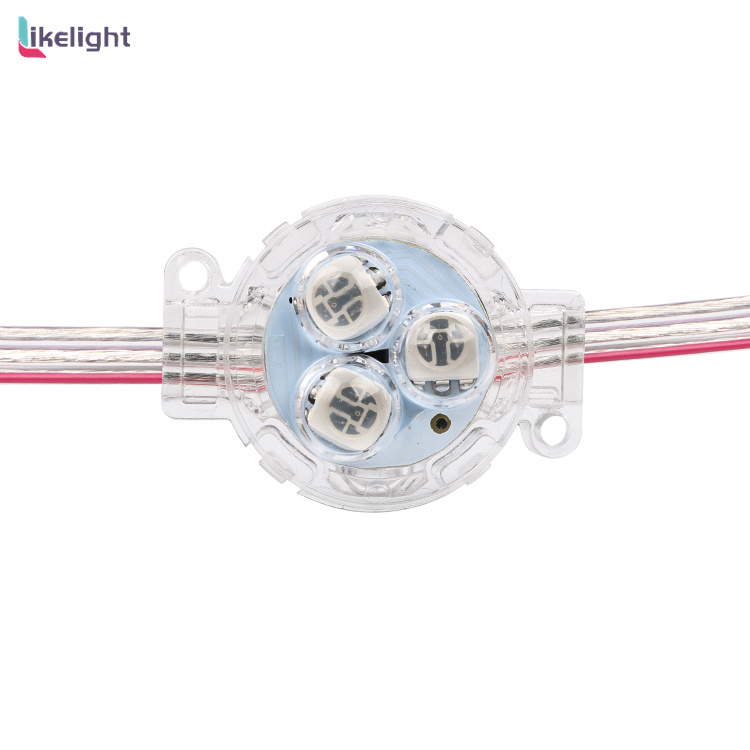
For this model, one lamp contains three SMD5050 RGB LEDs, while the page states that each pixel is individually controlled and supplies 20 points per string. Three LEDs in one lamp are not three separately programmed points. Set the sample project to the actual 20-point sequence rather than to the total LED count.
Test with a controller explicitly configured for the supplied UCS1903 version, documented polarity and connector pinout. The page identifies the male connector with pins as input, but the sample drawing should identify every pin. Work on low-voltage connections only with power isolated; mains supply work belongs to a qualified installer.
Save a working color test and moving-point file. Add one section at a time without simultaneously changing controller settings, cables and the effect. If the fault starts after one change, the comparison becomes useful rather than speculative.
Use the published load to distinguish supply problems
At the published 0.72W maximum per point, a 20-point string is 20 × 0.72W = 14.4W, with theoretical current 14.4W ÷ 12V = 1.2A. An illustrative 100-point load is 72W and 6A at DC12V before supply losses and design reserve. It does not establish how many strings may be linked or powered through one connector.
Actual demand varies with brightness, colors and animation. Divide a large installation into accessible power zones instead of assuming that the data chain and power feed must follow one uninterrupted route. The approved electrical plan determines conductor size, protection, supply reserve and feed positions.
Line voltage loss follows current × line resistance. Longer or thinner conductors and extra joints affect resistance; higher load increases the loss under comparable conditions. Measure loaded voltage at the first and farthest point during the same test scene. A supply terminal reading alone cannot show what the last lamp receives, and a lower brightness setting that hides the fault is not a completed repair.
Keep the lighting network separate from the pixel output
UCS1903 belongs to the cascade-pixel side of the system. The product page mentions SD, DMX and Art-Net controller systems, but that does not turn the lamp into a direct DMX fixture. A compatible controller may translate the upstream programme into the pixel data required by the string.
Check the selected pixel type, point count, color order, output assignment and data direction. If the color test is stable but wrong, investigate color mapping before replacing lamps. If a boundary persists, isolate the suspect joint or section using a known-good equivalent with power off; do not bridge unknown pins. No port capacity or signal-distance figure is published here.
Protect the repair path as carefully as the light path
The 30mm body and published 140° beam angle make mounting orientation part of the visual result. A deep lip can hide points from the pavement even when all electrical tests pass. Check the nearest and main viewing positions with the actual support before closing it.
IP66 is published for the string, but a modified splice, cable exit or supply enclosure still needs its own protection design. Leave access to zone transitions and avoid cable tension at joints. Because the page's spacing descriptions differ, use an approved dimensioned string drawing for drilling or track fabrication rather than deriving pitch from the photographs.
A symptom-to-test table for the installer
| Observed symptom | Next controlled test | Decision value |
|---|---|---|
| All colors are consistently swapped | Run separate red, green and blue scenes | Distinguishes color mapping from intermittent faults |
| Sequence stops at the same joint | Isolate that joint or section with a known-good equivalent | Narrows the fault boundary without guessing |
| Bench test passes, mounted line looks broken | Inspect from the actual viewing positions | Separates optical obstruction from control failure |
| Fault appears after outdoor modification | Inspect the modified joint and cable restraint | Original IP66 does not validate altered interfaces |
| Far end changes at high output | Compare first and last loaded voltages | Tests whether load and line loss contribute |
| New controller does not reproduce the sample | Check UCS1903 mode, count, output and mapping | Upstream DMX or Art-Net is not the lamp's pixel signal |
The LIKELIGHT configuration behind this test method
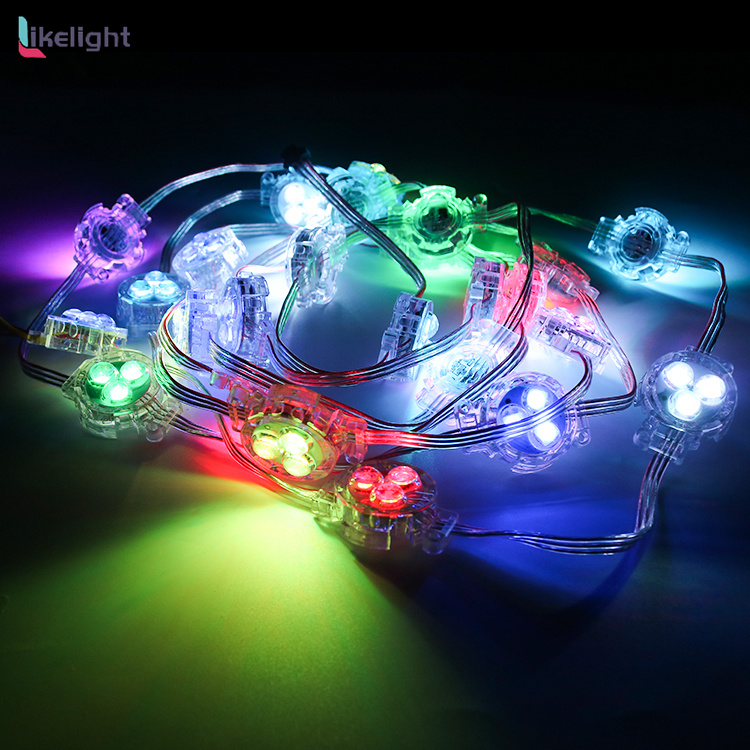
LIKELIGHT L-C-30ICRGB-1903 combines individually controlled RGB points, a 30mm body, DC12V supply and a published maximum of 0.72W per point. The 20-point string makes a manageable reference sample: its point order, visible colors and calculated load can be checked together before installation expands.
It can be evaluated for permanent decorative outlines where visible points and programmable sequences are desired. It is not a substitute for a continuous luminous strip, nor does the product name guarantee a complete maintenance-free outdoor system. The ordered controller interface, support visibility, feed zones and service access determine whether it fits the project.
| Model | L-C-30ICRGB-1903 |
|---|---|
| Light source | 3 SMD5050 RGB LEDs per point |
| Control IC | UCS1903; individually controlled pixels |
| Supply | DC12V |
| Maximum power | 0.72W per point |
| String quantity | 20 points |
| Body and beam angle | 30mm; 140° |
| Protection | IP66 |
| Spacing | Customizable; approved drawing governs |
Send a reproducible fault record or a new-project brief
- Zone drawing and point count in each zone
- Controller model, firmware and selected pixel mode
- Power-supply ratings and cable routing
- Photos of connectors, polarity labels and supports
- Test scene, affected points and loaded-voltage readings
- Installation environment, sample needs and project deadline
These records help LIKELIGHT reproduce the symptom and evaluate pixel mapping, power zones and connection choices together. For a new project, the same information defines a representative sample test before bulk production.
FAQ
Is a 20-point string a 60-pixel string because it contains 60 LEDs?
No. This configuration has three LEDs in each individually controlled point. Use the actual point count when preparing the sample sequence.
Can a DMX cable be connected directly to these pixels?
The page lists compatible controller-system approaches, not a direct DMX lamp input. Use a controller with the confirmed UCS1903 output and correct pinout.
Does 1.2A mean any controller port can power the string?
No. It is a theoretical string load at the published maximum. The controller output, wiring and protection require their own approved ratings.
Why keep power and control zones separate on the drawing?
A data sequence may cross a physical boundary while each area needs accessible power and service isolation. Recording both avoids treating the whole installation as one unserviceable chain.