


WWA or RGB LED Strip for Commercial White Ambience? A WS2818 Buying Guide
A hotel corridor or display shelf may need crisp white by day and warmth at night. Buyers are often offered an RGB strip because it can change colour. But mixing something that looks white is not the same purchase as designing around white light. If the brief is changing white ambience along the line, start with WWA. If saturated red or blue is essential, choose RGB; if both matter, assess a different strip with the required channels. The stop gate is a sample in the actual profile.
30-second answer
- One fixed white: Compare a fixed-white strip before paying for point-by-point control.
- White scenes that move: Sample addressable WWA for crisp, warm and amber scenes along the line.
- Saturated brand colours: Assess RGB, or a suitable RGBW/RGBTW configuration when both colour and dedicated white are needed.
Already have a target-white reference, approximate length and profile clearance? Send those to LIKELIGHT to discuss one representative sample; you need not guess a controller specification first.
What should the space actually look like?
Imagine a commercial corridor that needs a crisp daytime white and a warmer evening scene, without red or blue animation. The buying question is how the whites look on its walls and people, not how many colours the box claims. WWA's white and amber emitters address that task, but colour rendering and mixed scenes still need a physical sample.
If a seasonal display needs unmistakable red, green or blue, this WWA strip is the wrong source. RGB suits a colour-led brief; for both colour and a dedicated white source, compare another RGBW/RGBTW sample. Programmable does not make different emitter architectures interchangeable.
What do the three published tones prove?
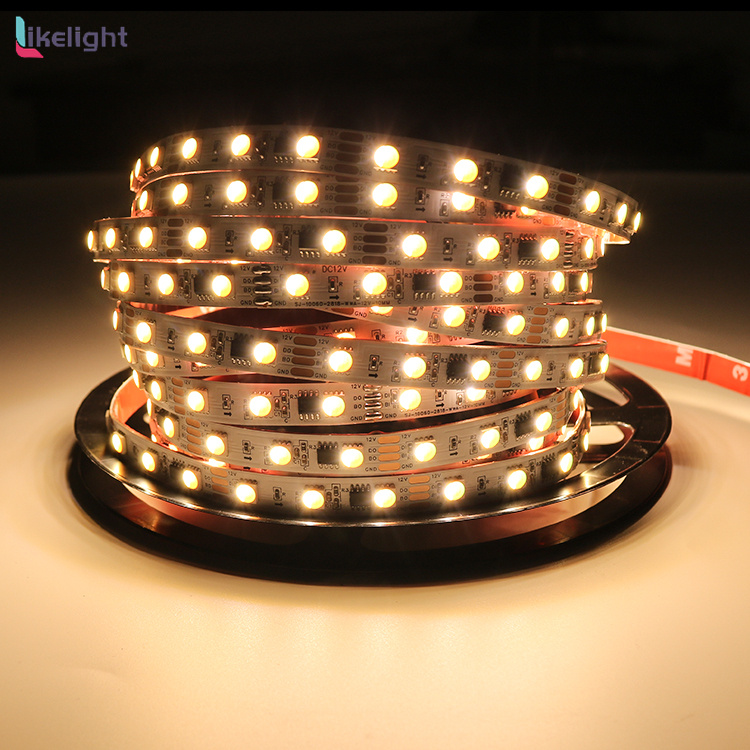
The LIKELIGHT page lists W at 6000–7000K, WW at 2700–3200K and Amber at 1800–2000K. Those are stated ranges for the separate emitters, not a promise that every mixed scene reaches a precise colour temperature. Treat them as crisp, warm and very warm starting points for sampling.
For merchandise, faces or artwork, colour temperature alone is insufficient. Compare brightness, colour rendering and the diffused appearance on the actual object and in the proposed profile; this page does not publish enough evidence to promise those outcomes.
Why compare the installed system rather than tape price?
Addressable white adds a controller, data wiring, supplies, connectors and a service plan to the strip cost. The page states 18W/m but elsewhere 0.24W per LED; multiplied by 60 LEDs/m that gives 14.4W/m. Since these figures disagree, neither is a sound basis for sizing the project supply.
Compare strip, profile, diffuser, controls, supplies, labour and spares as one installed package. Obtain one consistent power figure and wiring drawing for the quoted version before circuit design. If the whole line will always show one white, a fixed-white option may cost less to control and maintain.
When does control of each point pay off?
The page names WS2818 and 60 LEDs/m, describes each LED/pixel as independently controllable and shows cut marks every 16.67mm. WS2818 passes sequential data to points; it does not give each LED a native DMX512 address. Local white transitions, rather than whole-line changes alone, are the reason to consider this architecture.
On the sample, move gradually from crisp to warm along the line, then show a single white across it. If the buyer sees no value in the local change, do not pay for pixel control. The stated dual-data path also does not remove the need to plan accessible joints and replacements.
Will the chosen profile change the result?
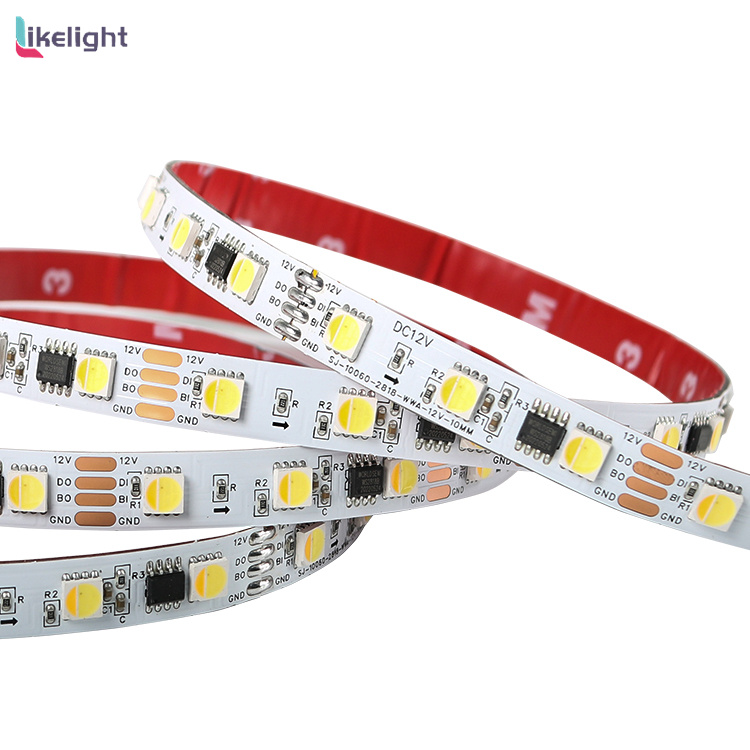
The bare board is listed at 10mm wide; a waterproof silicone-tube build is separately described as 12.5mm wide and 4mm thick. These are different installed envelopes, affecting channel clearance, lead exit and service access. The gallery shows visible LED points, not a guaranteed dot-free neon line.
Place the exact build behind the intended diffuser and view the points, white transitions and wall reflections from the customer's position. For a dry interior or wet location, choose the corresponding IP construction and document the ends and joints; the strip rating is not the rating of the entire installation.
Compare three buying briefs in the same profile
If changing white is the main effect and local transitions are visible, sample WWA first. If saturated colours are mandatory, turn to RGB; if both are mandatory, sample a different architecture with the required white channels. For a single white, compare fixed-white tape.
These are hypothetical buying tasks, not completed customer projects. Compare samples in the same intended channel, on the same object and from the same viewing position; no price or mixed-scene CCT is assumed.
Choose by the required image, not the word programmable
-
One white all day
Outcome of a hypothetical comparison
Check whether a fixed white already serves the space.Better direction
Compare fixed-white tape; reduce control and maintenance work. -
White changes by place or time
Outcome of a hypothetical comparison
Compare crisp, warm and amber samples and the transition.Better direction
WWA is a candidate, subject to acceptance in the real profile. -
Brand colours are essential
Outcome of a hypothetical comparison
Check red and blue as well as the required white on one object.Better direction
Choose RGB or another architecture with dedicated white; WWA is not a substitute.
Choose by the intended effect
| Project condition | Better direction |
|---|---|
| Only one white is needed | Compare fixed-white strips first. |
| White transitions along the line | Sample addressable WWA from the real viewing point. |
| Narrow, dry interior channel | Allow for the 10mm bare board, connector and selected IP20 construction. |
| Rain or splashing is possible | Check the selected 12.5×4mm silicone-tube build, ends and joints together. |
| Comparing whole-project cost | Price strip, channel, controls, supply, installation and spares together; obtain consistent power data. |
| Red/blue or colour plus white | Assess RGB or RGBW/RGBTW instead; WWA is not saturated colour. |
Where LIKELIGHT WS2818 WWA fits
The published model L-S-10060-2818-WWA-12V-10MM (32) is described as DC12V SMD5050 WWA with 60 LEDs/m and WS2818. The page lists 5m reels or custom lengths, IP20/IP65/IP67 construction choices and JST or waterproof connector choices. It is a candidate where local white changes matter and the point-source look can be accepted in the final profile.
It is not a red/blue brand-colour source, nor proof of colour rendering or brightness for primary merchandise lighting. Specify one compatible combination of body and connector options. A reel alone is not the controller, supply and installed system.
| Item | Page information |
|---|---|
| Emitter tones | W 6000–7000K; WW 2700–3200K; Amber 1800–2000K |
| Supply and control | DC12V; WS2818; page describes control per LED/pixel |
| Physical layout | 60 LEDs/m; 16.67mm cut marks; 10mm bare board |
| Envelope and supply | Waterproof silicone-tube version 12.5×4mm; 5m reel or custom length |
| Selectable construction | IP20/IP65/IP67 and JST/waterproof connectors must be tied to the order version |
What a useful quotation should include
- Describe the effectShare a white-scene reference and whether local transitions matter; this selects a sample direction.
- Show the installationGive profile clearance, indoor/outdoor exposure and approximate length; this selects the physical build.
- Request a comparable quoteAsk for the exact SKU and valid option matrix, dimensional/wiring drawings, and an itemised BOM and total for strip, controller, supply, profile, joints, installation parts and spares.
- Accept a representative sampleAsk for checks of white appearance, transition and fit, plus reconciled power data and lead time before a bulk decision.
For a first enquiry, send only the desired white effect, approximate length, installation space/exposure and destination country. A useful LIKELIGHT response should make the sample and complete installed system comparable, not just quote tape per metre.
Buyers ask
Can WWA make red or blue brand colours?
Do not treat it as RGB: this page specifies W, WW and Amber emitters.
Does 60 LEDs/m mean 60 controllable points?
This page explicitly describes independent LED/pixel control; verify the intended programme with the proposed controller and sample.
Can I size the supply from 18W/m?
Not yet. The page also says 0.24W per diode, which conflicts when multiplied by 60; request one version-specific power and wiring record.
An enquiry you can send
We need changing white light for [space/use], approximately [length or quantity], in [profile clearance and indoor/outdoor location], delivered to [country].
Please propose the suitable WS2818 WWA version with exact SKU, a representative white-scene sample, dimensional/wiring drawings and a complete quote including controls, power and connectors. We will approve the installed white appearance before fixing the bulk configuration.