


12x12mm LED Neon Flex: How to Choose LED Density, Voltage and Protection for Commercial Projects
Two neon-flex samples can share the same 12x12mm cross-section and still behave very differently. LED density changes the visible dot spacing, voltage changes the electrical architecture, and single-color, RGB and digital versions require different control plans. Choosing by profile size alone often produces dark steps, incompatible drivers or an installation that cannot follow the intended curve.
This article uses the published LIKELIGHT L-NH-1212-2835-24V product facts: silicone construction, SMD2835, 30/60/72/96/144 LEDs/m or customization, DC5V/DC12V/DC24V options, single-color plus RGB/digital/addressable variants, and listed IP65/IP66/IP67/IP68 information. The page does not publish power, bending direction, minimum radius, cut length or a digital control IC, so those values are not invented.
Published product facts
| Published item | Value |
|---|---|
| Model | L-NH-1212-2835-24V |
| Cross-section | 12x12mm |
| Material | Silicone |
| LED package | SMD2835 |
| Density options | 30 / 60 / 72 / 96 / 144 LEDs/m or customized |
| Voltage options | DC5V / DC12V / DC24V |
| Color/control options | Single color / RGB / digital / addressable |
| Protection information | IP65 / IP66 / IP67 / IP68 listed; ordered construction required |
| Temperature | Working -20°C to +60°C; storage -30°C to +80°C |
Choose the light line before choosing the highest LED density
Nominal LED spacing is about 33.3mm at 30 LEDs/m, 16.7mm at 60, 13.9mm at 72, 10.4mm at 96 and 6.9mm at 144. A smaller spacing can help a shallow diffuser or close-view letter appear smoother, but the actual line also depends on silicone optics, diffuser distance, color and viewing angle.
For distant outlines or deep channels, 30 or 60 LEDs/m may be worth testing because added density may not remain visible from the normal viewing position. For close signage or exposed short curves, compare 72, 96 and 144 LEDs/m samples. Density is not a substitute for a profile that bends or emits in the wrong direction.
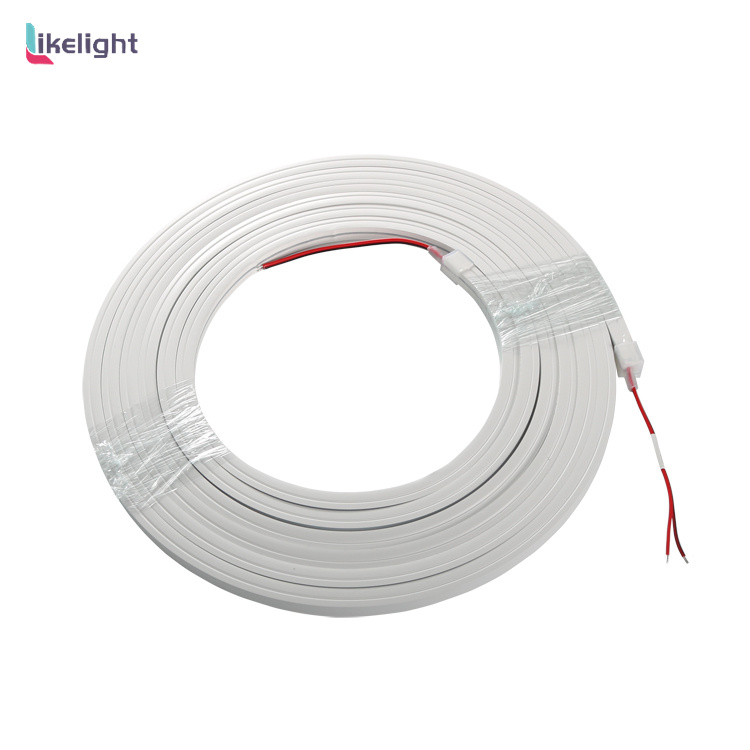
LED spacing is not the cutting unit or bending radius
The spacing calculation describes the nominal distance between LEDs only. It does not reveal the electrical cutting unit, copper-pad position, minimum bending radius or permitted bending plane. Those construction limits must come from the approved sample, PCB marks or a confirmed specification sheet.
The 12x12mm silicone body affects channel fit, end-cap space, cable exits and corner detailing. Before ordering, draw every straight run and curve at full scale and check whether the selected version can follow it without twisting the luminous face.
Select DC5V, DC12V or DC24V from the electrical system
The page lists DC5V, DC12V and DC24V options, but no W/m value. Without the published power of the selected density and color version, a responsible current calculation, voltage-drop result or maximum run length is not possible.
Choose voltage together with the driver, control architecture, cable route and available feed locations. In comparable-power circuits, a higher voltage normally means lower current, but this model's versions may use different circuit designs and densities. Freeze the actual W/m first, then calculate circuits and measure loaded voltage at the end of each branch.
Project selection table
| Project condition | Decision direction | Why |
|---|---|---|
| Distant outline or deep channel | Compare 30 or 60 LEDs/m | The normal viewing distance may not reveal a higher density. |
| Medium viewing distance | Compare 72 or 96 LEDs/m | Balance line smoothness with electrical and procurement cost. |
| Close-view lettering | Evaluate 96 or 144 LEDs/m | Use a real diffuser and curve sample before approval. |
| Static identity color | Choose the single-color version | Avoid unnecessary digital control when the effect does not use it. |
| Color-changing or programmed content | Choose RGB or digital only after defining the effect | Controller and IC compatibility are version-dependent. |
| Wet or outdoor installation | Freeze one confirmed IP construction | Neon body, ends, connectors and cable exits must form one system. |
Single color, RGB and digital are different control decisions
The page lists single color and also RGB, digital and addressable choices. A static single-color version can use a simple switching or dimming architecture, while RGB needs multi-channel color control and a digital version needs a confirmed IC, data direction, controller and mapping plan.
No digital IC or protocol is published for this product record. Do not label it DMX512, UCS1903 or WS2811 without the final order data. The quotation should identify the required effect first, then lock the compatible version and controller before sampling.
Resolve the IP option before describing the outdoor system
The page lists IP65, IP67 and IP68 options and separately shows IP66. These values should not be presented as if one finished reel has every rating. The actual silicone construction, end treatment, connector and cable exit must be tied to the ordered version.
Even where a higher protection option is selected, joints, end caps, feeds, drainage and mounting remain part of the complete installation. The page publishes -20°C to +60°C working and -30°C to +80°C storage ranges; final connectors, drivers and adhesives also need to suit the project environment.
Where this LIKELIGHT 12x12mm neon flex fits
The page identifies exhibition decoration, luminous characters, theaters and clubs. The compact 12x12mm silicone body and selectable LED density make it a candidate for letters, decorative outlines and integrated details where the tested light line, bend direction and mounting channel match the drawing.
It is not ready to specify for tight curves, long single-feed routes, underwater use or a named digital protocol from the current page alone. Those conditions require the missing radius, cut unit, W/m, run design, exact IP construction and control IC to be confirmed on the product sample.
Suitable when
- Letters and outlines verified with the actual diffuser
- Projects that can lock voltage, density and control version
- Installations with planned ends, connectors and service access
Re-evaluate when
- Tight bends without a published radius or bend direction
- Long runs without W/m and feed calculations
- Underwater or named-protocol claims based only on the current page
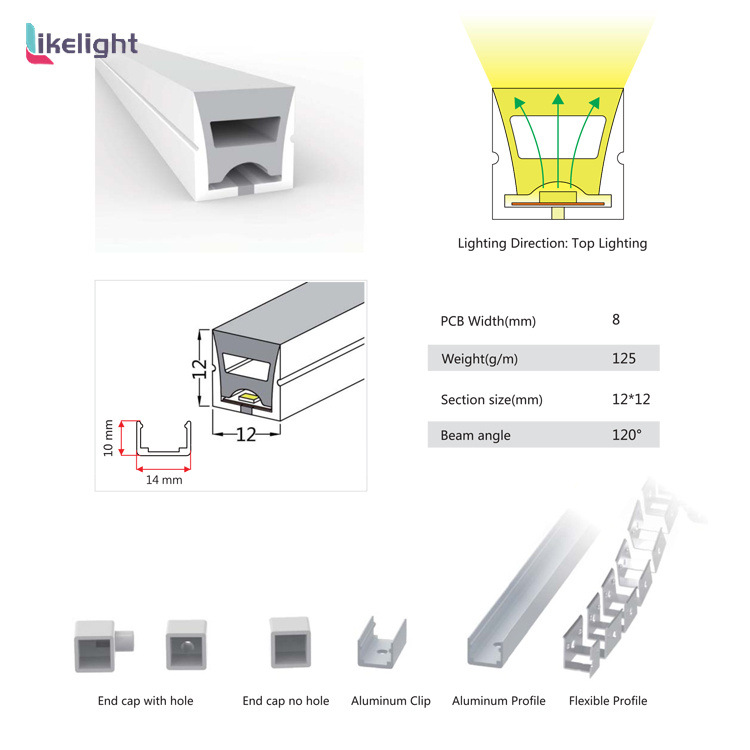
Information required before quotation and sampling
Send the artwork or outline drawing, straight and curved run lengths, minimum curve radius, viewing distance, channel dimensions, required light uniformity, selected density, DC5V/DC12V/DC24V preference, single-color/RGB/digital effect, controller information, feed locations, IP target, cable exits, connector direction and schedule.
These inputs allow LIKELIGHT to compare density, optical line, electrical circuits, control version and terminations as one system. The approved sample should record W/m, cut marks, bending direction, minimum radius, connector construction and control compatibility before bulk production.
- Artwork and run lengths
- Curves, channel and diffuser dimensions
- Viewing distance and line-uniformity target
- Density and DC5V/DC12V/DC24V preference
- Single-color, RGB or digital effect and controller
- IP target, feeds, connectors, sample and schedule
Frequently asked questions
Does 144 LEDs/m guarantee a dot-free line?
No. Silicone optics, viewing distance, channel and diffuser depth also determine the result.
Can LED spacing be used as the cut length?
No. Cut only at marks confirmed on the selected PCB or specification.
Which voltage gives the longest run?
The page does not provide W/m or run limits, so the exact version must be calculated before that decision.
Is every version IP68?
No. Several ratings are listed; the ordered construction and complete terminations determine protection.


