

How to Choose LED Density for 16x16mm Silicone Neon Flex
Compare 30, 60, 72 and 144 LEDs/m by visible pitch, viewing distance, control needs and project cost before specifying 16 x 16 mm neon flex.
Start with the lit surface and viewing position
A digital neon flex project can look convincing in a rendering yet disappoint on site when light is aimed at the wrong surface, the visible line is too coarse, or the installation leaves no route for cable exits and maintenance. Start by defining whether the line must outline architecture, wash a narrow detail, or create a programmable decorative border, then assess the viewing position and mounting direction.
What the published configuration means
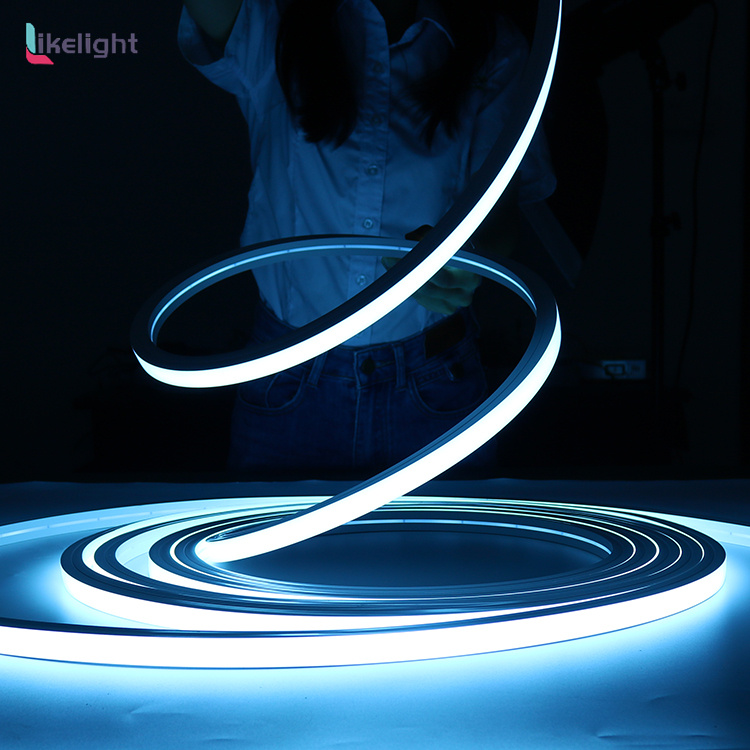
The published L-NH-1616 silicone format measures 16 x 16 mm and is top-lighting; the product title also identifies a 120-degree version. This describes where the light should leave the profile. High LED density cannot compensate for a channel or mounting direction that sends light toward the wrong surface, so test a short installed section at the planned angle.
The page lists SMD5050, 30/60/72/144 LEDs per metre or customised density, DC5V/DC12V options, and single-colour, RGB, digital or addressable configurations. These are production choices rather than one fixed version. Voltage alone does not set visible pixel steps; the circuit, LED grouping and selected digital configuration do. If LEDs are distributed evenly, the theoretical centre spacing is about 33.3 mm at 30 LEDs/m, 16.7 mm at 60, 13.9 mm at 72 and 6.9 mm at 144. These values compare source spacing, not final luminous uniformity: silicone diffusion, viewing angle, dimming level and installation geometry still shape the visible line.
Power planning from the published data
If LEDs are distributed evenly, the theoretical centre spacing is about 33.3 mm at 30 LEDs/m, 16.7 mm at 60, 13.9 mm at 72 and 6.9 mm at 144. These values compare source spacing, not final luminous uniformity: silicone diffusion, viewing angle, dimming level and installation geometry still shape the visible line.
Control architecture and content planning
The page identifies digital and addressable versions but does not publish one final IC or protocol. Before sampling, confirm the selected controller interface, data direction, pixel grouping, connector pinout and content mapping. A cascade-pixel line is planned around pixel quantity and data flow, not assumed to use DMX addressing.
Installation, protection and service access
The product page lists IP67 as the waterproof grade and also lists IP65/IP67/IP68 options. Choose only the final approved version for the actual exposure. End treatment, field joints, cable exits, drainage, corrosion and replacement access still determine the completed installation.
Quick selection table
| Project condition | How to judge it |
|---|---|
| Visible edge or letter return | Test the side-emitting direction with the actual channel and visible surface. |
| Fine animated outline | If LEDs are distributed evenly, the theoretical centre spacing is about 33.3 mm at 30 LEDs/m, 16.7 mm at 60, 13.9 mm at 72 and 6.9 mm at 144. These values compare source spacing, not final luminous uniformity: silicone diffusion, viewing angle, dimming level and installation geometry still shape the visible line. |
| RGB or addressable effect | Freeze the colour and control version before sample approval. |
| Indoor or exterior route | Select the confirmed protection version and design all field joints and drainage. |
| Power planning | Obtain final W/m and voltage before calculating circuits. |
| Programmable control | Confirm the final IC/protocol, controller interface, data direction and mapping. |
Where this LIKELIGHT configuration fits
LIKELIGHT L-NH-1616 is suitable for narrow side-emitting architectural edges, letters, signs and decorative outlines where the installation needs to direct light across a visible surface. It is not a substitute for a high-resolution point display. The final choice depends on the profile direction, viewing distance, required animation detail and confirmed electrical version.

| Model | L-NH-1616 |
|---|---|
| Light source | SMD5050; 30/60/72/144 LEDs/m |
| Voltage | DC5V/DC12V options listed |
| Physical format | 16 x 16 mm top-lighting silicone; horizontal/side bending listed |
| Control / IC | RGB / RGB Pixel / RGBW options listed |
| Published protection | IP67 listed |
Information to send before quotation
- Total installed length or quantity
- Main viewing distance and mounting height
- Target effect, rendering or video reference
- Installation environment and protection target
- Controller or data-interface information
- Cable exit, connector direction and sample date
Send the line drawing, total and zone lengths, mounting section, main viewing distance, target colour or animation, environmental exposure, required protection option, controller information, cable-exit direction and sample date. These details let the supplier evaluate pixel pitch, power circuits and connection treatment together instead of treating a roll of neon flex as a complete installed system.