

Replacing E14 Fairground Cabochon Lamps: Why the Socket Alone Is Not Enough
Quick decision
Do not order by screw thread alone. Record the old supply type, controller, harness and wet-area connections. Test a representative new lamp on an isolated DC24V branch. E14, 60mm and a yellow cap are not electrical compatibility tests.
Published facts and evidence boundary
| Parameter | Published or derived value |
|---|---|
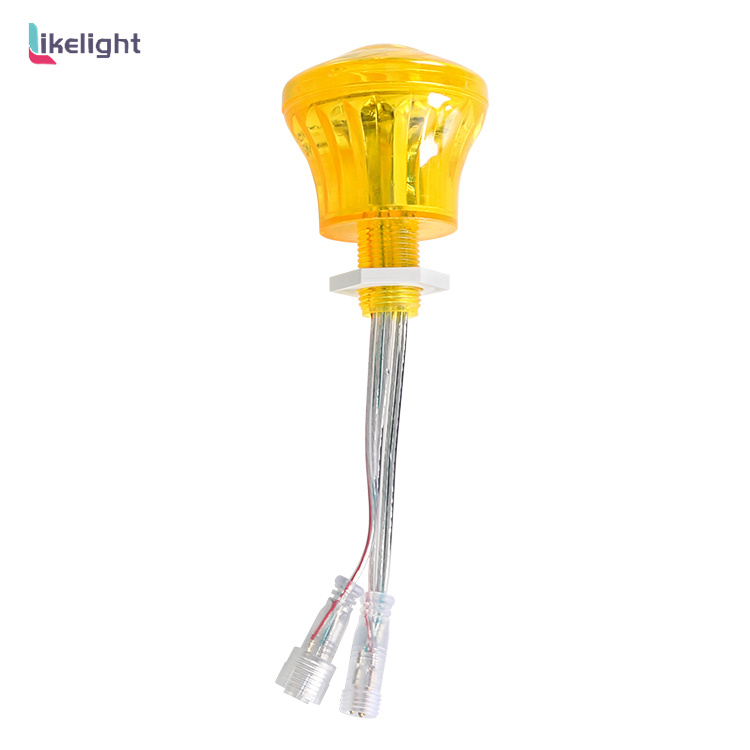
| Published model | L-D-6018-Yellow Cover; E14 yellow cap; 60mm |
| Source and supply | RGB; 18 SMD5050 LEDs; DC24V; 4.32W per lamp |
| Protection | IP66 stated for product; socket and field joint require separate review |
| Derived load | 4.32W / 24V = 0.18A each; 50 lamps = 216W and 9A |
| Not specified | Ordered IC, data pinout or addressing, socket wiring and AC24V compatibility |
Identify the existing circuit before buying an E14 replacement
E14 amusement lamps can use different supplies and control methods. A matching thread does not show that the existing socket provides this product's DC24V, nor that the old controller can run its colour effects. Other E14 lamps on the market are AC24V, a useful warning against substituting by base alone.
With power isolated, document the old supply label, socket polarity and harness. Test one sample with a separate current-limited DC24V supply. If the ride feeds AC, this DC product is not a direct drop-in even if it screws in.
Test cap appearance independently of the base
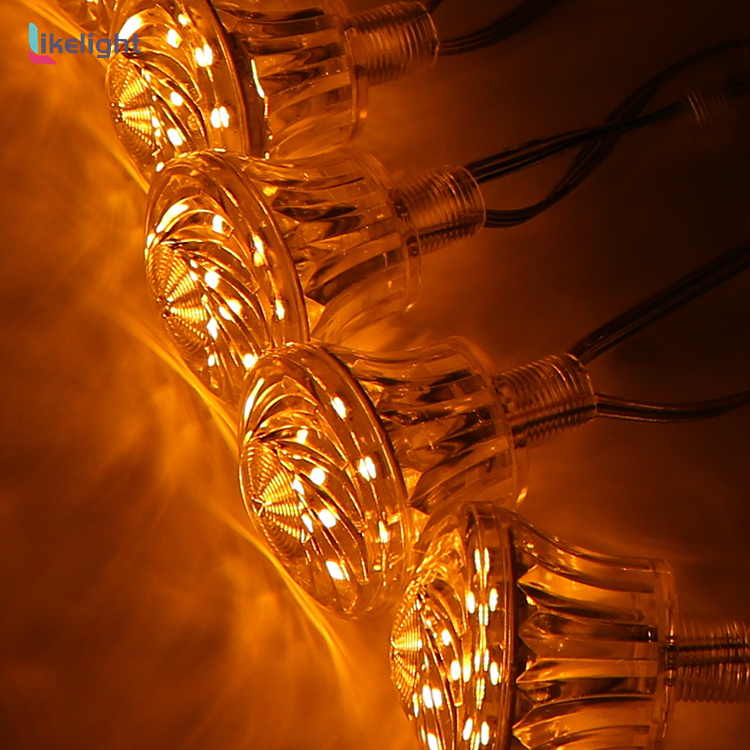
The page identifies a 60mm yellow-cover body, RGB output and 18 SMD5050 LEDs. The cap changes daytime appearance and perceived colour at night; matching only the base can leave a row with a visibly different profile, projection or shade.
Put the old and new lamps into a piece of actual fascia. Compare from the queue by day and after dark, and ensure rear access permits replacement. This is a compatibility test, distinct from calculating the ride-wide spacing and quantity.
Use 4.32W to audit an existing branch
Published 4.32W at DC24V implies 0.18A theoretical per lamp. If a hypothetical existing branch holds 50 replaced lamps, the lamp load is 216W or 9A. That arithmetic checks a supply and fuse plan; it is not a permitted daisy-chain length.
Record the old supply's real rating and loaded voltage at the farthest socket. Recalculate for the actual number of points, then account separately for cable loss, connector limits and engineering margin. A paper total cannot prove the last lamp receives adequate voltage.
A pixel label does not establish the old controller interface
The page calls this an RGB pixel light, but the available record does not establish the ordered IC, signal direction, address method or connector pinout. The existing ride could use auto-run, DMX or a different cascade system.
On an isolated test bench, verify the ordered lamp's input, channel order and fault response against the existing controller. Without that evidence, treat it as a sample awaiting integration, not as an automatic reuse of the old programme.
IP66 is not the whole ride connection
The published IP66 belongs to the product construction described on the page. The rear socket, fascia hole, field connector and reassembled service joint do not inherit that rating. Movement, vibration and cleaning add strain to the tail.
Inspect cable pull, drainage and water entry on a mounted sample. If the old panel cannot protect the rear connection, a correctly shaped front cap is not enough to justify a bulk replacement.
Conditional project decision table
| Project condition | Decision and evidence |
|---|---|
| Only the old E14 base is known | Measure voltage and polarity before asserting DC24V compatibility. |
| Old feed is AC24V or mains | Do not drop in this DC24V version; redesign supply or choose a proven match. |
| A branch contains 50 replacement lamps | Use 216W and 9A as theoretical checks, then measure the loaded end. |
| Rain or wash-down reaches the fascia | Audit socket, field joint and penetration beyond the lamp's IP66. |
| Old chase sequence must remain | Verify ordered IC, pinout and controller protocol first. |
| Cap appearance must match | Approve the 60mm yellow-cover sample in day/night side-by-side tests. |
Where the LIKELIGHT 60mm E14 RGB lamp fits
L-D-6018-Yellow Cover brings the published 60mm cap, 18 SMD5050 LEDs, DC24V, 4.32W and IP66 into a physical replacement sample. It fits a retrofit whose supply is or can become verified DC24V and whose socket, rear clearance and service route pass the mock-up.
It is not a direct AC24V or mains replacement merely because the thread is E14. Neither does an unspecified pixel interface prove controller compatibility. Record the tested lamp, power, connector and controller as one purchase configuration.
Information required before quotation
- old lamp photos, nameplate and measured supply
- old controller model, programme and wiring
- socket, fascia hole and rear clearance
- point count and present branch layout
- cap colour, sample quantity and viewing position
- rain, cleaning, vibration and maintenance conditions
- supply, fuse, cable and connector ratings
- production quantity and delivery date
These inputs decide whether the old system can safely accept a DC24V sample and what must change; an E14 piece count alone cannot define a quote.
Frequently asked questions
Can an E14 lamp be connected to AC24V?
The thread does not answer that. This page states DC24V; measure the old feed.
What lamp load do 50 points create?
50 × 4.32W = 216W, or 9A theoretical at DC24V, before losses and margin.
Will RGB work with the old controller?
Not without confirming the ordered IC, signal wiring and programme.
Does IP66 include the rear socket?
Not automatically; review the complete mounted connection.