


50mm RGBW DMX Pixel Lights: Verify the White Channel Before Facade Installation
A facade grid can pass an RGB chase and still fail when the white channel is called. This commissioning guide uses a DC24V, 1.44W, 50mm RGBW point-light case to freeze channel behaviour, mapping, load and outdoor connections before installation.
Why an RGB chase cannot approve an RGBW grid
An animation can look correct while never calling the dedicated white output. The defect appears later as a cold or warm mismatch, an unexpected RGB mixture, or an offset in every address after the first point.
Commission with four fixed scenes first: red only, green only, blue only and white only. Then add paired-channel and full-output scenes. This identifies a channel-order problem before motion effects hide it.
Read the nine emitters and 50mm body correctly
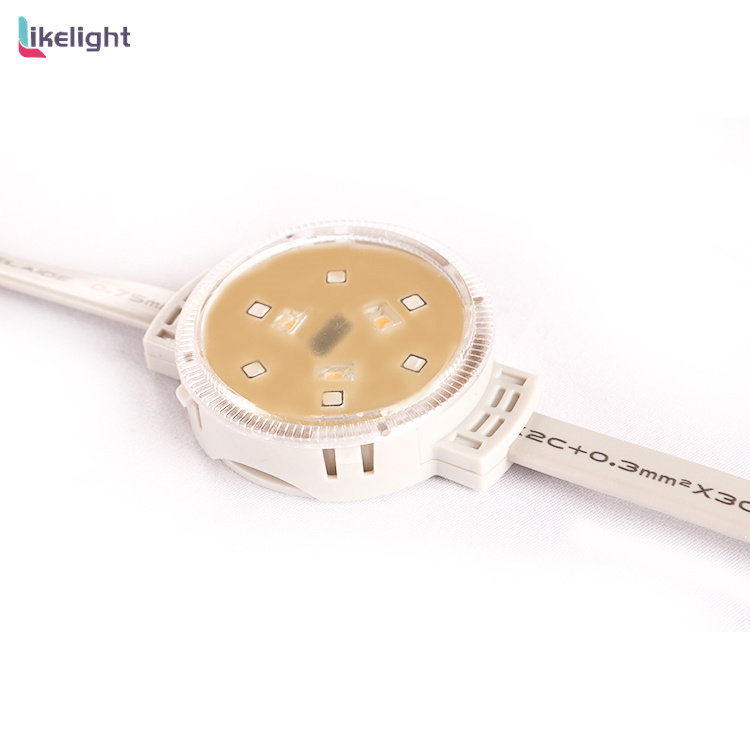
The page lists six SMD5050 RGBW emitters plus three SMD3535 white emitters in a 50mm point. That construction describes light sources inside one housing; it does not prove nine DMX pixels or publish the fixture personality.
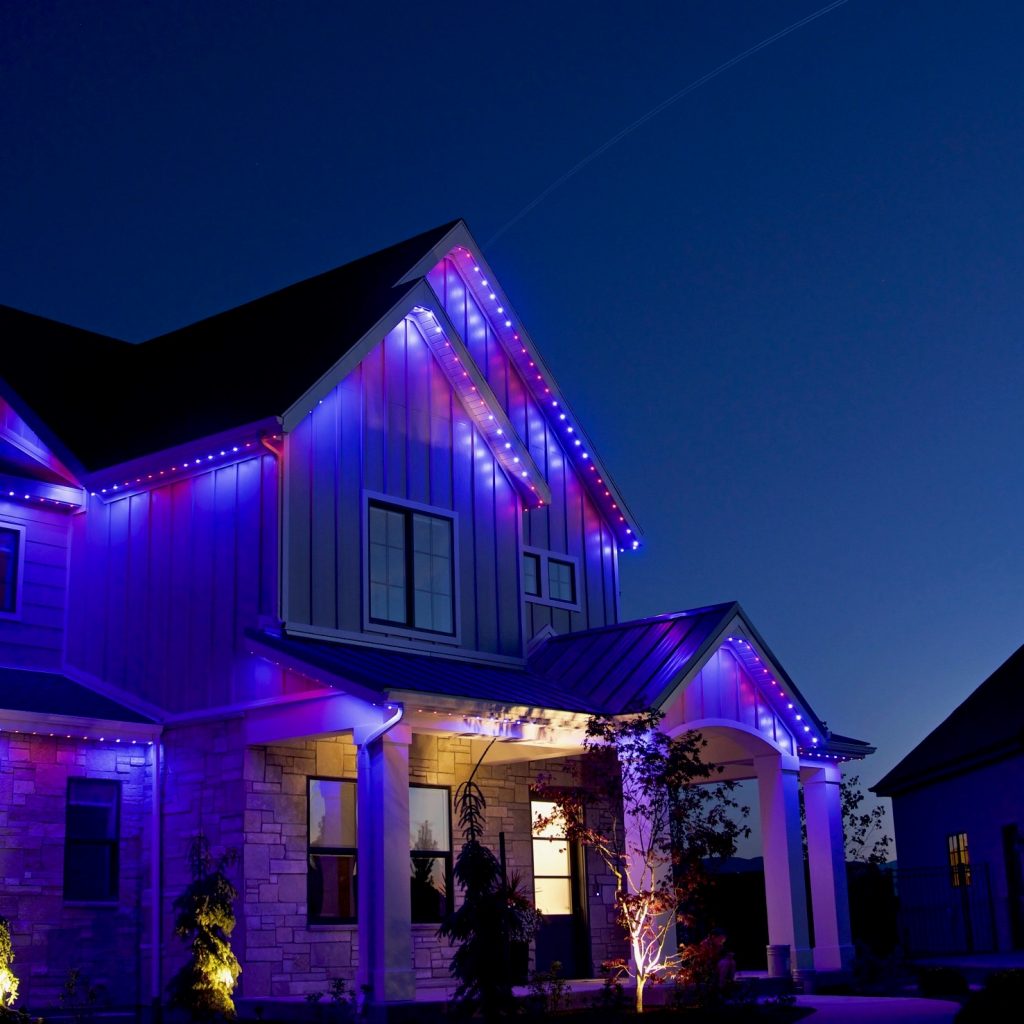
The 140° published beam angle supports a broad apparent point, but grid pitch, facade reflectance and viewing distance still determine whether points read as separate dots or a continuous graphic.
Put nominal load beside the address schedule
Published DC24V and 1.44W give 1.44 ÷ 24 = 0.06A per point theoretically. An illustrative 100-point zone totals 144W and 6A. These values estimate nominal luminaire load; they do not establish cable size, power-feed count or controller capacity.
Calculate every physical zone separately and record the supply position beside its DMX address range. If high-output white causes remote points to shift or flicker, compare near-end and far-end voltage in the same scene before changing the data map.
Actual consumption changes with channel levels and programmed content. Keep supply margin, protection, connector ratings and line loss in the electrical design instead of treating 6A as an instruction to use one feed.
Freeze DMX personality, order and white behaviour
The product name and model identify a DMX RGBW point light, but the page does not publish channel personality, addressing method or RDM support. Request the supplied revision's wiring and addressing instructions rather than assuming four channels per point.
Number the installed positions on the drawing, trigger one control position at a time, and record which physical point responds. A repeatable offset indicates mapping or personality; a fault beginning after one connector calls for a powered-off connection inspection.
IP67 is a housing boundary, not a completed facade system
IP67 is the published point-light rating. Field joints, power supplies, controllers and junction boxes require their own suitable protection; the rating does not validate drainage, cable strain or a submerged installation.
The 50mm diameter is not a drilling template. Freeze panel hole, retaining method, cable bend, rear clearance and replacement route with a sample panel before machining the full facade.
Commissioning decision table
| Observed condition | Next decision |
|---|---|
| RGB works but white is wrong | Run white-only and paired-channel scenes; verify personality and channel order. |
| Every point shifts by the same channels | Compare controller personality with the supplied fixture revision. |
| Fault begins after one joint | Disconnect power, inspect that joint and substitute a verified short section. |
| Illustrative 100-point zone | Start at 144W and 6A, then design feeds from cable and component ratings. |
| Perforated facade panel | Approve hole, retention, rear clearance and replacement path on a sample. |
| Fine video content | Prototype pitch and viewing distance; 50mm diameter does not define image resolution. |
LIKELIGHT case: approve one repeatable sample zone
LIKELIGHT L-C-509-DMXRGBW is published for DC24V at 1.44W per point with a 50mm RGBW construction, 140° beam and IP67. It fits decorative facade dots where broad colour visibility and a dedicated white response are required.
It is not yet a complete media-facade specification. Approve the exact DMX personality, white appearance, address order, connector assembly and representative-load test together; the signed sample then becomes the reference for production and site acceptance.
| Model | L-C-509-DMXRGBW |
|---|---|
| Electrical | DC24V; 1.44W/point; theoretical 0.06A |
| Light sources | 6 × SMD5050 RGBW plus 3 × SMD3535 white |
| Optical | 50mm point; 140° published beam angle |
| Protection | IP67 point-light housing |
| Illustrative zone | 100 points: 144W and 6A; not a feed limit |
Inputs to freeze before quotation
- Facade drawing, point count and physical pitch
- DMX controller, personality and addressing workflow
- Required white appearance and reference scene
- Power-zone lengths, supply positions and cable specification
- Panel hole, fixing, connector and service access
- Sample acceptance tests and delivery schedule
These inputs connect appearance, DMX mapping, load and mechanical access so the sample can be reproduced on the facade instead of approving only a short animation.
FAQ
Does RGBW always use four DMX channels?
No. The actual personality and addressing method must come from the supplied fixture documentation.
Can 100 points share one 6A feed?
Six amperes is a nominal total-load estimate, not a feed design. Cable loss, margin, connectors and protection still govern zoning.
Does IP67 cover the connectors?
Only when the complete supplied connector assembly carries that confirmed rating. Do not transfer the housing rating to field joints.
Why test white separately?
An RGB animation may never expose a dedicated-white wiring, personality or colour mismatch.