


DMX Pixel Bar Chases Look Stepped? Choose Band Width Before Buying More Pixels
A sample photograph shows a luminous line, but its chase looks like blocks taking turns. Buyers often blame a slow controller. First ask how many spatial positions the fixture controls independently:48 LEDs and 8 pixels are different.
Running a single-dot chase faster does not create additional luminous positions.
30-second answer: change the show or the fixture?
- Distant contours and broad color bands: Keep an 8-pixel/m candidate initially and compare gradients or a wide band spanning several segments. If segmented rhythm is acceptable, replacing the entire hardware system may be unnecessary.
- A fine moving dot at close range: Prioritize denser independent positions and an appropriate emitting structure. A diffuser or faster show cannot turn a nominal 125 mm control interval into smaller independent pixels.
- Stop gates before approving an order: Stop bulk purchasing if the target show fails at representative viewing positions or a replacement cannot recover its address and show. Define the required spatial detail and keep supplied samples and controls consistent.
For the first inquiry, send a target-animation clip with its narrowest band width, desired movement speed, main viewing distance and installation length.
These distinguish a content change, an optical change and a genuine need for more independent positions.
Three hypothetical purchasing tasks with different failure causes
- Hotel contour: a broad band moving slowlySuppose a client watches from across a road and accepts visible segments but not abrupt color changes. Test a multi-pixel band and crossfades between adjacent segments before deciding whether 8 pixels/m meets the target.
- Exhibition railing: a tiny dot seen nearbySuppose visitors walk close to a railing and want a dot clearly shorter than 125 mm. Compare denser pixel products first. Brightness interpolation can move a luminous centroid but cannot create a shorter independent emitting unit.
- Branded installation: no pause at a cornerSuppose the chase crosses several bars. Include seams, corners and different mounting directions in the sample. Map pixels along the actual route, then distinguish a physical dark gap from a sequencing error.
1. Why do 48 LEDs still give only 8 chase positions?
The current candidate page specifies 48 LEDs/m, 8 pixels/m and six LEDs changing together in each control segment. Animation therefore has eight independent color positions, not 48.
Average control spacing is 1000 ÷ 8 = 125 mm: a control grid, not a cutting length, a measured luminous-segment width or precise LED-center spacing.
For broad bands and rhythmic contours, design content around those eight positions first. If the moving region must be shorter than one segment, prioritize denser independent pixels.
Adding LEDs without changing their control grouping does not automatically add spatial detail.
Diffusion can change the appearance of LED points and segment edges, but not the independent control count.
Compare control pitch, diffuser appearance and main viewing position together rather than selecting by LED count or a controller's smoothness slogan.
2. Separate spatial stepping from time-domain stutter
Spatial stepping moves a bright region between fixed control-grid positions. Time-domain stutter involves show output, data updates and fixture response.
Both may occur, but higher transmission frequency does not remove an eight-position-per-metre geometric limit. Interpolation can illuminate adjacent segments together and move their luminous centroid while retaining that grid.
First use a slow single-segment chase to identify real grouping, then play a multi-segment gradient. If the broad band passes but the tiny dot fails, change content or increase pixel density.
If all positions pause irregularly, diagnose the control chain. Insufficient spatial detail is not automatically poor refresh performance.
The calculated segment-change rate is not a fixture refresh rate. This article asserts no PWM frequency, dimming bit depth or maximum frame rate for this model.
Camera requirements need separate acceptance with the actual camera settings; passing a spatial sample does not prove flicker performance.
3. Compare reprogramming with replacement at system level
Keeping hardware and redesigning a broad band mainly adds content work, mapping and sample retesting. Denser replacement fixtures may also change control load, controller configuration, power, installation and spares.
Actual changes depend on the alternative SKU: neither cost nor power automatically multiplies with pixel count.
If a broad band already meets the brief, compare the total price and delivery time of content adjustment first. If the buyer must see movement finer than the current segment, quote a denser candidate for the same effect task.
Cheap original hardware that cannot deliver the target is not a valid low-cost option.
Align quotation scope: fixtures, mounting and wiring, power distribution, control and content, installation and commissioning, representative sample, transport and matching spares. Include dismantling and recovery after failure.
Where access is difficult, replacement work cannot be hidden behind fixture price.
Worked example: how wide and fast on a 125 mm grid?
If a 0.5 m band is acceptable, test a four-segment gradient on these three bars before retaining 8 pixels/m. If an independent moving region must be clearly shorter than 125 mm, prioritize denser candidates.
Speed arithmetic designs the sample show; it neither replaces viewing nor defines a universal smoothness threshold.
Educational hypothetical, not a completed customer case: three one-metre bars form a straight line, temporarily ignoring extra dark space at seams, using this candidate's 8 pixels/m.
A single-segment chase advances one average 125 mm spacing per change at a target 0.4 m/s. Compare a 0.5 m-wide band. Speed and width are illustrative show inputs, not product performance ratings.
Spatial sampling only, not a claimed maximum refresh rate
-
Spatial positions
Assumption and formula
p = 1 ÷ 8; N = 3 × 8Result
Average spacing 0.125 m, or 125 mm; 24 control positions across three bars.Purchasing decision
These 24 positions form the spatial grid. Seams and the actual visible controlled regions still need a physical sample. -
Single-segment rhythm
Assumption and formula
f =v ÷ p = 0.4 ÷ 0.125; t =p ÷ v = 0.125 ÷ 0.4Result
3.2 segment changes/s; approximately 0.3125 s per change.Purchasing decision
Even with denser updates, a single illuminated segment changes positions on a 125 mm grid. This is neither maximum fixture FPS nor a prediction that viewers must see stepping. -
A broader band
Assumption and formula
K =band width ÷ p = 0.5 ÷ 0.125Result
A 0.5 m band spans approximately four control segments.Purchasing decision
Adjacent gradients may alter the centroid and edge appearance: a candidate content strategy, not guaranteed smoothness. A broad band must not silently replace a required fine dot. -
Sample fixture load
Assumption and formula
P = 3 × 11.52; I =P ÷ 24Result
34.56 W and 1.44 A total fixture load from published maximum power.Purchasing decision
Neither measured show consumption nor a power-supply reserve. Include control, supply, connections, mounting, programming and replacement recovery rather than buying three bare bars.
Choose hardware for the animation task
| Buyer requirement | Preferred route and order condition |
|---|---|
| Broad-band contours may show segmented rhythm | Retain 8 pixels/m initially; test multi-segment gradients at representative viewing positions. |
| An independent moving region must be clearly shorter than 125 mm | Prioritize denser independent positions, not more total LEDs or a faster sending rate. |
| One bar passes; movement reverses or pauses at seams | Check the actual path, pixel order and physical gap before replacing hardware. |
| Nearby viewers reject visible segment edges | Compare cover, control pitch and content together. Diffusion adds no independent positions; change category or density if the sample fails. |
| Outdoor mounting is possible but connectors are inaccessible | Improve maintenance access and price installation and replacement work. Body IP67 does not solve field-connection access. |
| Bulk supply must restore the original show after replacement | Require the intended writer, address/mapping records and replacement acceptance. This model is explicitly not automatically addressed. |
Product candidate: verify the purchase against real grouping
LIKELIGHT L-R-10048-DMX is a sample candidate for the broad bands and segmented contours discussed above. Published configuration provides 8 pixels/m, six RGB LEDs changing together per segment and cover choices.
This case illustrates purchase verification, not a completed project or manufacturer-tested result for our example.
After a representative three-bar sample passes the target show and replacement recovery at the main viewing position, expand the quotation using the approved cover, addressing mode, mounts and connections.
If it only looks acceptable by changing a requested tiny dot into a broad band without the client's approval, reject this candidate.
| Configuration | Published value and purchasing meaning |
|---|---|
| Model and standard size | L-R-10048-DMX; 1000 × 50 × 45 mm. Allow additional space for holders, connections and maintenance. |
| LEDs and independent control | 48 LEDs/m, 8 pixels/m; six LEDs change together per segment. 125 mm is average control pitch, not a cutting unit or measured luminous-segment width. |
| Supply and maximum power | DC 24 V; 11.52 W/m(max). Calculated one-metre current at maximum is 0.48 A; actual show load varies. |
| DMX mode and addressing | Current body specifies standard DMX512,UCS512,RGB three channels/pixel, 24 channels/m; a writer is required, not automatic addressing. |
| Cover, profile and mounts | Transparent or milky cover; silver-white or black aluminum profile; two movable holders per bar. List valid combinations against the exact SKU. |
| Body and distribution scope | Body IP67 and waterproof male/female connectors in the description; power-feed T connectors cost extra. The recommended 5 m feed interval is supplier guidance, not a universal safe wiring length. |
4. When is this LIKELIGHT 8-pixel bar worth retaining?
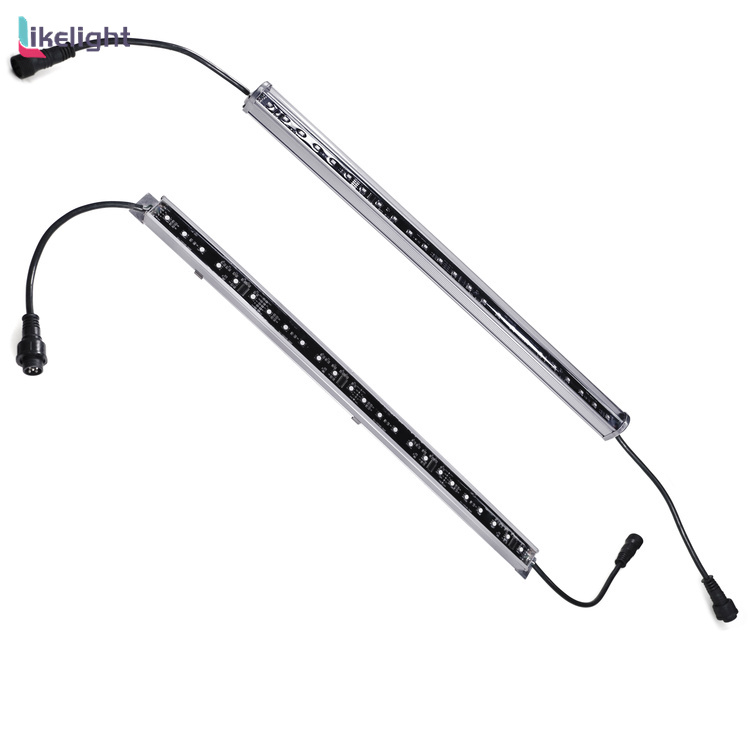
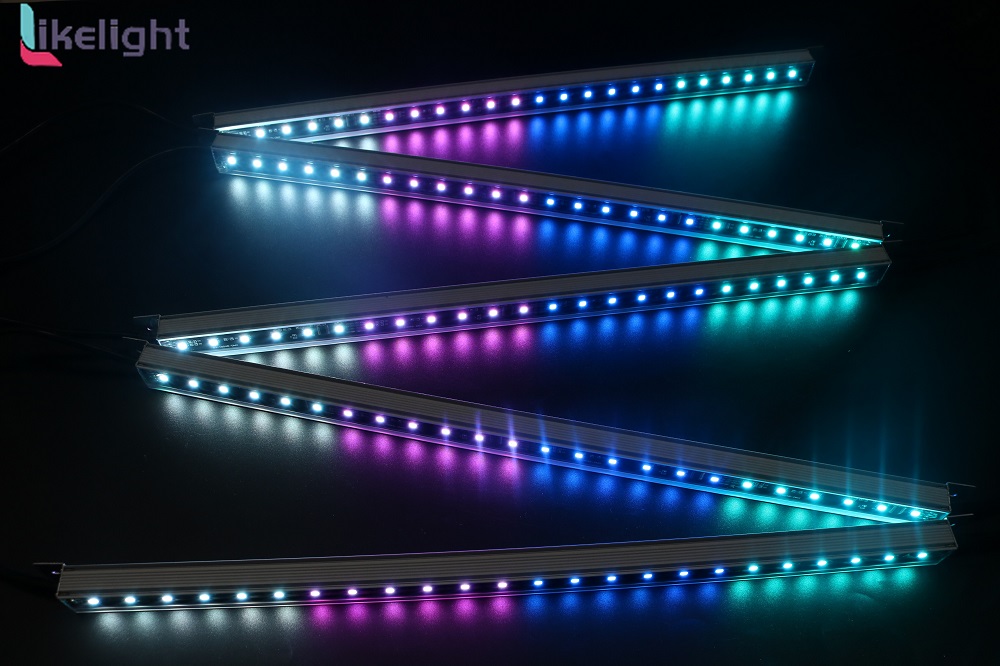
LIKELIGHT L-R-10048-DMX has a standard 1000 × 50 × 45 mm body. The page lists transparent or milky covers, silver-white or black aluminum profiles and two movable mounting holders per bar.
Segments determine color detail; cover and site structure determine edge appearance and installation space. Compare them on the same physical sample.
Retain this candidate when segmented contours or multi-segment broad bands are acceptable and a representative-position sample meets the target.
For close-up fine dots, small text strokes or specific camera behavior, separately compare denser grids, a suitable display category or a configuration that passes the required camera acceptance.
The current description lists IP67 for the body and waterproof male/female connectors. Field connections and power enclosures still require exposure-specific design.
A rigid body cannot bend into arbitrary curves; arrange separate bars and brackets at corners. Without maintenance access, revise the installation even when the show looks good.
5. What can a three-bar sample reject that one lit bar cannot?
A hypothetical sample with three one-metre bars, a seam and a representative corner can test motion within segments, direction across fixtures and physical dark gaps. If one bar passes but the chase reverses at a seam, correct path mapping.
If sequencing is correct but the gap ruins the picture, change the layout or accept a different effect.
The page explicitly requires a DMX code writer: this model is not automatically addressed. Include the intended address tool and recovery records in the sample purchase.
Approve bulk supply only when a replaced bar recovers the original route, colors and show. A DMX label does not make all replacement work automatic.
Record the target show at main viewing positions, seams and corners, supply checks under representative load, connector access and replacement steps.
Whether failure affects one fixture or others on the same circuit depends on the actual wiring and power structure. No automatic fault isolation or address recovery is promised here.
What should a quotation return before sampling?
- Exact SKU and available combinationsIdentify L-R-10048-DMX, 24 V, 8 pixels/m, cover and profile color. Return the valid option matrix, dimensions, cable exits and mounting drawings so sample appearance can be reproduced in bulk supply.
- Show, path and complete BOMSend the target animation, speed, narrowest band, length and main viewing position. Request the path drawing, mode/address records, controller and writer, fixtures, holders, harness/feed accessories, supply and distribution BOM. Identify responsibility for programming and commissioning.
- Representative sample and acceptanceQuote three bars with a seam, representative corner and intended control system. Agree single-segment chase, multi-segment gradient, load checks and replacement recovery acceptance. An automatic demo alone cannot answer whether the buyer's actual show passes.
- Complete price, spares and lead timesSeparate equipment, site installation, content/commissioning, sample retests, transport and matching spares. State sample, production and spare lead times. Spare fixtures also need recoverable addressing and mapping information, not merely matching appearance.
This quotation compares complete costs for keeping hardware and changing content versus replacing it with a denser system. Requesting valid options and sample data does not imply arbitrary customization or unpublished camera performance for this model.
Chase-effect purchasing questions
Will a faster controller make 8 pixels as detailed as 48?
No. Denser temporal updates add no independent spatial sites. Interpolation can alter adjacent brightness and the luminous centroid, but an independent bright region clearly shorter than one segment still needs a denser grid.
Does a milky cover solve all stepping?
No. It may change LED and segment-edge appearance without adding independent positions. Compare under the same viewing position and show; a fine dot and a broad band are different targets.
Does 3.2 changes/s mean this fixture is slow?
No. It is the hypothetical 0.4 m/s divided by 0.125 m control spacing: the example show's movement across its grid, not a hardware refresh or response test.
Will a replaced fixture restore its own address?
The page explicitly says this model needs a writer rather than automatic addressing. Include writing, map recovery and replay in acceptance. Actual fault impact depends on wiring and supply structure.
Copy-ready animation sample inquiry
We are buying linear pixel lighting for[project]. Installed length[ ], main viewing distance[ ], target[fine dot/broad band/segmented contour], narrowest bright region[ ], movement speed[ ].
Attached: target video,CAD dimensions,seams/corners,installation and maintenance space,environment and destination country. Please compare whether 8 pixels/m meets the target and offer a denser candidate if needed.
Propose a sample with three bars, a seam and representative corner. Return exact SKU, valid options, dimensional/wiring drawings, complete BOM, control/address tools, show/recovery records and acceptance points.
Quote complete system, installation/commissioning,sample,transport and matching spares separately, with lead times. Discuss bulk purchase after target-animation and replacement-recovery acceptance.