

LED Neon Flex for Events: Is a Reusable Carrier Worth the Cost?
At teardown, working neon can still need repair before the next event: it was bonded to a backboard, its leads were pulled or its packing kinked it.
For exhibition contractors rebuilding displays, the buying question is which parts survive teardown, which interfaces remain serviceable and whether later labour offsets the extra carrier cost.
30-second buying answer
- Reuse the same shape: First compare leaving the neon on a transportable carrier. Let the structure carry handling loads and keep connections accessible instead of peeling off and reshaping the neon each time. The project must design the carrier; it is not an inherent neon feature.
- One event or changing shapes: On-site fixing can reduce initial carrier spending. If the next structure has different dimensions, an old shaped carrier may have little reuse value. Compare complete costs against the planned number of uses.
- Order stop gates: Do not release the batch if the sample cannot be dismantled safely, interfaces mismatch, leads lack strain relief or transport changes the appearance. IP protection and a flexible jacket do not establish repeated mating or bending life.
Rebuilding the same display? Send the shape drawing, planned uses, section lengths and transport method.
Ask LIKELIGHT to assess a suitable neon version and work with your fabricator on a representative assembly that can be fitted, removed and inspected.
Three purchasing tasks: teaching examples, not customer cases
- A brand reuses its backdrop frame quarterlyThe next build must restore the original line and colour. Compare a carrier retaining the neon with removal and refitting each time. Include post-transport connection and appearance checks in build time, not only the first installation.
- A rental company replaces one damaged areaThe aim is to disturb only the replaceable portion. Match mechanical removal boundaries, accessible connections and spares. Four separate backboards do not automatically mean four independent circuits.
- Display dimensions change at every eventThe aim is to adapt to different shapes. Compare suitable standard material and preparation costs per event. A fixed-shape carrier may add freight volume without being reusable. Labour savings do not justify promising unlimited repeated bending.
Reuse the assembly, not just the neon
A flexible neon jacket encloses an internal circuit. Displaying it requires stable geometry; handling it requires avoiding concentrated bending at leads and vulnerable areas.
Retaining it on a shape-supporting structure can move handling operations from the light body to the carrier, but the benefit depends on fixing and packing design.
For the same shape across events, compare a shape-retaining carrier first. For changing shapes, favour material that can be prepared again.
In both cases compare front-view continuity, the carrier's daytime visibility and the space occupied by the carrier and packing.
Fixing determines whether removal damages the leads
Bonding or embedding can hide fixings, but replacement may require removing the surrounding finish. Accessible clips or carriers can separate servicing from the finish, while needing space for fixings, ends and tools.
The neon cross-section alone cannot prove the complete assembly fits.
For repeat builds, require the sample to demonstrate removing a failed section, restoring its fixing and repacking it. If removal necessarily pulls the leads or destroys the finish, change the support design before buying more spare neon.
A three-pin plug is not a universal event interface
The page lists connector, colour and voltage options. Pin count alone does not establish matching pinout, control method or output order. Whole-run RGB colour change and pixel chasing are different purchases.
Only the latter needs segment mapping; LED count cannot establish logical pixels or DMX addresses.
For one uniform colour, choose a simpler version meeting the effect. For chasing, test the final IC, pixel map and controller together. A mechanical replacement boundary is not an electrical fault boundary.
Match a spare section to the approved version and interfaces.
Put carrier premiums and later labour on one ledger
The first purchase may add carriers, accessible connections, packing and assembly work; later builds may need less repositioning and tidying. No manufacturer prices or measured efficiencies are available here.
Compare quotes and sample timing over the same scope, rather than treating the neon metre price as the system cost.
Include neon, carriers, power/control, wiring and protection, first assembly, later teardown/rebuild checks, spares and logistics. The assumptions below only help choose which sample proposal to request.
They do not claim that LIKELIGHT already supplies reusable kits or guarantees labour savings.
Accept a teardown cycle, not just a lighting photograph
After transport, loose support, strained leads or dirty interfaces may change the installation even if it initially lit correctly. The published IP67 rating is not a connector-cycle or handling-life rating.
Waterproof interfaces also need their own operating and closure procedures.
Use a representative assembly for installation, de-energised removal, packing, handling simulation, rebuilding and relighting. Record appearance changes, connections and actual time.
Agree limits and cycle count for the project; one sample cycle is not long-term durability certification.
Teaching example: five appearances—does the carrier pay?
For the same shape used repeatedly, request a complete carrier quote when the sample demonstrates lower later-build labour. For one appearance, excessive added freight or changing shapes, compare on-site preparation first.
Replace assumed hours with timed results before approving the buying direction.
Teaching assumptions, not a customer project or product capability: four display areas of 5m each, 20m total, appearing five times with the same shape.
After the first build, assume on-site refixing needs 2 labour-hours per event and a shape-retaining carrier needs 0.5 labour-hours for rebuilding and checks. Both timings cover the same removal, rebuilding and inspection scope.
Replace them with sample timings.
Hypothetical labour and cost boundaries for choosing a purchasing direction
-
Labour difference on later builds
Calculation
(5−1) × (2−0.5) = 6 labour-hoursPurchasing meaning
First assembly is included in the carrier premium, not in the later saving. This avoids counting the first event twice. -
Acceptable cost boundary
Calculation
Net initial carrier premium + extra transport/storage cost < 6 × cost per labour-hourPurchasing meaning
Only this inequality supports the carrier under these assumptions. Recalculate if measured time or appearance count changes. -
One area's replacement scope
Calculation
If one 5m area can be removed independently: (20−5) ÷ 20 = 75%Purchasing meaning
75% is the length left undisturbed, not a 75% cost saving or proof that the other areas remain lit during an electrical fault.
Choose by reuse pattern
| Buying condition | Decision |
|---|---|
| Visual result | For repeated shapes, retain geometry on a carrier; for changing shapes, favour easy re-preparation. Compare joints and background at the actual viewing distance. |
| Installation and transport space | Check the complete carrier, ends and tool access, then compare packing volume. 16x16mm describes only the neon body. |
| Power and control | Quote uniform colour separately from pixel chasing. Approve voltage, IC, pins and controller with the sample; three pins do not prove compatibility. |
| Fault impact | Define replaceable areas and power/data boundaries. Separate boards cannot replace an electrical fault demonstration. |
| Maintenance difficulty | Replace a de-energised section and restore its packing. Change the structure first if connections are inaccessible or the finish must be destroyed. |
| Complete cost | Compare initial premiums, repeat assembly, inspections, spares, packing and logistics. Validate the cost boundary with sample timings and real quotes. |
LIKELIGHT L-NH-1616 as the neon candidate for a removable display
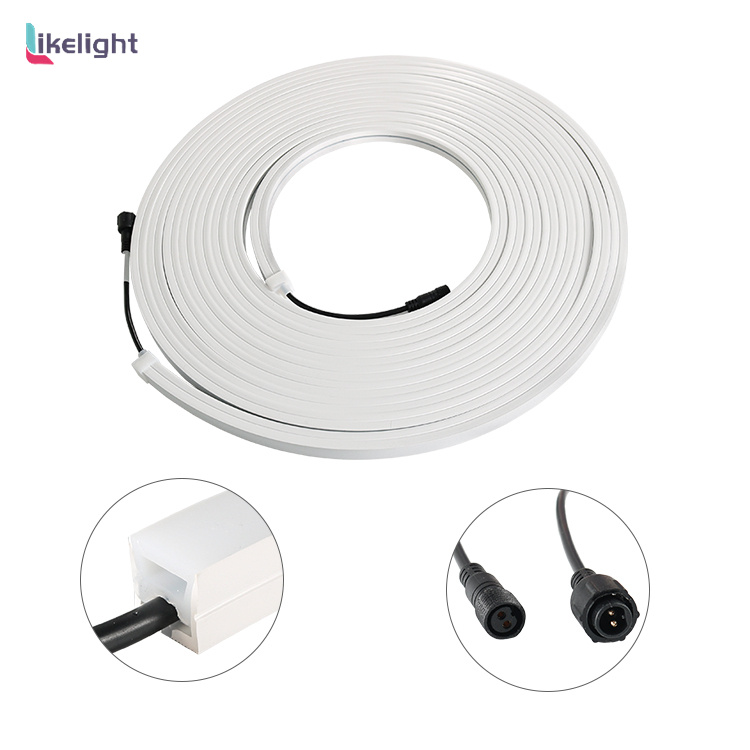
The L-NH-1616 listing gives a 16x16mm body, 5m roll packing, connectors and accessories including end caps, mounting clips and aluminium profiles.
These are starting points for a fabricator's fixing and wiring review—not evidence of an available reusable carrier, transport case or verified connector-cycle life.
If the 16x16mm light line and actual viewing direction suit the backdrop frame, and its shape will be reused, test it with the project carrier.
Voltage, colour and LED-density entries are options, not freely combinable components of an approved SKU.
Do not buy this approach directly for certified emergency-egress lighting, foot traffic, repeatedly changed unverified tight bends or inaccessible wiring. A static effect does not need unused programmable control features.
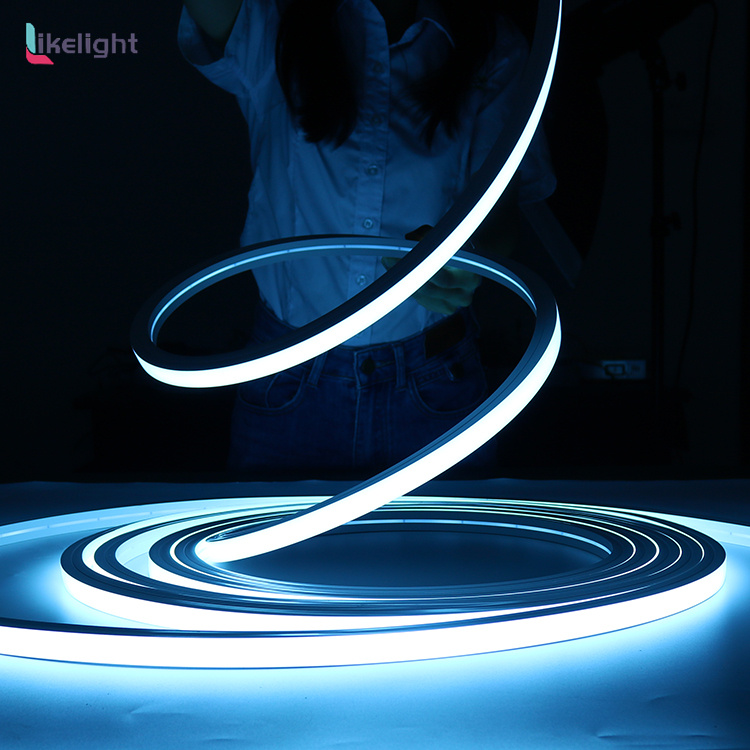
The photographs are product displays, not sample acceptance evidence. Lay out an energised product as required by its approved installation. A lit coil in a gallery does not establish continuous coiled operation or a minimum bend radius.
| Item | Public information |
|---|---|
| Model and section | L-NH-1616; 16x16mm |
| Packing | 5m per roll; not an approved single-end feed distance |
| Light-source options | SMD5050; 30/60/72/144 LEDs/m; LED count is not pixels or a cutting interval |
| Voltage and colour options | DC5V/DC12V; RGB/RGB Pixel/RGBW; valid combinations are version-specific |
| Connections and accessories | Three-pin male/female connectors, end caps, mounting clips and aluminium profiles listed; supply scope follows the quote |
| Protection | IP67; not evidence of repeated bending, mating or complete-display safety certification |
| Direction | Top emission and horizontal/side bending described; validate the actual display orientation, not arbitrary bending planes |
What to request in a LIKELIGHT quote
- Exact version and optionsReturn the SKU, revision, valid voltage/colour/control combinations, actual power and cutting limits. These determine compatibility with existing control, supplies and spares.
- Carrier and wiring drawingsReturn body/end dimensions, pins and power/data diagrams. The fabricator separately defines the carrier, strain relief and packing, distinguishing mechanical replacement from electrical boundaries.
- Complete BOM and costsItemise neon, accessories, power/control, cable protection, spares, assembly and packing; identify who supplies the carrier. Compare initial and later costs without assuming the manufacturer supplies every part.
- Sample and deliveryPropose a representative assembly, timed teardown/rebuild, visual and electrical acceptance points, matched spares, packing, lead time and costs. These are requested outputs, not claims that documents or custom services already exist.
A useful quote separates neon supply from the fabricator's carrier, transport and reuse responsibilities, returning a testable sample and comparable costs—not only a metre price.
Purchasing FAQ
Can IP67 neon be treated as rental equipment?
Not automatically. The rating does not establish connector cycles, repeated bending life, carrier strength or transport durability. Agree checks and tests for the actual installed assembly.
Can a 5m roll plug into the same controller at every build?
Only when approved voltage, pins, control and mapping match. 5m is packing information, not power, controller capacity or single-end feeding capability.
Do four areas guarantee that only one fails?
No. Mechanically replaceable areas may share a supply or cascade data. Determine fault impact from the actual circuit and agreed demonstration.
How do I avoid a good-looking sample that is difficult to dismantle in production?
Complete one teardown/rebuild cycle using the real carrier, longest planned connection and packing. Record steps, time, revision and acceptance points; preserve the approved supply and assembly scope in the batch.
Copy this inquiry and request a removable sample first
Application/destination: ___; planned appearances: ___; will the same shape be retained: ___.
CAD/shape and carrier dimensions attached; total/area lengths: ___; minimum radius/viewing distance: ___; transport/storage method: ___; colour and animation/existing controller: ___.
Please assess suitable L-NH-1616 versions and return valid options, dimensional/wiring drawings, complete BOM, sample/acceptance plan, matched spares and lead time. Separate neon supply from carrier/packing responsibility.
Time a teardown/rebuild first, then compare total repeat-build cost.