

Facade Point Lights or Continuous Contour Lighting? Compare Appearance and Installed Cost
Two budgets may both say ‘contour lighting’ while buying very different results: a continuous bright line emphasizes the building edge; visible dots emphasize rhythm.
If the owner wants the first but purchases the second, adding more points may still miss the desired appearance.
Choose the visual task first, then compare a complete price including fixing, wiring, power, control and installation, rather than only the price per lamp.
Choose the effect first
- Keep individual dots visible: Evaluate point lights first. Use a sample to choose dot size, spacing and side-view appearance; do not increase density simply to imitate a continuous line.
- It must look like a continuous line: Evaluate linear or neon-type products with an appropriate diffusing structure first. Inspect joints, corners and close-up appearance; point lights are not an automatic substitute.
- Text or a logo must be readable: Compare display solutions using the actual strokes and main viewing position. Decorative contour points cannot promise readability. Pause bulk ordering if the sample misses the visual target or fixing and wiring cannot be implemented.
For an initial enquiry, describe the target as ‘dot rhythm’, ‘continuous contour’ or ‘readable logo’, and send the outline length, main viewing position and site photos. That is enough to start eliminating unsuitable product categories.
Three hypothetical purchasing tasks, three directions
- Commercial entrance: continuous even close upSuppose a buyer needs an entrance-edge line without visible separate dots. Start with linear or neon candidates and assess sample joints and corners, instead of ordering point lights in bulk and trying to correct the appearance with tighter spacing.
- Facade nodes: dark gaps are intentionalSuppose the building has repeating decorative nodes and the owner wants light to move between them. Prioritize point lights, let the design nodes determine quantity, and quote installation by the actual fixing positions and connection workload.
- Brand logo: recognition is essentialSuppose a buyer needs a fine-stroke logo to be clearly recognized from a specified position. Prioritize dedicated sign lighting or a display solution suited to the content; keep a point-light quotation only after a sample proves that strokes are not lost.
1. What separates dotted decoration from a continuous contour?
Spacing is part of a point-light composition; linear or neon-type fixtures generally organize the contour through a continuous emitting or diffusing structure.
Viewing distance, background brightness, emitting surface and corners change the impression, so ‘it may merge from far away’ cannot replace the buyer’s requirement at the main viewing position.
The current point-light candidate is published as 50mm with a 140° beam angle. Neither body size nor beam angle guarantees a continuous line or defines text resolution.
If individual rhythm is required, dots and dark gaps are intentional; if close-up continuity is required, compare continuous-emission categories first rather than filtering dots by a wider beam angle.
Compare both categories on the same contour, from the same position and against the same brightness target. With points, judge whether gaps suit the rhythm; with continuous fixtures, judge straight runs, joints and corners.
Both require a daytime check of visible bodies and cables, not just a nighttime rendering.
2. Why does tighter spacing add more than lamp cost?
An additional body usually adds a position to locate, fix and inspect; actual connector quantity follows the supplied harness and wiring design, not an assumption of one field connector per point.
Linear solutions are installed in sections and may reduce separate positioning work, but supports, joints, corners and cutting rules also affect labor, so they are not necessarily cheaper.
50mm is only the candidate’s published size, not a machining-hole diameter. Point lights can enter quotation where the building permits a confirmed fixing structure.
If panel drilling, concealed rear harnesses or panel removal are necessary, include fabrication and access in the installation scope before choosing the product.
Compare the fixing and connection work needed to finish the same contour.
Ask the installer to itemize positioning, fixing parts, harness routing, corners and work at height rather than only a per-meter installation rate; otherwise a low lamp price can leave the real cost on site.
3. What belongs in the complete budget?
The candidate’s published nominal power is 1.44W per point, with DC24V supply.
More points proportionally increase the load calculated from nominal values; supplies, distribution, cables, protection and enclosures may change by zone or specification step and do not all scale linearly with lamp price.
The page title states DMX but does not provide the supplied version’s channel mode or control capacity.
Select the control system for the intended program and actual supplied mode, not a fixed four-channel assumption for RGBW or a control-point count derived from nine LEDs.
Use the same scope for lamps, fixing and harnesses, supply and distribution, control and programming, connection protection, installation and commissioning, and spares and freight.
If tighter spacing adds expense without satisfying another visual requirement, keep the sparser approved sample instead of purchasing more dots.
How do point quantities change a 24m contour purchase?
If the 0.4m sample already provides the owner’s intended dot rhythm, take the 60-point design into complete quotation: it has 60 fewer fixing locations and 86.4W less nominal load than the 0.2m design.
If neither satisfies close-up continuity, move to a continuous-emission category instead of further densification. Inspect the sample first; this example supplies no universal acceptable spacing.
All inputs below are purchasing-comparison assumptions, not a real customer case: a 24m closed contour with evenly spaced points, comparing center spacing of 0.4m and 0.2m.
Both divide the length exactly, and the closed contour does not count its start/end twice. Load uses this candidate’s published nominal 1.44W per point and DC24V.
Assume two minutes of net positioning and fixing per location, excluding access at height, harness work and commissioning.
Hypothetical closed contour: quantity, load and workload
-
Point quantity
Assumption or formula
N = contour length ÷ center spacing; 24 ÷ 0.4; 24 ÷ 0.2Result
60 and 120 points: the second adds 60 bodies and fixing locations.Purchasing implication
Tighter spacing creates a tighter rhythm but does not automatically turn separate points into a continuous emitting structure. An open contour requiring a point at both ends needs separate endpoint counting. -
Nominal load
Assumption or formula
P = N × 1.44W; I = P ÷ 24VResult
60 points: 86.4W and 3.6A; 120 points: 172.8W and 7.2A.Purchasing implication
These are total lamp-load estimates, not single-circuit or single-supply instructions. Actual consumption changes with brightness and program; electrical design separately allows for losses, headroom, protection and zones. -
Fixing work
Assumption or formula
T = N × 2 minutes ÷ 60Result
60 points take 2 hours; 120 take 4 hours, adding 2 net hours.Purchasing implication
This is not an installation-schedule promise. Real time including elevated access, fabrication, wiring and commissioning can matter more than body price. -
Complete price
Assumption or formula
C = lamps + fixing/harnesses + supply/distribution + control/programming + connection protection + installation/commissioning + spares/freight. With lamp price u and fixing labor/material per location f, the added-location component is 60 × (u + f).Result
Add the actual quoted differences for supplies, circuits, control, harnesses, site access and spares. No unit price or controller quantity is invented here.Purchasing implication
Compare point and continuous candidates against the same 24m effect task and complete BOM. Do not compare a point-light-only price with a fully installed continuous system.
Six purchasing conditions
| Project condition | Preferred direction and purchase conditions |
|---|---|
| A continuous bright line is required close up | Prioritize linear or neon candidates; assess joints, corners and diffusion instead of promising continuity through tighter dot spacing. |
| Visible dots should move along the building edge | Prioritize point lights; approve the rhythm at the main viewing position, then price actual locations. |
| Existing decorative nodes and fixing structures can be used | Point lights can enter sampling; follow structurally permitted positions instead of adding unnecessary fabrication to meet a fixed density. |
| Outdoor exposure permits a complete connection/enclosure design | Evaluate this IP67 body candidate and complete protection; do not transfer its body rating to site connectors. |
| Each point requires complex elevated installation access | Compare location labor, access equipment and harness cost. If the target is only a continuous contour, obtain a continuous-category quotation too. |
| Fine text, logos or detailed images must be readable | Prioritize dedicated sign or display solutions. Retain points only after an actual-content sample passes; neither 50mm nor nine LEDs promises readability. |
LIKELIGHT candidate case: a clear purpose for dotted contours
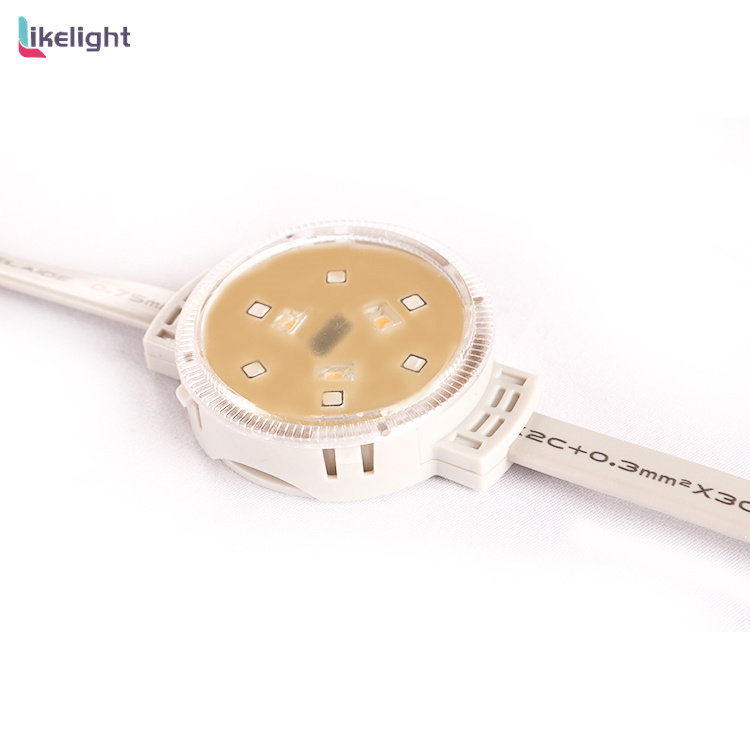
LIKELIGHT’s current L-C-509-DMXRGBW page positions it as an outdoor facade decorative point light and mentions architectural landscapes and bridge outlines.
It can be a physical-sample candidate for the task of retaining dot rhythm; this is not a completed project or a verified-effect case.
On the hypothetical 24m closed contour, selecting it means separately quoting 60 or 120 bodies, their fixing and the complete system, not multiplying quantities by nine LEDs.
Published configuration supports candidate screening; the sample establishes whether this project accepts separate visible dots. Neither replaces the other.
| Item | Published value or calculation boundary |
|---|---|
| Model and published category | L-C-509-DMXRGBW; 50mm RGBW DMX point light. 50mm is not a hole diameter. |
| Supply and nominal power | DC24V; 1.44W per point. Theoretical current per point: 1.44 ÷ 24 = 0.06A, not fixed measured current for every program. |
| Sources inside the body | 6 SMD5050 RGBW + 3 SMD3535 white LEDs: nine devices, not nine independent pixels. |
| Published beam angle | 140°; no guarantee of line continuity, illuminance or text readability. |
| Published body protection | IP67; site connectors, supplies and enclosures require their own environment-appropriate design. |
| Control and fixing scope | The current title says DMX. Define actual mode, compatible controller, harness and fixing parts through supplied-SKU documents and the sample list. No fixed channel count or drilling method is specified here. |
4. When is this 50mm point light worth selecting?
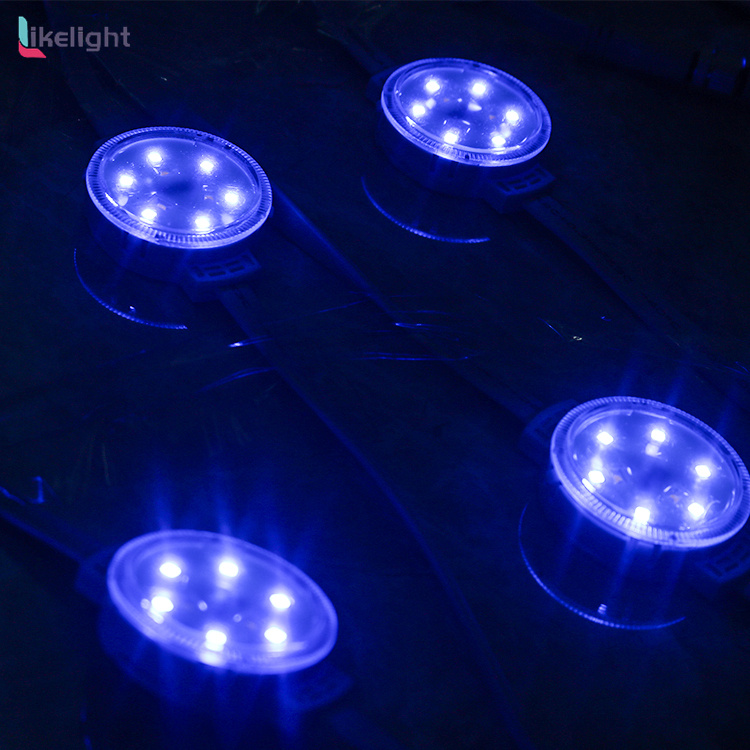
The model contains six SMD5050 RGBW LEDs and three SMD3535 white LEDs in one point-light body. These nine devices are not nine independent pixels.
The configuration warrants consideration for visible color points and contour rhythm, but LED quantity cannot establish fine-image capability.
This candidate has a clear purchasing purpose if the buyer wants the body itself to be a visible decorative point, the front and side views pass the sample review, and fixing and cable routing can be implemented.
For a continuous dot-free line, legible fine text or specified wall illuminance, prioritize another category or a solution with the relevant optical data.
The page lists IP67. Outdoor procurement must evaluate the body, site connections, enclosures and drainage as one installation design.
The body rating does not give every connector the same rating, establish salt-spray certification or allow arbitrary environments. Reject a mismatch in exposure or service access despite an individual IP number.
5. Which purchasing decision should the sample resolve?
A short sample is valuable for deciding ‘dots or a continuous line’, not for demonstrating more animations.
Use the actual fixing material, a representative corner, intended cable exit and target program; compare nighttime appearance from the main viewing position, then inspect daytime appearance and the replacement route close up.
If visible dots suit the design, corners preserve the rhythm, and fixing and wiring costs are acceptable, freeze the sample’s SKU and installation list before expanding the order.
If the owner still wants to eliminate gaps, switch to continuous candidates; a working animation alone does not justify a bulk order.
Acceptance can cover front and side appearance, consistency between straight runs and corners, target-program operation, end-of-run supply checks under representative load, and the disassembly needed to replace one lamp.
Agree project-specific limits in advance; these are not claims that this model has already passed those tests.
Make two quotations genuinely comparable
- Exact SKU and valid option matrixSpecify L-C-509-DMXRGBW and the DC24V, RGBW, 1.44W-per-point configuration. Ask the supplier for combinations of housing, cable exits, connections and fixing accessories actually available for this SKU, distinguishing standard supply from new development. A photographed appearance is not an orderable-option guarantee.
- Contour drawings and complete BOMSupply length, corners, viewing position, fixing substrate, supply locations and access conditions. Request lamp quantity, fixing parts, harnesses, controller, supplies, distribution and protection devices in the BOM, with supply boundaries. These define the difference between lamp price and project price.
- Representative sample and acceptance pointsUse the intended SKU and real fixing material, including a straight run, representative corner and proposed connection structure. Agree dot rhythm or continuity, side appearance, program, load checks and replacement disassembly before deciding on bulk purchase.
- Complete price, spares and lead timeSeparate equipment, installation, programming/commissioning, freight and spares. State quantities and matching requirements for spare lamps and harnesses. Request sample, production, shipment and spare-part lead times; sample stock does not establish the complete project’s delivery date.
This information turns ‘the lamp lights up’ into a scope for a purchased system that achieves the specified contour effect, allowing point and continuous solutions to be compared against the same task and construction boundaries. Fixing and control options are requests for accurate supply information, not claims that every combination is available.
Purchasing questions
Can very tight spacing replace continuous contour lighting?
Not necessarily. Emitting surface, background, viewing position and brightness also affect continuity. If the main viewpoint requires no distinct dots, evaluate continuous categories first; extra quantity cannot replace category selection.
Can this light make the facade a uniformly bright wall?
The point-light title and 140° beam angle alone cannot establish that. Uniform wall lighting needs fixtures suited to washing and relevant photometric data; this candidate’s task here is visible dotted decoration.
Are point lights always cheaper than linear lighting?
Body price is insufficient. Positioning, fixing, harnesses, elevated access, control and commissioning affect complete cost; continuous lights also need supports, joints and corners. Compare the same effect task and BOM scope.
Can panels be machined directly from the 50mm dimension?
No. Published size is not a hole dimension or fixing drawing.
Make a mechanical sample with the intended body and substrate before approving fabrication dimensions; without a confirmed fixing structure for that substrate, do not treat bulk panel machining as a settled plan.
Project enquiry text ready to complete
We plan to purchase contour lighting for [project location], targeting [visible dot rhythm / continuous line / readable logo]. Outline length: [ ]; main viewing position: [ ]. Contour drawings and substrate photos are attached.
Please first assess whether 50mm point lights fit and provide a continuous-category comparison where appropriate.
If recommending L-C-509-DMXRGBW, please provide the exact SKU and available-option matrix, fixing/wiring drawings, complete BOM, representative sample plan and acceptance points.
Quote complete equipment, fixing/harnesses, power/control, protection, installation/programming/commissioning, freight and matching spares separately, and state sample, bulk and spare-part lead times.