

Can an RGBW Pixel Strip Deliver Continuous White and Animated Effects?
For a new shop, one strip that provides white light during business hours and color animation during events seems simpler than two systems.
Yet white lines require individual bright points to blend, while some animations require adjacent regions to remain distinct. The same diffuser changes both.
Decide which effect cannot be compromised before choosing a shared RGBW pixel strip or separate white-light and animated-decoration paths.
Choose a direction
- Share white and slow gradients: When both effects alternate on the same line and sharp moving edges are unnecessary, first compare an RGBW pixel strip with a deeper diffusion assembly.
- Separate demanding white and chase effects: If white must look dot-free at close range and animation must have crisp boundaries, first compare separate white and pixel-effect lines. Stronger diffusion can improve white uniformity while softening short moving segments.
- Simultaneous overlay is not two independent lines: A configuration that controls RGB and W separately can overlay a white base and colored animation, but added white reduces perceived saturation. Use separate optical paths when pure white and vivid color must remain independent at the same time. Pause the bulk order if a sample fails any required mode or the actual control configuration cannot be matched.
For initial comparison, prepare the installation cross-section, closest viewing position and whether white, animation or both take priority.
These inputs exclude unsuitable optical arrangements before detailed controller and system budgeting.
Three hypothetical purchasing tasks with different priorities
- Hypothetical task one: a visible boutique coveCustomers see a continuous white line close up; after-hours events need only slow color movement. Start with a cross-section that accommodates greater mixing distance. A shared assembly merits sampling without paying for unused fine animation control.
- Hypothetical task two: an exhibition chase borderMoving segments and zone contrast are the main effect; white is only an opening or closing scene. Preserve the required boundaries using the actual animation first, then decide how much white dotting is acceptable rather than making dot-free white the only criterion.
- Hypothetical task three: merchandise lighting plus event effectsMerchandise needs stable white illumination while nearby effects run simultaneously. First compare two optical paths: buy white lighting against illuminance, color-temperature and rendering targets, and animation against visual rhythm, avoiding a compromise in merchandise lighting.
One RGBW strip can support two modes: distinguish switching from overlay
RGBW sources contain red, green, blue and white components; pixel control changes color and brightness across space.
This makes a shared installation line for white and animated modes possible, but adding white does not create two independent optical paths. The program, driver configuration and color mapping must express the required RGB/W combination.
When business-hours white and event gradients alternate, sharing can reduce duplicate profiles and installation routes.
If the same position must remain pure white while showing highly saturated chases, its mixed output changes color and separate paths are more direct.
For merchandise lighting, accept illuminance, color temperature and rendering against project targets rather than inferring them from the RGBW name.
Continuous white depends on mixing distance, not just the cover name
The case lists 60 LEDs per meter, giving average physical LED spacing of 1000/60, approximately 16.7mm. LEDVANCE profile guidance recommends a diffuse cover and an LED-to-cover distance greater than LED spacing for homogeneous lighting.
This screens optical cross-sections; it does not guarantee dot-free output from this product. Cover material, viewing angle, brightness and assembly affect the result.
Measure from the emitting LED surface to the inside of the cover, not the profile's overall external height. For a closely viewed white line, first compare greater effective distance with the actual cover.
If the recess cannot accommodate it, compare a denser white source with optical evidence or a separate white system; buying a thicker cover is not a guaranteed solution.
Smoother light does not mean higher animation resolution
Diffusion overlaps adjacent outputs, reducing visible points but also softening transitions between short bright and dark segments. Actual animation detail is limited by both true control grouping and the optical assembly.
LED quantity describes physical sources, not controllable points; pixel grouping does not automatically establish a cutting unit.
Compare samples using the planned shortest bright segment, fastest movement and principal viewing distance. Long gradients tolerate stronger mixing, whereas short chases should preserve recognizable boundaries.
Before control configuration is fixed, this case compares light sources and installation options without promising pixels per meter, a specific IC or cut length. Match the final controller to the actual driver and RGBW mapping.
A shared strip may save an installation route, not necessarily total cost
The page describes 57.6W/m as full-white-output data but does not separately report measured consumption of the W channel alone. It is electrical power data, not a value entirely converted into heat.
Thermal behavior depends on optical efficiency, operating scene, mounting contact and enclosure. Profiles affect both mixing distance and the heat path to the mounting structure.
Comparing bare-strip price with an alternative that includes profiles, control and installation omits costs.
Include strip, profile and cover, controller, power supplies, wiring protection, installation and commissioning, and spares/logistics in the shared option. Itemize both optical paths and shared or added facilities in the separate option.
Avoided duplicate installation matters only after the shared assembly passes white, animation and sustained-operation acceptance. Recutting a recess or reworking effects to remedy dots can erase an initially lower component price.
Choose through two cross-section samples, not an attractive photo
Using the same strip and playback file at different effective diffuser distances separates optical changes from control changes.
Sixty LEDs per meter supports an initial spacing calculation, and the listed 57.6W/m supports an initial budget load estimate.
These address installation and electrical questions respectively; neither proves accepted white brightness, dot-free output or animation detail.
Screen cross-sections within the available mounting space first, then request complete BOM quotations for shortlisted options.
If a deeper assembly passes white and the required gradients while a shallow one fails, budget the shared design with the deeper assembly.
If it makes chase boundaries unacceptable, switch to separate paths rather than increasing white or animation brightness to disguise the optical conflict.
Purchasing tool: screen optical geometry, then cost the system
First sample the shared cross-section with 20mm effective mixing distance in this example. Purchase it only if white uniformity and target animation are both acceptable and complete-system pricing is advantageous.
If one cross-section cannot satisfy white and crisp chases together, buy two independent optical paths.
Assume a 6m strip installation. Cross-section A has an effective LED-to-cover distance of 8mm and B has 20mm. These are hypothetical installation dimensions, not specifications of this product or a particular profile.
Both use the same 60 LEDs/m strip, control file and viewing position, comparing white, gradients and short-segment chases separately.
A hypothetical 6m visible commercial line, not a customer project or verified product result
-
Physical spacing and mixing distance
Assumptions and method
Average physical LED spacing s=1000mm/60≈16.7mm. Compare h/s: A=8/16.7≈0.48; B=20/16.7≈1.20.Result
A's effective distance is below average LED spacing; B's is above it. Under LEDVANCE homogeneous-light guidance, B merits the first white-uniformity sample.Purchasing implication
Sample B first without declaring it dot-free. Also check whether it blurs the required animation edges too much. Quote A only if both modes are acceptable from the actual viewing position. -
Electrical budgeting baseline
Assumptions and method
Using only listed power: P=6m×57.6W/m=345.6W.Result
345.6W is a listed-power calculation for the hypothetical strip length, not measured consumption in white or gradient modes, heat output or a single-supply selection.Purchasing implication
Request load data for target white, animation and permitted overlay scenes; separately allow for supply losses, wiring and headroom. Do not quote all operating modes from a low-duty animation load. -
Total price and selection
Assumptions and method
Ctotal=Cstrip+Cprofile_cover+Ccontrol_supplies+Cwiring_connectors_protection+Cinstallation_commissioning+Cspares_logistics. Fill separate quotations for shared and independent paths over the same installation scope; assume no market prices.Result
If B passes both modes, compare its total with the separate option. A shared assembly failing either required effect is excluded even when its bare strip is cheaper.Purchasing implication
Sharing saves an installation route, not necessarily every cost. State spare quantities, lead time, samples and site-acceptance costs; an unquoted item is not zero.
Six conditions and purchasing directions
| Project condition | Preferred direction |
|---|---|
| Close-view continuous white; only slow dynamic gradients | First compare RGBW with a deeper mixing cross-section; combine procurement only after both white and gradient samples pass. |
| Short segments and crisp chase edges take priority | Select diffusion using actual animation, accepting approved white dotting or adding a separate white line. |
| Existing shallow recess cannot gain effective distance | Do not preapprove 60 LEDs/m as dot-free. Compare optically evidenced alternative sources or separate paths. |
| Damp or exposed installation | The page offers IP20/IP65/IP67, not IP67 on every version. Evaluate IP65/IP67 against exposure plus ends and connectors for damp/outdoor use. A diffuser does not waterproof the system. |
| White illuminates merchandise while animation runs | Prefer independent paths with separate lighting and decoration acceptance; RGBW naming does not replace illuminance and rendering targets. |
| Both modes pass on a shared sample | Compare totals including control, supplies, installation, spares and lead time, matching the actual driver and RGBW mapping before ordering. |
LIKELIGHT case: an RGBW source for dual-mode comparison
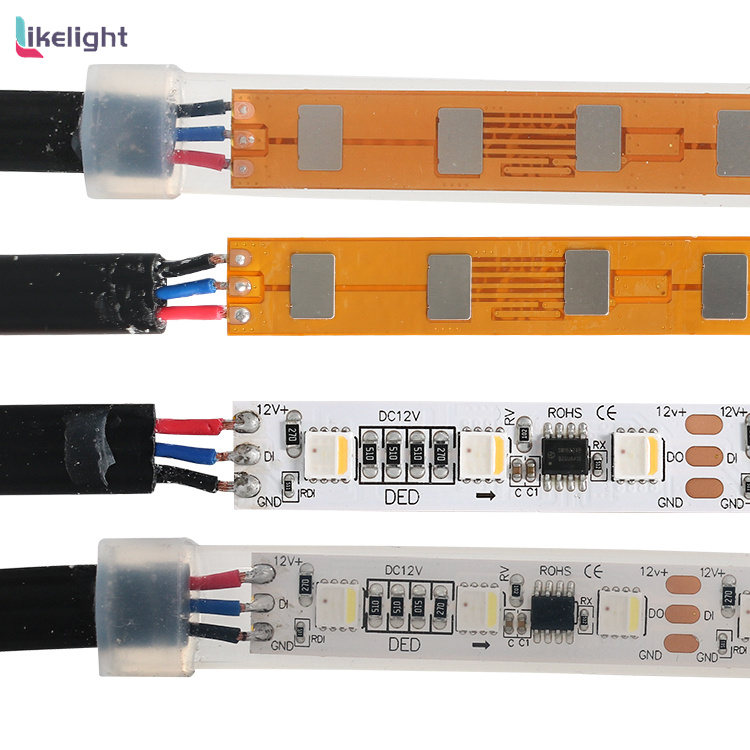
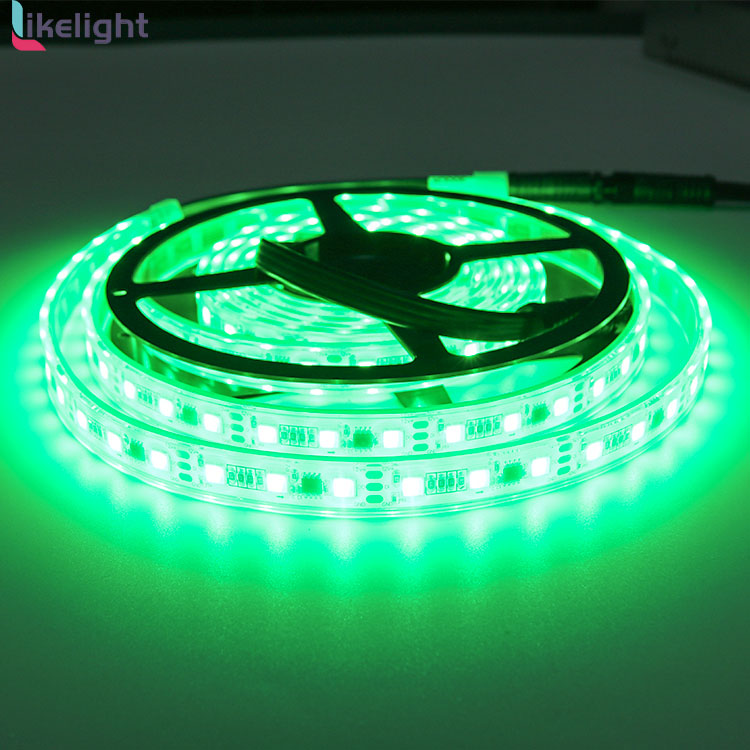
The LIKELIGHT L-S-10060-16824-RGBW-12V page lists 12V, 5050 RGBW sources, 60 LEDs/m, a 120° viewing angle and 57.6W/m listed power, describing a programmable addressable strip.
Combining RGBW and programmability makes it a candidate for sampling a shared business-hours-white/event-color line, rather than evaluating it only as monochrome tape or an ordinary whole-strip color changer.
For hypothetical task one, ask whether a deeper diffuser assembly meets both white and slow movement. For task two, actual animation must first demonstrate distinguishable segments.
For task three, separate paths better match independent merchandise white and colored decoration. This case does not infer true control resolution from LED density or promise dot-free white from product photos.
| Item | Details |
|---|---|
| Model | L-S-10060-16824-RGBW-12V |
| Voltage and power | 12V; listed 57.6W/m, described as full-white-output data, not measured W-only consumption or maximum power |
| Light source | 5050 RGBW; 60 LEDs/m |
| Viewing angle | 120°, not a covered assembly's distribution or a dot-free guarantee |
| Direct calculations | Average physical LED spacing about 16.7mm; hypothetical 6m is 345.6W using listed power |
| Published control and protection | Standard SPI; IP20/IP65/IP67 options chosen for the environment, with ends and connectors matched separately |
| Order-configuration boundaries | Final specifications establish true control grouping, IC, white CCT/rendering, effective width and cutting drawing; this article assigns no defaults |
How quotation inputs change the choice
- Exact SKU and valid option matrixList genuinely available combinations of white configuration, driver/grouping, protection and dimensions. Distinguish existing SKUs from customization requiring assessment, giving both modes a common acceptance object.
- Cross-section, wiring drawings and BOMDrawings specify effective mixing distance, mounting contact, cable exits and marked cut positions. The BOM covers strip, profile/cover, control, supplies and connection protection, revealing installation costs missing from bare-strip quotes.
- Sample plan and acceptance pointsAt one viewing position evaluate white dotting, color temperature and required illuminance, gradients and shortest bright segments. Also evaluate permitted overlay scenes and sustained-operation temperature. Record methods and project acceptance limits in the sample plan rather than accepting a single lit photograph.
- Complete-system price, spares and lead timeBoth shared and separate offers itemize commissioning, spare quantities, logistics, sample cost and lead time, identifying shared equipment. Compare totals over equal scope; unquoted items are not free.
These inputs select an assembly satisfying both effects and quantify the saving from one fewer optical path. They do not postpone all technical decisions until delivery.
Purchasing questions
Does RGBW guarantee suitable white merchandise lighting?
No. W identifies a white component, not compliance with illuminance, color-temperature or rendering targets. Buy demanding merchandise lighting against optical evidence and sample measurements; separate lighting from decoration if it fails.
Can a deep profile remove dots and increase pixel resolution?
Do not infer that. Greater mixing distance helps overlap adjacent output but adds no controllable points and may soften animation edges. If fine dynamics are mandatory, play target content with the actual control configuration first.
Can white stay on under a colored chase?
Evaluate overlay only with a configuration supporting separate RGB/W drive and the intended combination. The output is mixed and color may appear less vivid than in RGB-only mode.
Use separate paths when pure white and saturated color must remain independent.
Why not buy the cheapest strip and change the cover later?
A cover cannot change true control granularity or white quality; stronger diffusion changes output and edges.
Sample the cross-section and both modes together, then compare total-system prices for a clearer decision than post-purchase remedies.
Optical basis: LEDVANCE strip-profile guidance
RGBW components and mapping: Adafruit documentation, not this model's protocol
Ready-to-use dual-mode project enquiry
We are procuring linear lighting for a new project. White and animated effects will operate [alternately/simultaneously], with priority on [white/animation/both].
Installed length is [ ]; attached is the cross-section and closest viewing distance [ ]. Please quote both a shared RGBW strip and separate optical paths.
Provide the exact SKU, genuinely available option matrix, white/control configuration, cross-section and wiring/cutting drawings, complete BOM and sample plan.
Samples must compare white dotting, target illumination metrics, gradients, shortest moving segments and permitted overlays, with sustained-operation acceptance methods.
Itemize complete-system price, installation/commissioning, samples, spare quantities, logistics and lead time rather than replacing a system quotation with bare-strip price.