


LED Wall Washer for Facade Lighting: 60-Degree Beam, Power Options and Control Decisions
A facade can fail visually even when every luminaire turns on. Fixtures mounted too close can reveal bright bands, a broad beam can spill beyond a narrow feature, and a power option selected from wattage alone can exceed the available circuit plan.
A useful wall-washer decision therefore begins with the surface and mounting geometry, then checks power and control. This article applies that order to the published LIKELIGHT configuration without inventing an IP rating, signal distance or controller capacity.
Published product facts
| Published item | Value |
|---|---|
| Model | L-W-10048-220V-45W-4000K |
| LED layout | 48 LEDs/m; one or two rows |
| Published power choices | 24W/m, 48W/m, 96W/m |
| Published voltage | AC220V |
| Viewing angle / IC | 60 degrees / UCS1903 |
| Certification entries | CE, RoHS |
Decide whether the brief needs washing or grazing
Wall washing aims for a broad, blended field across a vertical surface; grazing places the light closer to the surface to emphasise texture and shadow. The published 60-degree viewing angle can be evaluated as a broad-wash direction, but the actual result still depends on setback, aiming, fixture spacing and wall reflectance.
This model is not the first choice when a project requires a narrow, sharply defined beam or a verified texture-grazing result without a mock-up. Test one representative wall bay before freezing the full layout.
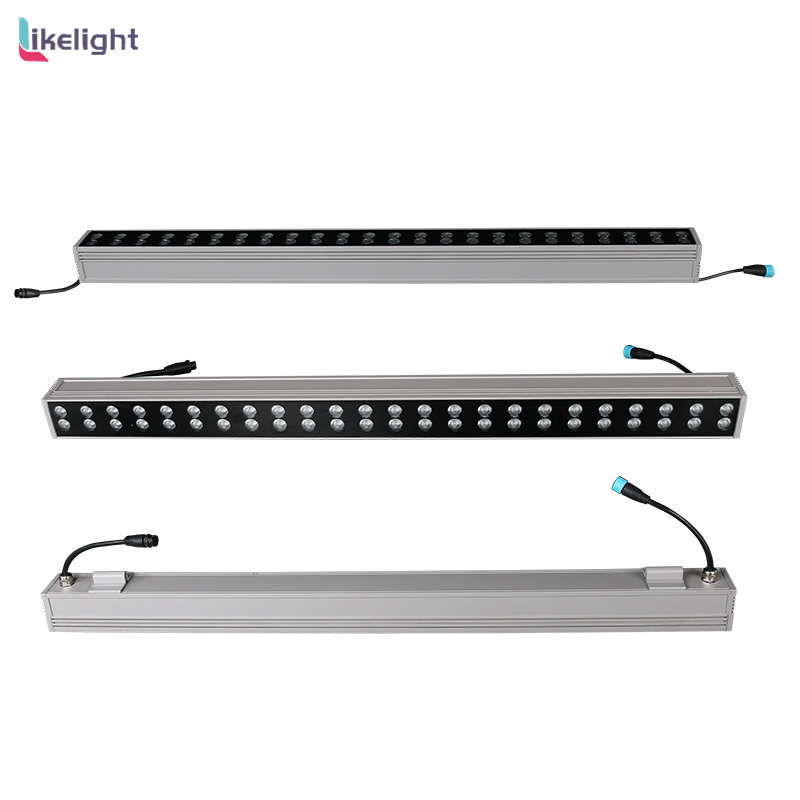
Translate 48 LEDs/m into a useful geometry check
The page publishes 48 LEDs/m and notes one-row or two-row arrangements. If 48 emitters are distributed uniformly along one metre, the nominal longitudinal pitch is 1000mm / 48 = 20.83mm. That theoretical pitch helps compare visible source spacing, but it does not describe the transverse spacing of a two-row version.
The page also offers 1W, 2W and 4W per LED options. Row arrangement, LED option and optical construction must therefore be frozen together; LED count alone cannot predict brightness or wall uniformity.
Compare 24W/m, 48W/m and 96W/m as circuit loads
For a 20m zone, the published power choices produce starting loads of 480W, 960W and 1920W respectively. These are arithmetic planning values: 20m x 24W/m, 20m x 48W/m and 20m x 96W/m. They show why the power version changes cable, protection and circuit zoning before it changes the visual programme.
The structured page identifies AC220V for the published model. Final voltage, driver arrangement, power factor, inrush, cable size and protection must be confirmed in the released electrical schedule; the article does not infer the DC24V configuration mentioned in the page URL.
Project selection table
| Project condition | Decision direction | Why |
|---|---|---|
| Broad, blended facade field | Evaluate the 60-degree version | Approve setback and overlap on a sample bay. |
| Narrow texture grazing | Re-evaluate optics | A broad angle may spill beyond the feature. |
| 20m at 24W/m | 480W planning load | Lowest of the three published load choices. |
| 20m at 96W/m | 1920W planning load | Requires a materially different circuit plan. |
| DMX tender requirement | Confirm controller conversion | UCS1903 evidence does not prove direct per-light DMX. |
| Outdoor exposure | Freeze protection as a separate item | No protection grade is published in the structured evidence. |
Keep DMX system planning separate from UCS1903 pixel data
The page title uses DMX RGB/RGBW language while the published IC field identifies UCS1903. These facts can coexist when a higher-level controller converts project commands into cascade-pixel data, but they do not prove that every light directly receives a standalone DMX address.
Freeze controller model, conversion layer, pixel grouping, data direction, connector pinout and test-file version. Commission a short zone with numbered and solid-colour patterns before building the final universe or network map.
Use the surface test to choose power and spacing together
A light wall, dark stone and reflective metal can respond differently to the same 60-degree beam. Record mounting distance, aiming angle and the overlap between adjacent fixtures on the actual or representative material.
Select the lowest published power option that meets the approved visual target with reasonable circuit loading. If the mock-up shows hotspots, first review geometry and overlap rather than assuming that a higher 48W/m or 96W/m version will improve uniformity.
Where the LIKELIGHT wall washer fits
The published model L-W-10048-220V-45W-4000K combines 48 LEDs/m, one- or two-row options, a 60-degree viewing angle, AC220V, 24W/m, 48W/m or 96W/m choices, UCS1903 evidence, and CE and RoHS entries. It can be evaluated for broad architectural washes, long facade bands and projects that can approve control and optics through a sample bay.
It is not a priority fit for a narrow accent beam, for a site requiring an unverified protection grade, or for a control tender that assumes direct DMX behaviour without confirming the UCS1903 interface. LIKELIGHT can align the sample, control file and electrical version before bulk production.
Suitable when
- Broad facade washes with a representative mock-up
- Long bands that can be divided into electrical zones
- Projects that can freeze the controller-to-UCS1903 workflow
Re-evaluate when
- Narrow accent or grazing without optical testing
- Outdoor approval based on an invented IP grade
- Direct-DMX assumptions without interface confirmation
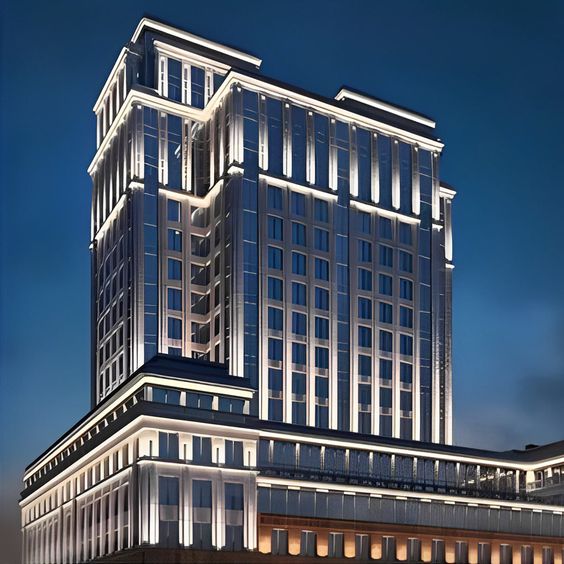
What to send before a facade quotation
Provide elevation drawings, wall material and colour, mounting setback and height, total and zone lengths, target RGB or RGBW effects, selected power range, available supply, controller and network workflow, cable routes, connector direction, exposure, quantity, sample bay and schedule.
These inputs allow the beam overlap, visual target, circuit loads and control conversion to be evaluated as one system. They also define the acceptance photographs and electrical readings that should be captured during the sample test.
- Facade elevation and material
- Mounting setback, height and aiming
- Total and zone lengths
- RGB/RGBW effect and power option
- Supply, controller and network workflow
- Exposure, cables, quantity, sample and schedule
Frequently asked questions
Is 60 degrees always a wall-wash beam?
It is a broad direction, but the installed result depends on setback, aiming, spacing and surface.
Does 48 LEDs/m mean 20.83mm pixel pitch?
It is a theoretical longitudinal LED pitch only when emitters are uniformly distributed; pixel grouping may differ.
Is the product directly DMX-addressed?
The page uses DMX wording and lists UCS1903, so the controller/interface architecture must be confirmed.
Which power option is best?
Choose after a surface mock-up and circuit review; higher power does not automatically improve uniformity.


