


LED Wall Washer Replacement: Restore Aiming and Verify the Sample
Consider a hypothetical maintenance situation: a mock-up was accepted, but replacing one wall washer six months later leaves a bright band higher on the wall. The new fixture has the same voltage and length and changes colour normally.
Repeated brightness adjustments still leave a visible seam. For the buyer responsible for handover and maintenance, the question is not which lens to choose again.
It is how to preserve the originally accepted installation state so that the next replacement can reproduce it.
Without references for fixture position, aiming and test scene, a model number and a photograph of a working light cannot establish that the effect has been restored.
The Short Answer
- Preferred direction: Keep the original optic and scene unchanged. Check the mounting surface, wall offset and body tilt first, then compare the wall under the original test conditions. Do not start by raising brightness to hide a displaced band.
- Hold release: Stop bulk replacement if the fixture cannot return to the original mounting references, new dark seams or spill remain under the same scene, or the sample does not match the existing connection system. Resolve the item that changed first.
- Test a replacement: Establish a baseline on the real finish with at least one joint between adjacent fixtures, then remove and reinstall one sample. A single demonstration that it lights up is not a reproduction test.
For an initial discussion, send one photograph showing the fixture and target wall, the original fixture configuration, replacement quantity and permitted work window.
These inputs distinguish a mechanical-reproduction sample test from a replacement-configuration review.
Three Hypothetical Tasks Need Different Acceptance Targets
- Hypothetical task one: one bar on a smooth entrance wallLeave neighbouring fixtures in place and restore the bright-band position across the joint. Reproduce the geometry first, then compare from a fixed viewpoint. This tests whether replacement disturbs an already accepted continuous effect.
- Hypothetical task two: servicing a landscape wall beside a windowThe wall effect remains acceptable, but the new fixture directs light towards the window. Check tilt, shielding and fixture position first. Merely dimming may also reduce the intended wall effect and does not establish restored direction.
- Hypothetical task three: a different bracket along the whole runThe original fixtures have not failed, but the fixing method must change. A new bracket may place identical fixtures at different positions. Accept a new mock-up of the installation combination rather than reusing photographs of the old fixture arrangement.
Separate a Displaced Band from a Brightness Change
Rotating a fixture changes its emission direction; moving a fixing point changes the source position. The rays reaching the wall change accordingly.
New band edges or seams can therefore appear even when the electrical configuration is unchanged. Conversely, brightness settings, colour scenes and wall condition can make the same area appear brighter or darker.
Treating these changes together can turn a mechanical displacement into an apparent output problem.
If the band edge has moved, restore position and aim before comparing output.
If its position is broadly unchanged but the area looks darker, establish the same static colour, brightness setting, test time and wall condition before a qualified person checks operating conditions.
Keep the original observer locations when reviewing direct glare and spill outside the target; standing beside the fixture is insufficient.
Record a Mounting Reference, Not Just a Bracket Angle
An angle can be reproduced only against the same reference surface. If the first reading uses horizontal as zero and the second uses a sloping mounting ledge, identical readings can represent different fixture directions.
Fixing holes, body end positions, the measuring surface and cable exit together describe the installed state. Fixture length describes occupied space, not its installed angle.
For a straight run of one-metre bodies, number each fixture in the handover record and retain the fixing surface, both end positions, wall offset, measuring surface and measured tilt.
Use a repeatably positioned site ruler, locating template or reference mark that does not damage the housing. Let a remove-and-reinstall trial determine whether a dedicated jig is needed.
Existing graduations may aid positioning, but their presence does not establish the final wall effect.
If the measuring surface, bracket or fixing base changes with replacement, do not directly transfer the old angle. Restore the geometric relationship or establish a new mock-up reference, then accept the effect.
A new combination is not an equivalent replacement merely because the delivery deadline is close.
How a Remove-and-Reinstall Trial Proves Reproduction
Repeatable acceptance preserves both test inputs and judgment locations. Establish a static baseline using the real finish, joint and installation combination.
Record colour and brightness settings, fixed measurement points, observer locations and camera exposure. Keep neighbouring fixtures untouched and remove only the target sample.
This isolates the changed variable more effectively than readjusting the entire run.
Compare the reinstalled band edge, seam and spill with the baseline. If position returns but a colour difference remains, assess sample matching separately.
If the seam moves with small aiming adjustments, resolve mechanical reproduction first. Fixed-exposure photographs record relative appearance; they are not illuminance measurements.
Where the project requires quantified illuminance, use an appropriate instrument at fixed points and retain scene conditions.
Use the same optic throughout a trial. Do not change lenses, scene settings and spacing together between removal and reinstallation. Agree permitted edge displacement, colour difference or illuminance difference before testing.
Acceptance means the reinstalled assembly still meets those criteria, not merely that the fixture lights up again.
Turn Installation Error into a Reason to Test a Sample
A simplified geometry experiment explains how aiming error affects a distant target.
When the original axis is perpendicular to a plane at distance d, rotating the fixture by δ displaces the axis intersection by approximately x = d × tan(δ).
This calculates the intersection shift due to direction error, not beam width, wall illuminance or the throw capability of a model. An obliquely lit wall needs its actual geometry recalculated.
The hypothetical example below indicates how fine the reproduction reference needs to be.
If a few degrees exceed the agreed position allowance, buy a sample assembly that can undergo a removal trial and request its mechanical drawings first.
Do not present that allowance as a locking accuracy already achieved by a particular fixture.
Compare a Maintainable System, Not Just a Spare-Bar Price
Replacement includes access, power isolation, removal, reconnection, re-aiming and night-time retesting.
If the mounting method requires removing neighbouring fixtures or readjusting the full wall run, installation and testing can offset a lower bar price.
Aim to procure an installation combination that permits independent access and replacement without disturbing neighbours.
A complete system budget is: fixtures and spares + brackets and fixings + power and control equipment + cables, connectors and protection work + access, installation and commissioning + sample retesting.
Separately list maintenance access equipment, labour per removal and reinstallation, and repeat-acceptance labour. Compare quotations on the same scope; do not assume one bracket is inherently cheaper.
Outdoor arrangements also need cable bending room, drainage and reachable connectors. IP65 is the published fixture rating for this model, not an immersion permission or a substitute for field-connection and installed-system protection.
If replacement opens a sealed structure, restore protection under the applicable service instructions. Without such instructions, favour replacing the complete fixture assembly rather than opening the body.
Qualified personnel must handle isolation, fixing and wiring to site requirements.
Hypothetical Example: Does a 2° Shift Pass Reproduction Acceptance?
Prefer an installation combination that records a reference and permits a remove-and-reinstall verification. Do not mask directional error with a wider optic or higher power.
If the site reference cannot resolve the required change, improve the measuring method or agree achievable effect criteria before releasing a bulk order.
Geometry screening is only the starting point for sample testing; it cannot guarantee wall uniformity or colour consistency.
This is a hypothetical mechanical-reproduction task, not a product test or a reported project. Represent the source direction as one axis originally perpendicular to a target plane at d = 3.00m. Allow an intersection shift of 0.050m.
Only tilt changes; fixing point, plane, optic and scene remain unchanged.
Direction-error screening, not a photometric calculation
-
2° rotation
Formula and result
x = 3.00 × tan(2°) ≈ 0.105mProcurement implication
Exceeds the hypothetical 0.050m allowance. Improve positioning and retesting before bulk replacement. -
0.5° rotation
Formula and result
x = 3.00 × tan(0.5°) ≈ 0.026mProcurement implication
Below the position allowance in this geometry, but the real-wall sample comparison is still required. -
Geometric angular boundary
Formula and result
δ = arctan(0.050 / 3.00) ≈ 0.955°Procurement implication
A test-planning value, not a published fixture or bracket accuracy. The locating method should let this scale of change be checked.
Match the Symptom to the Next Step
| Site condition | First action and release condition |
|---|---|
| New band moves up; neighbours remain untouched | Keep the original scene; check fixing points and tilt. Release after the boundary returns and like-for-like comparison passes. |
| Similar boundary, different colour or brightness | Check identical test inputs, then sample matching and operating conditions. Raising brightness is not proof of equivalence. |
| Only a photograph records the original installation | Re-establish mounting, measurement-point and scene references. Test one removal and reinstallation before defining bulk acceptance. |
| Fixture is replaceable but its joint is inaccessible or collects water | Revise service access and drainage so reconnection and protection can be restored before purchasing the run. |
| Replacing one bar moves neighbouring fixtures | Compare independent-replacement assemblies and complete labour costs, not just bar prices. |
| Bracket or optic changes during replacement | Accept a new mock-up and mechanical reference for the new combination; do not reuse the old configuration's approval. |
Putting the LIKELIGHT One-Metre Aluminium Bar into the Trial
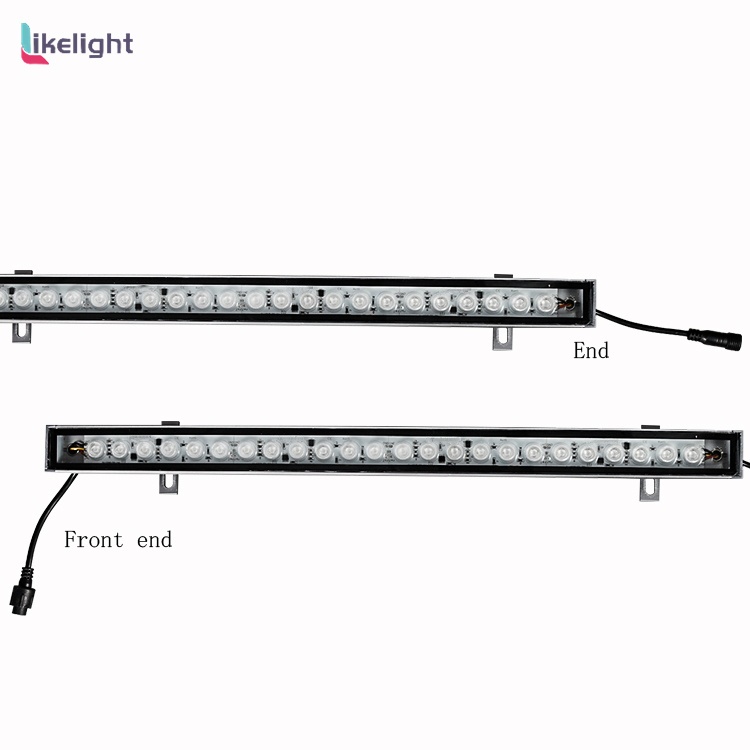
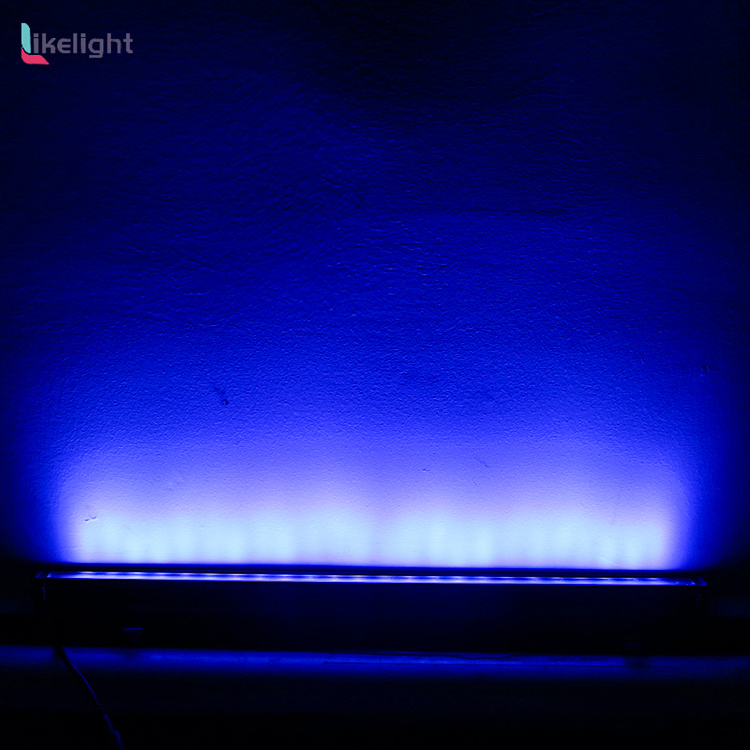
The current description of LIKELIGHT L-W-10048-DGL-24V publishes a one-metre standard body, SMD5050 RGB light sources and an optic lens over each LED.
It is a candidate for a mechanical-reproduction trial on a colour-lit wall with fixed straight mounting positions.
Keep the selected optic unchanged, record references on the actual fixing structure and verify whether one-bar removal disturbs neighbouring bands.
The page offers 30°, 60°, 90° and 120° lens options. Specify the ordered optic; these options do not authorise arbitrary mixing during replacement.
Product photographs show the body and fixing ears, not an angle scale, adjustment range or locking accuracy.
Procure a sample of the actual fixture and intended mounting hardware together, and validate fixing locations and repeatability through drawings and the sample.
Use this candidate first for a straight segment and real-joint replacement trial. Do not release it directly where untested high-wall illuminance, immersion or unconditional compatibility with an existing system is required.
The current description identifies UCS2903 and connectors with three pins at both ends.
Match the sample using the existing system and relevant wiring documents; this article assigns neither native DMX addresses nor universal controller compatibility.
| Item | Published information |
|---|---|
| Model | L-W-10048-DGL-24V |
| Input and power | DC24V; published maximum consumption 24W |
| Standard body dimensions | 1000×32×25mm |
| Light source and optic | SMD5050 RGB; 30° / 60° / 90° / 120° lens options |
| LEDs and pixels | Description: 48 LEDs/m and 8 pixels/m; 12.5cm pixel pitch |
| IC and connections | Description: UCS2903; three-pin connectors at both ends; 15cm wires |
| Fixture protection | IP65; installed-system protection also includes field connections |
Include Effect Reproduction in the Quotation
- Exact SKU and valid combinationsSpecify model, length, optic, colour configuration, IC and connection method. Request a valid configuration matrix and corresponding SKU so a spare is more than a similar name.
- Mechanical drawings and mounting hardwareProvide fixing surface, holes, wall offset, direction and service space. Request fixture and mounting drawings: these dimensions determine whether the original references can be reproduced.
- System BOM and labour scopeList fixtures, brackets, power supplies, control equipment, cables, connectors and protective parts separately in the BOM. State whether access, aiming and night testing are included to make complete costs comparable.
- Sample acceptance recordProvide baseline scene, fixed points and allowed differences. Request the sample assembly, removal-trial method and acceptance-record format. A working light has not necessarily passed reproduction.
- Spares and lead timesState replacement quantity, intended spares and work window. Request separate sample, bulk and spare lead times plus a spare-configuration identification method to avoid guessing the optic or connection version during maintenance.
These inputs tie fixture configuration, mounting reference and effect acceptance to one order scope. Obtain the exact SKU, valid configuration matrix, drawings, system BOM, sample acceptance criteria, spare plan and lead times before deciding whether a quotation covers a repeatable replacement rather than just working lights.
Procurement and Sample Questions
Does sample testing need the whole wall run?
Not initially. Use one removable sample and neighbouring fixtures at the real mounting location to create a joint and fixed baseline. Expand the mock-up when cumulative error, end obstructions or a whole-run bracket change is involved.
Can 0.955° become this bracket's acceptance specification?
No. It comes from the hypothetical 3.00m distance and 0.050m position allowance and indicates directional sensitivity in that geometry.
Validate actual repositioning capability on the intended assembly and compare the wall effect separately.
Will a wider optic hide the seam?
A wider distribution may change the seam's appearance but may increase spill outside the target. That changes the original configuration and does not reproduce the original effect.
Accept the new scheme again if changing the optic is necessary.
Which projects cannot be released directly using this method?
Establish a new mock-up first where the installation baseline is absent, fixings or optics change, or the replacement has not passed connection and scene matching.
Neither immersion nor unmeasured high-wall performance can be approved from this model's IP65 and power fields alone.
Ready-to-Complete Sample Inquiry
We plan a replacement-reproduction trial for [quantity] RGB wall washers at [site/wall finish]. Original configuration: [model/length/optic/IC/connection].
Mounting references: [surface, fixing holes, wall offset, measuring surface and tilt]. Fixed test scene and observer locations: [details]. Proposed permitted differences: [project criteria].
Please evaluate L-W-10048-DGL-24V and return the exact SKU, valid configuration matrix, fixture and mounting drawings, system BOM and one-bar removal/reinstallation acceptance method.
Separately identify [spare quantity], its configuration identification and sample/bulk/spare lead times. Work window: [date and access hours]. Quote any changed optic or bracket as a separate combination requiring new acceptance.


