


RGB or RGBW Linear Lighting? White Light and Control Decisions for Commercial Spaces
A commercial lighting scheme can pass its colour demonstration and still disappoint during normal trading: the brand colours look convincing, but the white scene clashes with merchandise, wall finishes or neighbouring luminaires. The problem may not be insufficient brightness. Purchasing has treated colour effects, white-light quality and optical distribution as one requirement. RGBW linear lighting adds a white component, but the extra letter is not a complete upgrade specification. First decide whether the line is a visible outline, ambient decoration or functional illumination. Then assess white appearance, controller compatibility and mounting direction separately.
The short answer
- Colour decoration only: Keep RGB in the comparison; unused white capability need not add system complexity.
- Daily trading and special events: Evaluate RGBW, with separate acceptance scenes for everyday white and event colours.
- Merchandise, tables or work surfaces: Require photometric, CCT and colour-rendering evidence; the RGBW label does not prove functional lighting performance.
White light is not simply three colours at full output
RGB mixes red, green and blue to create a white-looking appearance. RGBW adds a separate white component, giving colour and white scenes different adjustment paths. Color Kinetics also explains the role of the additional white LED in its RGBW literature. That principle does not replace a fixture's CCT, colour rendering or output data, and another manufacturer's performance cannot be transferred to this model.
If the line mainly runs brand colours, chases or gradients, compare the RGB option's effect and cost first. If normal trading needs a consistent white background, include RGBW and test both options against the same real wall or material alongside the existing lighting. For merchandise or dining tables, evaluate illuminance and colour rendering independently: a white appearance in a phone photograph is not an acceptance result.
Broad diffusion and directional wall washing solve different problems
A visible luminous line and an illuminated wall are different targets. A round diffuser exposes the emitting surface to viewers in several directions; directional optics send light towards a chosen area. This product publishes a 330 degree round diffusion design. It therefore deserves an assessment of surrounding visibility and spill, rather than being treated as a narrow-optic wall washer. The angle alone cannot establish mounting distance or wall illuminance.
Consider broad-diffusion profile lighting for open outlines, decorative columns or elements seen from multiple sides. If only one wall should receive light, or spill into nearby windows must be limited, compare directional fixtures or shielding. Mount the sample in the proposed orientation and inspect the front, side and neighbouring areas together. A smooth front view with distracting side spill still indicates an unsuitable distribution.
RGBW control starts with the fourth component
An RGB logical colour group carries R, G and B; RGBW adds W. A controller reading four-component data as three components can produce shifted colour order or missing white output. UCS2904 is the digital IC published for this product, not evidence of native DMX512. Separate the upstream scene system from the data format delivered to the fixture. Logical component count is not cable conductor count, DMX address allocation or a cutting unit.
For a retrofit retaining an existing controller, verify explicit support for the ordered UCS2904 RGBW output configuration and colour order before deciding to keep it. Run R-only, G-only, B-only and W-only commands, then a chase across modules. If the fourth command cannot independently produce white, correct the mapping first. Do not blame brightness or promise compatibility with an existing DMX or Art-Net system before testing the complete output path.
24V helps current planning, not unlimited single-end feeding
Current can be estimated with I=P/V. In a general engineering example, assume a branch actually draws 120W: at 24V that is 5A, versus 10A for the same 120W at 12V. If total outgoing-and-return line resistance is 0.2 ohm in both cases, the estimate from voltage drop = current × resistance is 1V versus 2V. Load and resistance here are hypothetical, not this fixture's power or feed-distance rating. The confirmed supply configuration of this model is 24V.
Do not convert a 24V specification into a promise of unlimited single-end length. White, colour and mixed scenes may draw different loads. Measure input current and loaded end voltage in the intended scenes before deciding branch divisions and supply locations. If the far end dims or colour changes with brightness, investigate the power path; software colour adjustments are not a substitute for a suitable circuit design.
Separate white and colour acceptance to locate rework
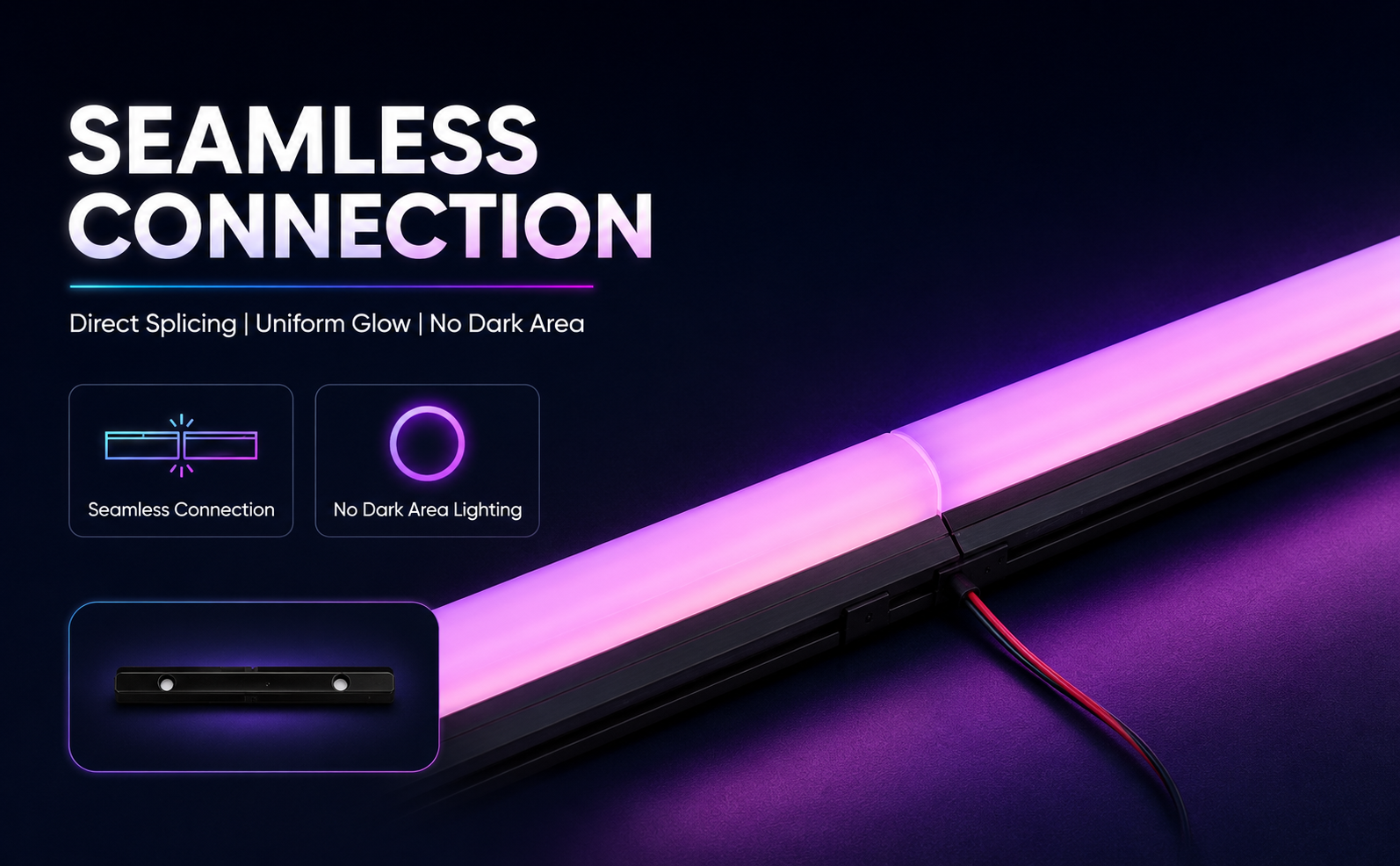
One vivid colour photograph cannot reveal low-level white appearance, visual changes at joints or abrupt scene transitions. A representative sample includes the intended connections, mounting orientation and controller, with everyday white, event colours and switching inspected separately. This product offers custom lengths; joint count and module layout affect the installation, so an isolated sample does not establish the appearance of a connected run.
Set the white scene's visual target first, tune the event colours second, then check transitions and restart behaviour. Investigate layout and connections for visible joint discontinuities, data mapping for wrong colour order, and supply paths when end-of-run changes follow load. This symptom-based acceptance method is more useful than repeatedly requesting a bright demonstration video.
A 25-group comparison: what does adding white change?
Hypothetical project: divide the decorative lighting into 25 independently controlled logical colour groups, directly controlling RGB or RGBW components without extra function channels. This is a control-planning example, not a claim that the product has 25 pixels or 25 cutting units.
| Option | Calculation | Purchasing implication |
|---|---|---|
| RGB | 25 × 3 = 75 | Three independently adjusted colours; no separate W component. |
| RGBW | 25 × 4 = 100 | 25 additional logical components, about 33.3%; controller and content must support them. |
If the 25 groups only need colour effects, the extra white component need not justify the purchase. If everyday white switches to event colours, a compatible four-component path becomes useful. The value 100 counts logical control values: it is not confirmed DMX channel consumption and cannot establish the length a controller can drive.
Choose by project condition
| Project condition | Decision basis |
|---|---|
| Merchandise or materials viewed close up | Set CCT, colour rendering and illuminance criteria separately from colour demonstrations. |
| An outline visible from multiple directions | Compare broad diffusion and test spill in the actual orientation. |
| Protected interior decoration | Accept white and colour scenes separately, retaining access to joints. |
| Rain-exposed or damp installation | Match fixture and connector protection; neither RGBW nor 24V establishes an IP rating. |
| Long installation route | Plan branches using scene load and loaded end voltage, not a distance promise based on voltage. |
| Existing controller retained | Test four-component output and colour order first; change the output path if incompatible. |
Product case: LIKELIGHT UCS2904 RGBW profile light
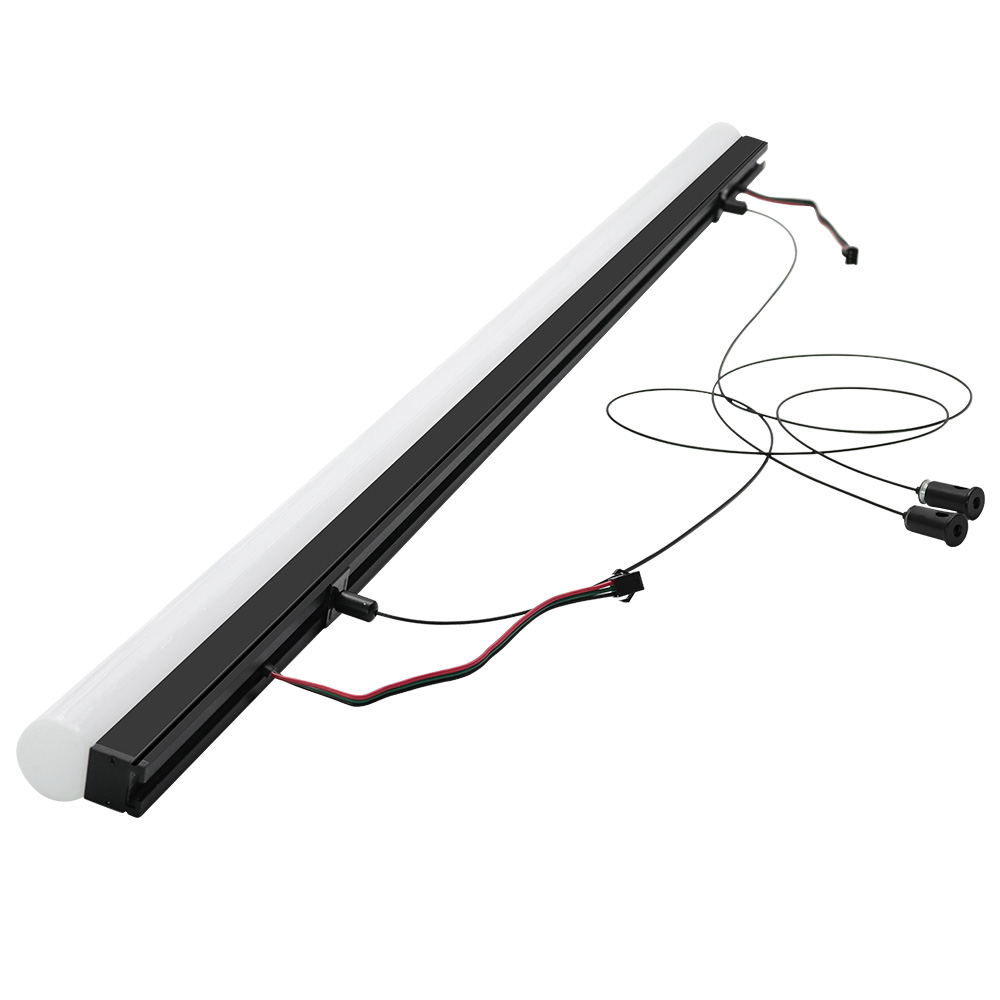
LIKELIGHT L-RD-2020 combines RGBW, a 24V supply, a UCS2904 digital IC and a 330 degree round diffusion design, with custom length options. Where a visible decorative line must provide everyday white ambience as well as event colours, it is a candidate for the scene tests above. Specifying lengths around actual architectural elements can also avoid compromises made to accommodate standard modules.
It is not a substitute for every lighting task. Precise wall washing, colour-critical merchandise and work-surface illumination require separate optical and photometric comparisons; outdoor installations also need the final protection configuration. Add the unpublished power, white CCT, colour-rendering and protection options to the quotation discussion without abandoning decisions that can already be made from the confirmed control and diffusion features.
| Parameter | Configuration |
|---|---|
| Model | L-RD-2020 |
| Colour configuration | RGBW |
| Supply | 24V |
| Digital IC | UCS2904 |
| Diffusion design | 330 degree round diffuser |
| Length | Custom options; defined by the ordered configuration |
Turn an enquiry into a project discussion
- Trading and event scenes: Explain the everyday white and event-colour targets to establish whether separate W control is useful.
- Element drawings and viewing positions: Show lengths, corners, nearby windows and sightlines to assess length configuration and distribution.
- Control and site environment: Provide the controller model, environment and connection plan to match output format, protection and sample tests.
Submit these inputs with the planned quantity so LIKELIGHT can evaluate length configuration, controller compatibility and a representative sample around the project, rather than quote only by metres of lighting.
Buyer questions
Is RGBW always worth more than RGB?
No. RGB can meet a colour-only decoration brief. Independent W control has value when everyday white is needed, but white-light quality still requires validation.
Can this light connect directly to a DMX console?
The published IC is UCS2904. Use a compatible control path supporting the required RGBW output; a digital IC name is not proof of native DMX support.
Does 330 degree diffusion make an entire wall uniform?
No. Distance, orientation and obstructions also affect the result. Broad diffusion primarily helps viewers see the luminous line from several directions.
What should be tested before a quotation is finalised?
Use the proposed controller to test R, G, B, W order, white at target brightness, joints and scene changes. For long routes, also measure load and loaded end voltage.
Technical source: Color Kinetics RGBW principle; not a test report for this model