


LED Pixel Lights or Continuous Lines for Stage Borders?
Every light works during the stage-border trial, yet the outline looks like a broken necklace. Insufficient brightness may not be the cause: the drawing shows a continuous line, but the order specifies separate light points. Conversely, a uniformly luminous line may miss the distinct chasing rhythm a show needs. Compare continuous lines and pixels at 200mm or 400mm centres before committing to quantities and power. The scope is a protected, dry indoor stage border.
Quick answer
- A complete outline: Start with a continuous diffused line. Denser pixels reduce gaps but do not guarantee a seamless appearance.
- Distinct chasing points: Choose independently controlled pixels, then compare 200mm and 400mm centres from intended viewing positions.
- Count before budgeting: Moving from 400mm to 200mm doubles fixtures and nominal load here, not automatically the visual benefit.
Choose a line or recognisable points first
A continuous line presents the outline as a whole; separate pixels divide it into positions for individual chases and rhythm. This compares luminous form, not whether either option is always brighter or cheaper. A continuous appearance does not preclude addressable control: that capability depends on the selected line's configuration.
For an unbroken luminous border, compare continuous diffusion first rather than treating extra pixels as the solution. If the artwork deliberately shows separate circles, compare spacing. Run the same sequence against the same background on both samples and judge from audience and camera positions, not close-up product photographs.
An 80mm body is not an 80mm pitch
This model has a published 80mm body diameter. Nominal straight-line geometry leaves approximately 120mm between bodies at 200mm centres and 320mm at 400mm. These are physical gaps, not measured luminous apertures. Closer spacing creates a denser sequence, but viewing distance, background and brightness affect perceived merging; neither gap establishes a seamless result.
Try 200mm where a nearer view needs a more complete dotted outline; compare 400mm where visibly separated large points create the intended rhythm. These are not fixed viewing-distance rules. Assess the whole border: if the 200mm sample still looks broken, reconsider a continuous line instead of adding points blindly.
What halving the pitch actually adds
For a uniformly spaced closed border whose length divides by the pitch, count N=L/p without counting the starting point twice. A 24m border needs 120 lamps at 200mm or 60 at 400mm. Using this model's published 2.88W gives 345.6W and 172.8W; theoretical aggregate current at 24V is 14.4A and 7.2A respectively.
The denser option adds 60 lamps and 172.8W of nominal load. Its value must come from a genuinely useful denser pattern, not treating quantity as quality. Aggregate current describes system scale, not approval for a single-end feed around the whole border. Branches, cables and connectors need separate design. Scene consumption and supply allowance are not included in these figures.
Count controlled positions, not LEDs inside a lamp
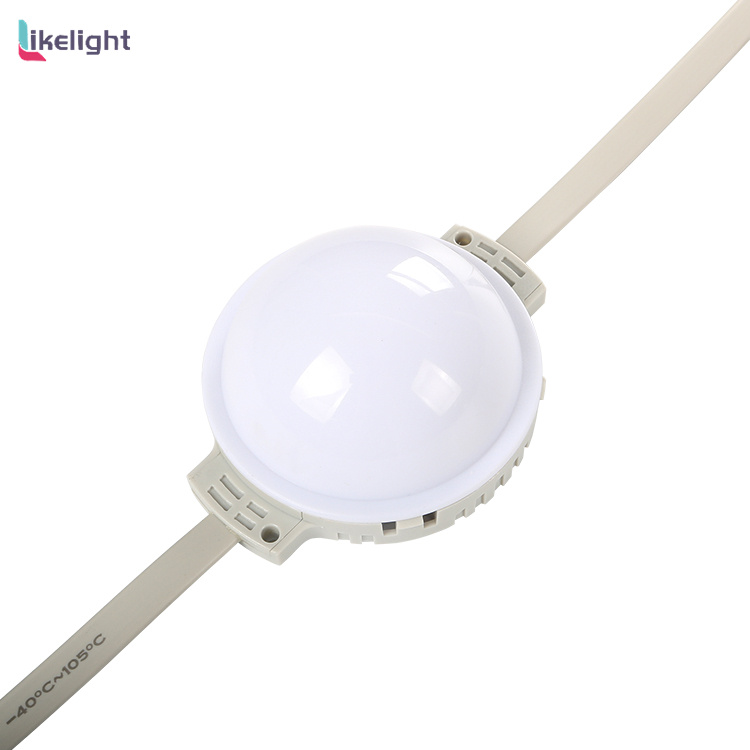
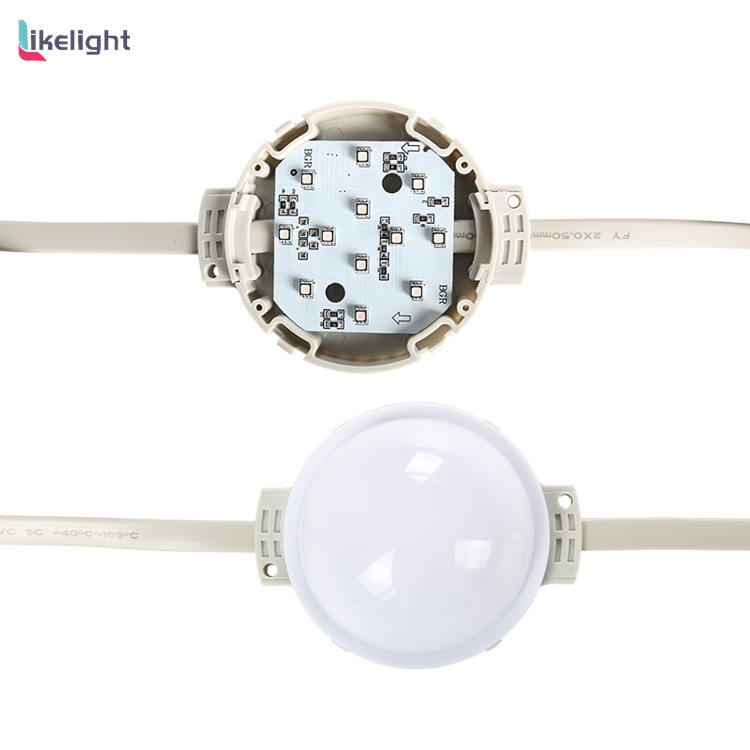
The page states individual pixel control, lists DMX and specifies 12 SMD3535 RGB LEDs per light. Those 12 LEDs are sources inside one fixture, not evidence of 12 independently programmable pixels. A 120-lamp border has 120 fixture positions to check, not 1,440 independent positions.
For a chase, test the sequence at the first point, each corner and the last point. Establish the supplied version's addressing, channel mode and controller compatibility before building the patch; DMX alone does not establish a fixed channel count. If the border only changes colour together, individual control may add commissioning without necessary visual value.
Resolve corners and cable routes before adding density
The page lists a standard 10cm connector length and offers customisation. Connector length is not centre pitch: fixture positions, mounting surfaces and cable paths determine whether the layout fits. Counting a 24m closed rectangle assumes each corner counts once, rather than counting endpoints of all four sides separately.
Mark centres, side lengths, corners and cable routes separately on the procurement drawing. Alongside appearance, both spacing samples should test corner placement and connector access for maintenance. Request custom leads against the actual route, not just a spacing number; this reveals whether density also adds harness and installation work.
One 8m by 4m border, three alternatives
Hypothetical example, not a completed project: a dry indoor stage has an 8m by 4m closed rectangle, perimeter 24m. Pixels have uniform centres, corners count once and mounting dimensions permit the pitch. Load uses this model's published 2.88W and 24V only, excluding controllers, supply losses and design allowance.
| Alternative | Quantity in this example | Nominal fixture load | When to favour it |
|---|---|---|---|
| Continuous diffused line | 24m luminous path | Calculate from the selected line's rating | A complete outline without clearly separate points |
| Pixels at 200mm centres | 120 lamps | 345.6W; 14.4A at 24V | The denser pattern's sample justifies extra fixtures |
| Pixels at 400mm centres | 60 lamps | 172.8W; 7.2A at 24V | Separate points for rhythm and individual chases |
This example cannot rank all three by a single value-for-money score. Choose a line for a continuous outline; compare density when points are wanted. The extra 60 lamps and corresponding power scale are justified only if the 200mm sample meaningfully improves the intended image.
Choose by the intended image
| Project condition | Preferred approach |
|---|---|
| An unbroken luminous border is required | Favour continuous diffusion; denser pixels do not guarantee continuity |
| Separate large points are intentional | Try 400mm first to avoid unnecessary density |
| The 200mm sample clearly suits the image better | Accept this example's 120 lamps and 345.6W nominal scale |
| An existing controller must chase individual points | Verify DMX version, addresses and order before mapping the sequence |
| Corners or connectors lack mounting space | Revise positions and routes before fixing the pitch |
| Rain or outdoor exposure is planned | Assess the actual protection version separately; this indoor example is not an outdoor design |
Where the LIKELIGHT 80mm solution fits
LIKELIGHT L-D-8012-35 combines an 80mm round body, 12 SMD3535 RGB LEDs, 24V supply and individual pixel control. For an indoor stage outline retaining recognisable circles and chases between positions, these features have specific purposes: the large point form expresses distinct dots and independent control provides rhythm. Neither makes it a naturally continuous line.
DMX alone is not a reason to replace continuous outlining, and 12 LEDs do not establish 12 independent pixels. Small letter strokes or borders that must look seamless up close should first be assessed with continuous alternatives. This article makes no outdoor protection recommendation for this model; rain-exposed installations need assessment against the actual supplied version.
| Parameter | Published information |
|---|---|
| Model | L-D-8012-35 |
| Body diameter | 80mm |
| Light sources per fixture | 12 SMD3535 RGB LEDs |
| Control | DMX listed; each pixel individually controlled |
| Supply and published rating | DC24V; 2.88W per lamp |
| Connector lead | Standard 10cm; customisation offered, not a pitch declaration |
Make the quotation match your border
- Target appearance: Provide a reference for a continuous outline or separate points to establish which alternative to quote.
- Border drawing and mounting dimensions: Identify open or closed routes, sides and corners to prevent double-counted fixtures.
- Sample pitch: Compare 200mm and 400mm before fixing quantity and nominal load.
- Controller and cable route: Provide model, effects and actual routing to assess DMX configuration and custom leads.
Send appearance, positions and connection routes together so quotations describe the same solution rather than only comparing lamp prices. Request both spacing samples before defining the bulk configuration.
Frequently asked questions
Will 200mm spacing always look continuous?
No. An 80mm body at 200mm centres leaves approximately 120mm of physical gap. Visual merging is not measured here; prioritise continuous diffusion for a seamless outline.
Do 12 LEDs mean 12 pixels?
No. The page states individual pixel control; the 12 SMD3535 LEDs are sources within one lamp. This article counts one independent fixture position per lamp, not 12 pixels.
Does a 10cm lead mean 10cm spacing?
No. The published dimension concerns the lead. Centre spacing also depends on placement and routing. Set positions on the drawing, then assess standard or custom leads.
Can 345.6W directly specify the supply and cabling?
No. It is the nominal sum of 120 lamps at 2.88W, excluding losses, allowance and branch design. The 14.4A total is not an allowable rating for an individual connector or cable.


