

13mm RGB Neon Flex: How to Choose LED Density, Voltage and Control Architecture
Two 13mm neon samples can look similar when switched off and require completely different electrical and control systems. A buyer who chooses only the highest LED density may still receive the wrong bend direction, a controller mismatch or a light line that does not improve at the actual viewing distance.
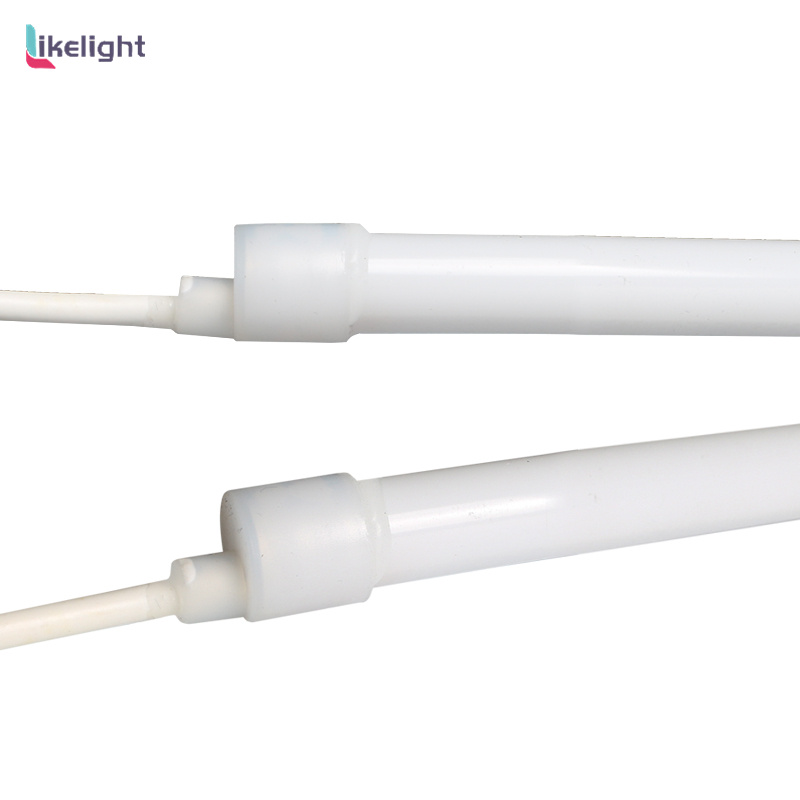
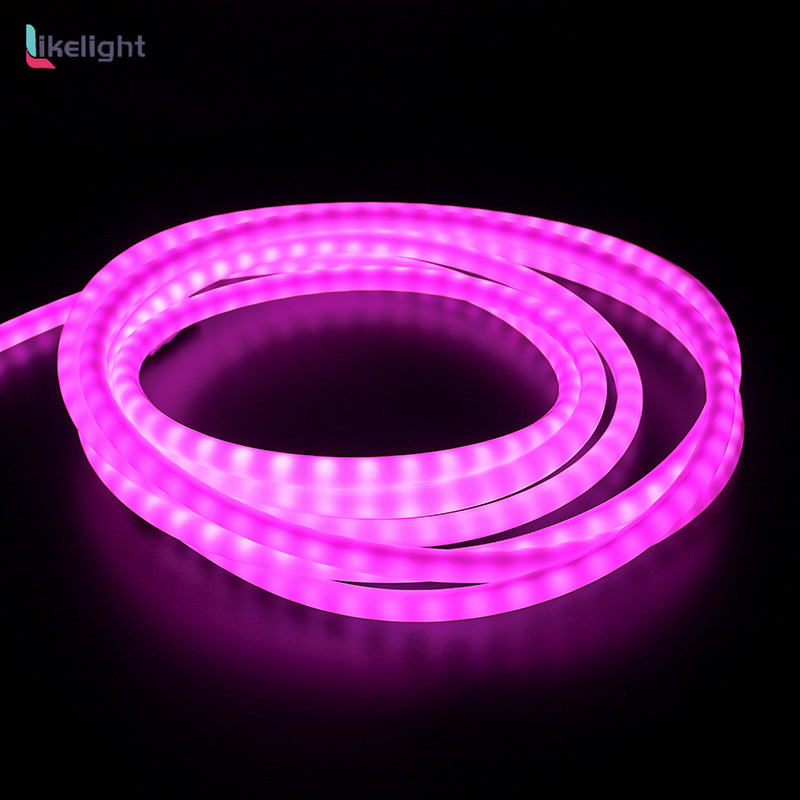
The LIKELIGHT L-NH-D13 page lists a 13mm silicone body, SMD5050, 30/60/72/90/120/144 LEDs/m, DC5V/DC12V/DC24V, 3000K/4000K/6000K, RGB or single-color versions, and UCS1903, WS2811 and DMX512 control options. Power, protection rating, bend direction, minimum radius and cut unit are not published, so they remain order-specific unknowns.
Published product facts
| Published item | Value |
|---|---|
| Model | L-NH-D13 |
| Body dimension | 13mm |
| Material | Silicone |
| LED package | SMD5050 |
| Density options | 30 / 60 / 72 / 90 / 120 / 144 LEDs/m |
| Voltage options | DC5V / DC12V / DC24V |
| Color options | 3000K / 4000K / 6000K / RGB / single color |
| Control options | UCS1903 / WS2811 / DMX512 and others |
| Working temperature | -20°C to +60°C |
| Not published | W/m, IP rating, bend direction, radius and cut unit |
Choose the visual task before the LED density
A static single-color outline, a smooth RGB wash and a moving pixel effect are three different tasks. Static identity lines prioritize color consistency and uncomplicated dimming; RGB zones need defined color mixing; pixel content needs a confirmed pixel grouping and compatible control architecture.
Viewing distance and silicone optics decide whether a smaller LED spacing remains visible. High density cannot correct a neon body installed with the wrong luminous face or bend direction. Approve the line on the actual channel, curve and background rather than comparing bare strips on a desk.
Translate 30-144 LEDs/m into nominal spacing
The published density options correspond to nominal LED spacings of about 33.3mm at 30 LEDs/m, 16.7mm at 60, 13.9mm at 72, 11.1mm at 90, 8.3mm at 120 and 6.9mm at 144. These numbers help compare potential line smoothness, but they are not cut lengths, pixel pitch, bend radius or a dot-free guarantee.
A distant contour may show little improvement beyond 60 or 72 LEDs/m, while a close shallow diffuser may justify testing 90, 120 or 144. The purchase decision should come from a side-by-side sample at the normal viewing distance, because silicone diffusion and color mode alter the result.
Do not mix single-color, cascade-pixel and DMX terminology
The page lists single color, RGB, UCS1903, WS2811 and DMX512 among version options. A single-color circuit is planned around circuits and dimming. UCS1903 or WS2811 versions are cascade pixels planned by pixel count, data direction, controller ports and mapping. A native DMX512 version is planned by channel mode, addresses and universes.
These architectures are alternatives, not interchangeable labels. Before sampling, freeze the required effect, exact IC or protocol, pixel grouping, connector pinout and controller. Do not describe every UCS1903 or WS2811 pixel as an individual DMX address unless an upstream system explicitly maps it into DMX or Art-Net.
Project selection table
| Project condition | Decision direction | Why |
|---|---|---|
| Static identity line | Evaluate single-color version | Avoid digital complexity when no animation is required. |
| Zoned color changes | Define an RGB control version | Freeze dimming/control interface before ordering. |
| Chasing pixel effects | Compare UCS1903 or WS2811 | Plan pixels, data direction, ports and mapping. |
| Native architectural DMX | Evaluate the DMX512 version | Plan actual channel mode, addresses and universes. |
| Close shallow diffuser | Test 90-144 LEDs/m | Smaller nominal spacing may improve the visible line. |
| Distant or deep profile | Compare 30-72 LEDs/m | Higher density may add cost without a visible gain. |
Voltage selection needs the missing W/m value
DC5V, DC12V and DC24V are published options, but the page does not provide a clean W/m value for each density and color/control version. Current, voltage-drop and power-feed calculations therefore cannot be released from voltage alone.
For equal power, a higher voltage normally uses lower current, but this general relationship does not prove a longer run for this model. LED density, PCB, pixel grouping, cable, connectors and effect content all change the load. Request the ordered version's W/m, then calculate circuit current and verify end-of-run voltage under the intended effect.
Treat 13mm as a body dimension, not a bend rule
The page confirms a 13mm silicone dimension and an operating range of -20°C to +60°C. It does not publish whether the ordered construction bends horizontally, vertically or in 360 degrees, nor a minimum radius, mounting profile or protection rating.
A project drawing should show luminous face, curve direction, corner transitions, cable exit and access. Do not borrow bend radius, cut length or IP values from another 13mm product: similar outer dimensions can contain different PCB orientation, extrusion and end treatments.
Where the LIKELIGHT L-NH-D13 options fit
L-NH-D13 can be evaluated for commercial contours, signage details, hospitality features and decorative linear work when a 13mm silicone format and one of the published color/control versions matches the design. Density choices let the mock-up balance line smoothness with circuit and procurement complexity.
It is not ready to specify from the web page alone for exposed outdoor work, a fixed maximum run, tight curves or a particular controller. Those decisions need the final power, protection construction, bend data, cut unit, pixel grouping and connection drawing for the selected version.
Suitable when
- Projects that can approve the luminous face and bend direction
- Static, RGB, cascade-pixel or DMX versions selected separately
- Density confirmed with a viewing mock-up
Re-evaluate when
- Orders that assume every option exists in one construction
- Power design without a confirmed W/m
- Outdoor or tight-radius claims borrowed from another 13mm product
Information to freeze before quotation
Provide total and zoned lengths, 13mm mounting detail, luminous face and bend direction, closest viewing distance, color or animation reference, preferred LED density, voltage infrastructure, required control architecture, controller model, pixel grouping, protection environment, cable exits, connectors, sample quantity and schedule.
LIKELIGHT can then compare the line appearance, circuit load, control mapping and installation construction as one project version. The quotation should identify the exact LED density, voltage, color/control option, W/m, cutting marks, bending rule and protection construction rather than relying on the family page alone.
- Lengths by zone and 13mm mounting detail
- Viewing distance and effect reference
- LED density and voltage preference
- Single color, RGB, UCS1903, WS2811 or DMX512 version
- Controller, pixel grouping and connection drawing
- Protection, cable exits, sample and schedule
Frequently asked questions
Does 144 LEDs/m guarantee a dot-free line?
No. Silicone optics, diffuser depth, color and viewing distance also control the result.
Are UCS1903 and DMX512 the same control method?
No. UCS1903 is a cascade-pixel option; native DMX512 uses address and channel planning.
Can DC24V be assumed to run farther?
No fixed distance is published. Confirm W/m, wiring and measured end voltage.
Is every L-NH-D13 version waterproof?
The page does not publish a protection rating, so the ordered construction must be confirmed.