


13×15mm RGBW Neon Flex: DMX512 or Cascade Control for Commercial Projects?
The same 13×15mm luminous profile can be offered with different voltage and control configurations, but those versions are not interchangeable. This guide compares DMX512 with UCS1903 or WS2811 cascade control using the published 60 LEDs/m, 14.2W/m and 71.42mm cutting data.
One neon profile can hide three different system decisions
A buyer may approve the 13×15mm appearance and later discover that the selected controller, addressing workflow or voltage does not match the delivered neon. RGBW describes the colour channels; it does not identify whether the data path is DMX512, UCS1903 or WS2811.
Start with who will commission the project and how zones will be mapped. DMX512 suits teams working with fixture addresses and professional lighting networks, while UCS1903 or WS2811 versions require a compatible cascade-pixel controller, data direction and pixel map.
Use section size, light direction and density together
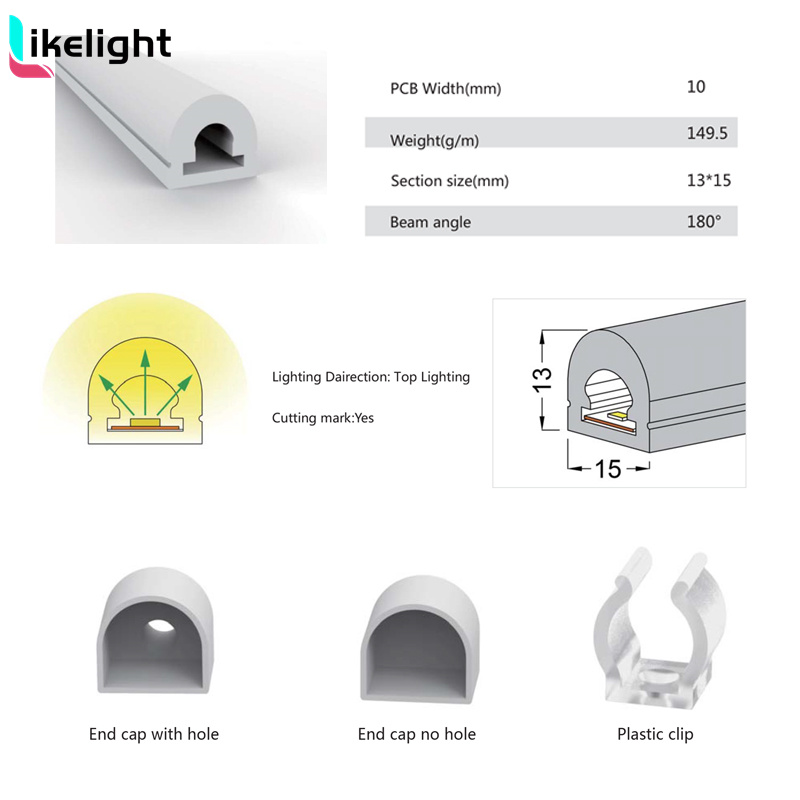
The page publishes a 13×15mm silicone section, 60 SMD5050 LEDs/m and a 180° beam angle; the grouped drawing shows top emission. A continuous-looking line therefore depends on mounting orientation, diffuser geometry, bend direction and viewing distance, not only LED count.
Sixty LEDs per metre means an average LED spacing of 1000 ÷ 60 ≈ 16.7mm. That is a density reference, not a promise that each LED is independently addressable. The ordered IC and grouping determine the actual control segment.
Calculate theoretical load before choosing voltage
Using the published nominal 14.2W/m, 5m represents 5 × 14.2 = 71W. The theoretical current is about 2.96A at 24V, 5.92A at 12V or 14.2A at 5V; these are comparison values, not measured installed consumption.
Lower voltage produces higher current for the same power, increasing the importance of conductor resistance, connector loss and injection planning. Divide a large layout into serviceable power zones and verify loaded voltage at the remote end with the final colour programme.
DMX512 and cascade control solve different workflow problems
With DMX512, planning centres on fixture addresses, channel mode, universe allocation and termination according to the supplied decoder configuration. With UCS1903 or WS2811, planning centres on pixel count, controller ports, data direction and mapping order.
Do not convert the published 71.42mm cutting unit directly into a DMX address count. It gives about 14 cut sections per metre, but the control segment may group LEDs differently. Freeze voltage, IC, pixels per metre, channels per pixel and cutting relationship on the sample label and wiring drawing.
The silicone body is not the whole outdoor system
The page publishes silicone material, but the current evidence does not state a product protection grade. Therefore this article does not assign an IP rating. Outdoor suitability must include end caps, cable exits, connectors, bonding method, drainage and site exposure in the approved sample.
The 13×15mm top-emitting profile also sets mechanical limits: use compatible clips or channels, avoid twisting the luminous face, and plan corners around the permitted bend direction. Confirm minimum bend radius and reel length for the ordered version because they are not published here.
Control and installation decision table
| Project condition | Decision |
|---|---|
| Professional DMX lighting network | Select the confirmed DMX512 version and freeze address/channel mode. |
| Cascade-pixel controller already selected | Match the ordered UCS1903 or WS2811 version, data direction and map. |
| Longer power zones | Prefer the voltage that keeps current manageable, then verify remote-end voltage. |
| Tight visual spacing | Use 60 LEDs/m and the 16.7mm density reference, then approve a lit sample. |
| Outdoor or wet location | Require a complete end-cap, cable and connector protection specification. |
| Frequent custom cuts | Use only the published 71.42mm cut positions and verify control grouping first. |
Where the LIKELIGHT L-NH-1315 case fits
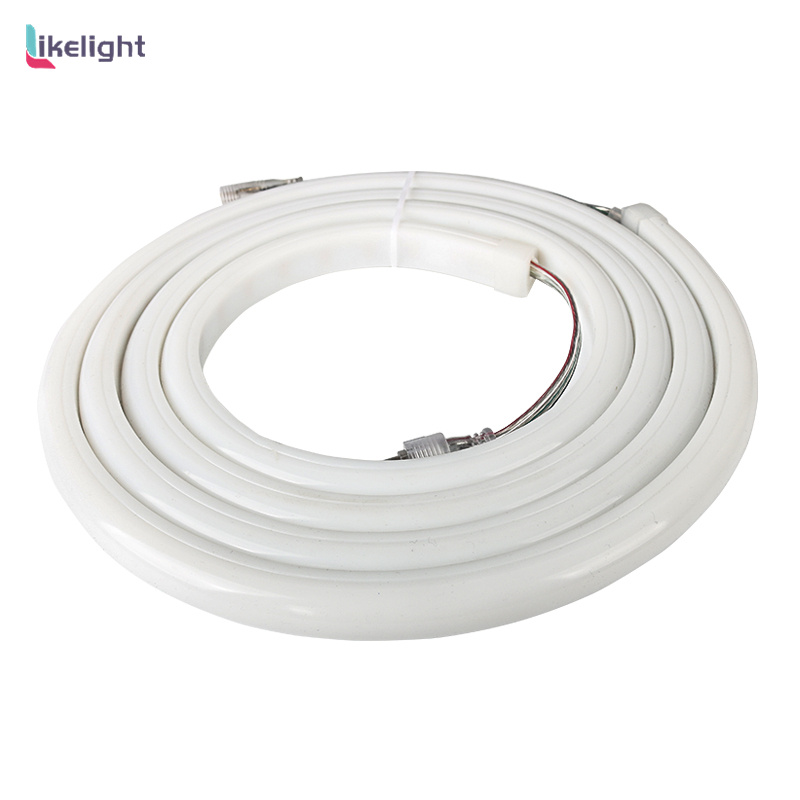
LIKELIGHT lists model L-NH-1315 with a 13×15mm silicone profile, SMD5050, 60 LEDs/m, RGBW options, 14.2W/m nominal power and 71.42mm cutting unit. The page lists DC5V, DC12V and DC24V versions plus UCS1903, WS2811, DMX512 and other control options.
This makes the product relevant to signs, theatres, clubs and commercial outlines that need a compact top-emitting RGBW line, provided the sample freezes one voltage and one control architecture. It is not suitable for a specification that leaves IC, pixel grouping, protection treatment or bend requirements undefined.
| Model | L-NH-1315 |
|---|---|
| Section and emission | 13×15mm silicone; top emission; 180° |
| LED configuration | SMD5050; 60 LEDs/m; RGBW |
| Published voltage options | DC5V / DC12V / DC24V |
| Published control options | UCS1903 / WS2811 / DMX512 / others |
| Nominal power and cut unit | 14.2W/m; 71.42mm |
Information to provide before quotation
- Total length and length of each luminous section
- Chosen voltage and control architecture
- Controller model and required addressing workflow
- Mounting drawing, bend direction and viewing distance
- Indoor or outdoor exposure and connection treatment
- Connector, lead direction, sample and delivery requirements
These inputs allow LIKELIGHT to evaluate control grouping, power zoning and connection details together, rather than treating a reel of neon as a complete installation system.
FAQ
Does RGBW automatically mean DMX512?
No. RGBW describes colour channels. The page offers DMX512 and cascade IC options, so the ordered control architecture must be named separately.
How many cut sections are there in one metre?
The published 71.42mm unit gives approximately 1000 ÷ 71.42 ≈ 14 physical cut sections per metre. It does not by itself define pixels or DMX addresses.
Can the product be specified as IP67?
Not from the current published evidence. Confirm the protection grade and complete connection treatment for the exact ordered version.
Why test the final animation under load?
RGBW channel mix changes actual demand. A loaded sample shows remote-end voltage, colour consistency and controller mapping more reliably than the nominal calculation alone.