


Whole-Facade Color or a Visible Outline? A First Buyer's RGB Wall Washer Guide
Imagine a shopping center that wants a broad brand-colored entrance wall but specifies lights only along the roof edge. The line might look bright while the wall stays dark. More brightness will not fix a mismatch between what must be lit and where the light goes. For a colored surface, compare RGB wall washers that project onto the wall; for a visible edge, compare outline lights; for moving individual points, compare point or confirmed pixel systems.
Decide what should carry the color
- Color the wall: Judge the field of color on the real surface from the main viewpoint, not from a picture of lit fixtures.
- Draw a line or points: An outline or point source makes the luminous object the image; neither colors an entire wall.
- Price the system: Compare mounting, power, control, wiring, commissioning and access as well as fixtures; DC24V alone does not establish total load.
For a first inquiry, send a daytime facade photo, desired night image, principal viewpoint and possible mounting positions. The buyer need not complete an optical worksheet before the supplier can sort the three categories.
1. Is the image a colored surface, a line or visible points?
A washer throws light onto the facade so the surface becomes the image. An outline light traces an eave or edge; point lights make separated luminous dots visible. RGB describes color mixing, not a promise that these jobs are interchangeable or that every LED is independently controlled.
Hide the fixtures in a reference picture and ask what should remain visible. If a broad entrance wall must retain a brand color, shortlist wall washing. If only an edge or dots remain, quote those categories. Fine text or point-by-point motion needs a confirmed pixel/display system, not an ordinary RGB washer.
2. Which parts of a large building actually need color?
A tall facade need not be colored from bottom to top. Mark the entrance, sign backdrop, corner and upper setback as visual zones, then decide which are seen from the plaza or street. Dark cladding, glass and walls broken by columns will not read as identical blocks of color.
Suppose only the entrance identifies a commercial building while the eaves need definition. Quote wash lighting for the entrance and outline lighting for the eaves. Expand color zones only if the owner truly wants a unified facade, and compare the added installed and maintenance cost zone by zone.
3. Why can two RGB proposals have different total costs?
A washer needs a surface and an unobstructed mounting position; an outline needs clean corners; visible points need locations and a program. Fixture unit prices compare poorly across these jobs. Use the same target image and include fixtures, brackets, power, control, joints, installation, commissioning and replacement access.
This candidate uses DC24V input, while its power entry still awaits a value. Compare the complete system first instead of guessing supply count from wall area. Once the offered version, length, power and circuits are known, quantities and electrical loads can be designed.
4. Should the whole facade change together or by zone?
RGB means colors can be mixed; it does not state a native control protocol, independent zone count or compatibility with a building controller. One facade changing to one brand color differs from an entrance, tower and corner changing independently. The latter needs a real fixture, driver, wiring and interface plan.
Write the scene plainly, such as 'entrance and main wall match; the corner changes separately'. Ask how the quoted configuration achieves it. The site's FAQ mentions ordinary RGB/PWM or conditional DMX integration; that does not establish native DMX or independent pixels for this model.
5. How do surface, viewpoint and maintenance change the choice?
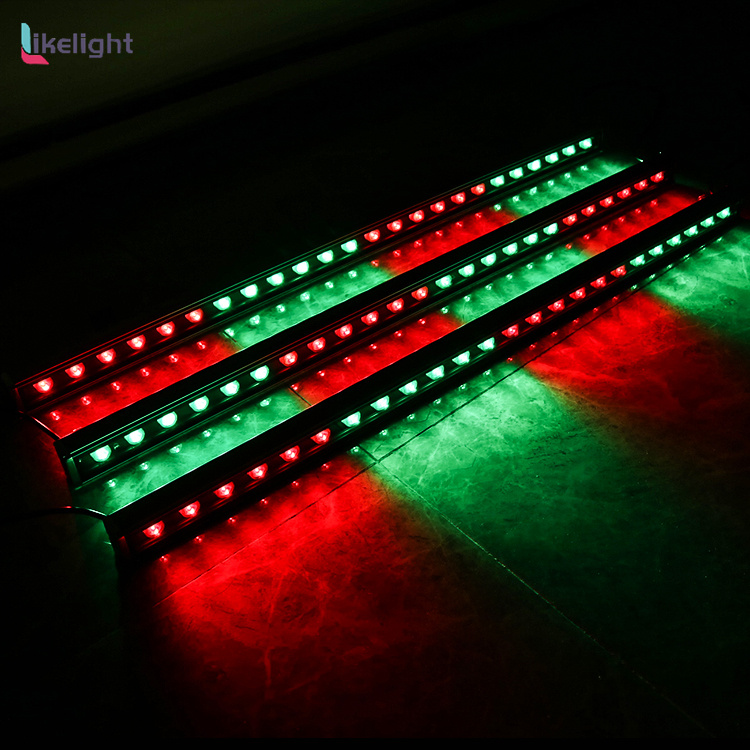
The same color appears different on a light matte wall, dark metal or glass. From the main viewpoint, ask whether the wall reads as one area; near the entrance, check exposed fixtures, glare and facade joints. Product photos show the fixture, not a verified uniform wash on this building.
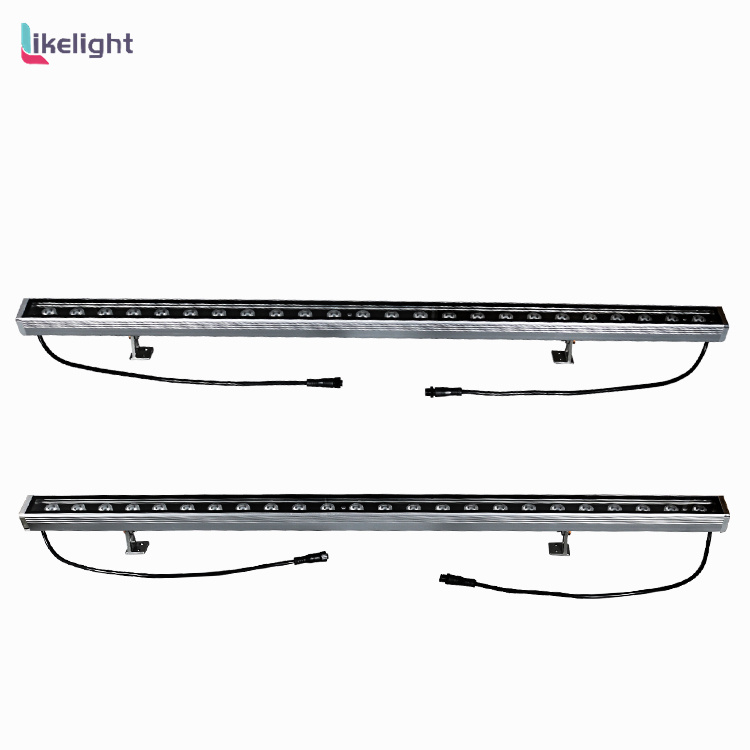
This candidate lists adjustable brackets, an aluminum-alloy and PC body, and IP65. Mounting position still determines whether light reaches the target wall; field joints, boxes and drainage belong in the installation plan. Where fixtures are hard to reach, price replacement access. Selected color zones may be better value than washing every elevation.
Hypothetical purchase: three night images for one mall
For this hypothetical mall, shortlist a washer for the entrance surface and an outline light for the eaves. Treat moving dots as a separate point-light brief. Once the jobs are separated, samples and quotes can be compared against the same intended image.
Hypothetical purchase: the same mall is viewed from across the street, with no fixed budget. Only the desired night image changes; no wall height, throw, fixture length, power or protocol is assumed.
This compares categories, not a completed project or product performance test
-
Entrance wall in brand color
First category
RGB wall washerWhy
Color must fall on the wall, not merely on a lit bar.What to compare next
Compare actual wall material, viewpoint and available mounting places. -
A bright line on eaves and corners
First category
Outline lightWhy
The buyer wants a line, not a colored wall.What to compare next
Compare corner continuity and service access. -
Separated dots or moving point graphics
First category
Point light or confirmed pixel systemWhy
Individual luminous positions are essential; RGB alone does not supply them.What to compare next
Obtain point layout and control details before pricing effects.
Choose by the intended night view
| Project condition | First direction |
|---|---|
| A broad wall color should be visible from afar | Compare a washer's color field on that surface from the intended viewpoint. |
| Fine graphics or independently moving dots are required | Compare a confirmed pixel or point-light system instead of assuming RGB is point control. |
| Only a visible eave or entrance line is required | Price an outline light first; do not buy unneeded wall coverage. |
| Rain exposure and field wiring are involved | Design joints, boxes, drainage and access separately from the IP65 fixture body. |
| The building is large but branding sits at the entrance | Quote entrance wash plus outline elsewhere before pricing a whole-building wash. |
| Several zones must change independently | Require an achievable zoning and interface plan for the exact configuration offered. |
Where does this LIKELIGHT candidate belong?
LIKELIGHT L-W-10024RGB-24V is a DC24V RGB IP65 wall-washer candidate for building facades and landscape decoration. The page also lists an aluminum-alloy and PC body and adjustable brackets. These facts justify initial screening when the purchase is for coloring a wall and light can reach it from a feasible mounting place; they do not guarantee a complete building effect.
Do not substitute it for a project that needs only a luminous edge or assume point graphics before the control configuration is known. 'Wide wash' is descriptive, not a usable beam angle, width or fixed throw; power remains a placeholder. Ask for the offered version, photometric information, dimensions and system wiring, then judge the night image on the real or comparable wall material.
| Item | What it means for buying |
|---|---|
| Model and application | L-W-10024RGB-24V; RGB candidate for facades and landscape decoration. |
| Color and input | RGB; DC24V. Neither proves native DMX or point control. |
| Body and mounting | Aluminum alloy + PC; adjustable brackets. Check space against drawings. |
| Fixture protection | IP65; field joints, boxes and drainage need their own design. |
| Missing design inputs | Power is a 'please specify W/pc' placeholder; 'Wide wash' gives no calculable angle. Neither fixture nor supply count follows from them. |
Four inputs for a useful first quote
- Desired imageSay whether the wall should change color, an edge should glow or points should be visible; this selects the category.
- Wall and photosSend a daylight image, surface finish and night reference; these define the zones worth coloring.
- Viewing and mountingMark principal viewpoint and accessible mounting locations; they affect direction and installed cost.
- Purchase scopeGive approximate zones, destination country and an existing controller if any; request the exact configuration and full system quote.
Ask LIKELIGHT to return the exact SKU and available options, dimension/bracket/wiring drawings, and a complete BOM and system quote covering fixtures, mounting, power, control, joints and commissioning. If the direction fits, request a representative sample with viewing and wall-surface comparison points, plus spare parts, replacement method and lead time. These outputs make alternatives comparable without asking a first-time buyer to complete a technical worksheet.
First-buyer questions
Can a washer replace a line along the eaves?
If only a crisp visible edge is needed, compare outline lighting first. A washer earns its place by coloring the wall surface.
Does IP65 settle all outdoor connections?
No. The page identifies the product's rating; field joints, cable exits, boxes and drainage need a plan for their exposure.
Can the page tell us how many units and supplies a building needs?
No. Power is a placeholder, and length and calculable photometry are insufficient. Define target zones, then obtain data for the quoted version.
Can a pleasing product photo authorize a whole-building order?
A lit fixture photo does not prove the effect on the intended wall. Use a sample to check wall and viewpoint, but also compare the complete system proposal.
A short message to LIKELIGHT
We are lighting [building/project]. The intended night image is [colored entrance wall / outlined eaves / visible points]. The main viewpoint is [ ], feasible mounting and service access are [ ], and target zones and destination country are [ ]. We attach daytime facade photos and a night reference. Please advise whether this RGB washer fits and quote the exact fixtures, mounting, power, control and connections as a system.