


20mm Wide COB Strip: Specify Heat, CCT and 30W/m Power Before Installation
A wide COB line can improve luminous coverage, but its 30W/m load, 20mm profile fit, CCT choice and IP20 boundary must be resolved together. This guide turns the published values into a buyer decision.
The buyer problem is not dots alone
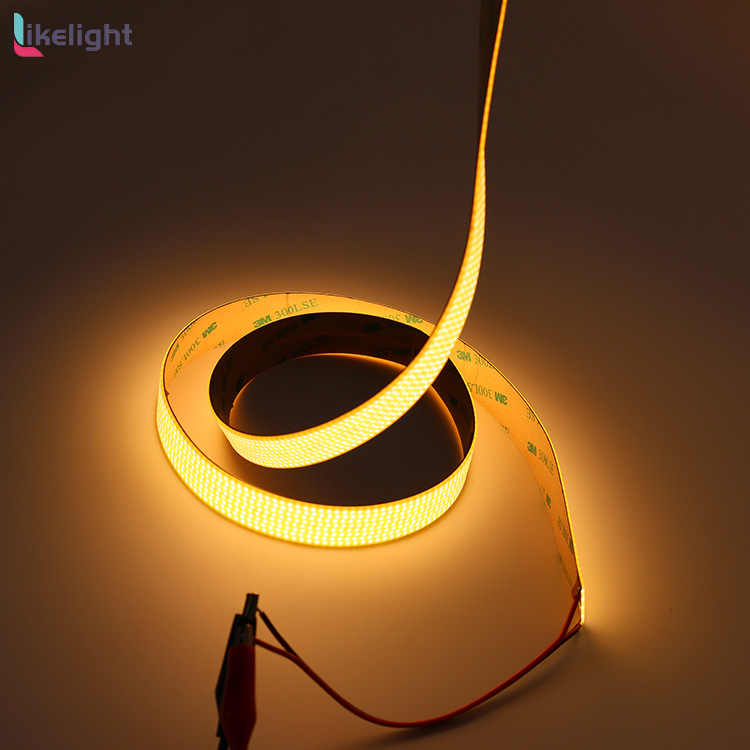
COB construction can create a broad continuous-looking luminous surface, but a project can still fail through the wrong colour temperature, insufficient heat transfer or a channel that is too narrow for the 20mm board.
Decide whether the task is a visible luminous line, indirect cove or high-output task light. The 180° beam spreads broadly, so glare control, diffuser depth and surface reflectance must be judged in the final section.
Treat 20mm width as a system dimension
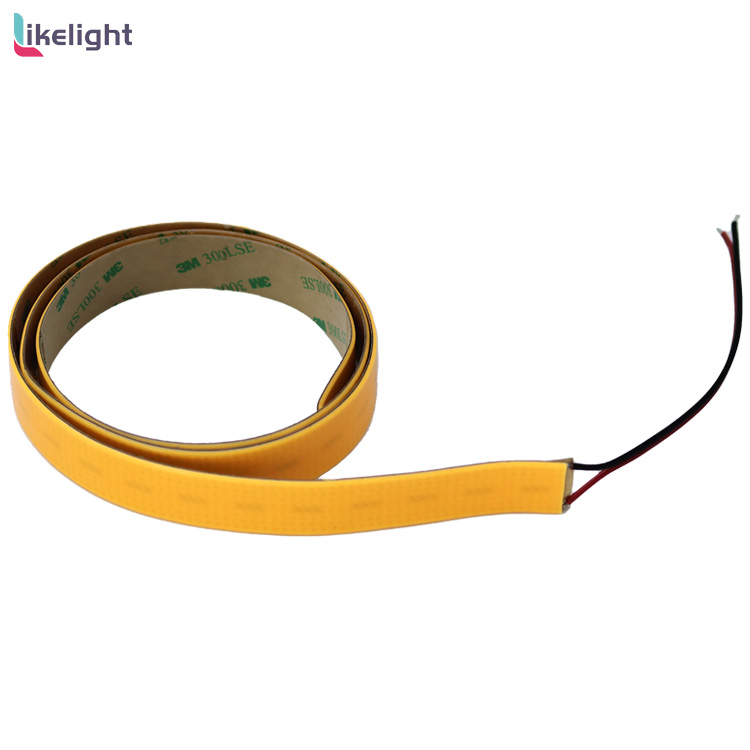
The published 20mm width is wider than many common strip channels. Check the internal channel width, solderless connector envelope, bend route and end access instead of assuming a nominal 20mm profile will fit.
The title lists 3072 LEDs, but the local page evidence does not unambiguously establish the quantity basis. Do not calculate pitch or cut interval from that number; use the final datasheet and sample marks.
Thirty watts per metre is also a thermal decision
At DC24V and 30W/m, nominal current is 30W ÷ 24V = 1.25A/m. An illustrative five metres equals 150W and 6.25A.
These are theoretical rated values. Actual demand depends on dimming and supply losses, while safe installation also depends on how the profile transfers heat from the flexible board.
Plan feed zones and thermal contact together. Measure remote-end voltage and operating temperature in the final profile at the intended duty level; the five-metre calculation does not approve one continuous feed.
Select CCT by material and task, not by preference alone
The page lists 2700K, 3000K, 4000K and 6000K, plus red, blue and green versions. Warm choices suit hospitality materials; neutral 4000K supports clearer task contrast; 6000K creates a cooler technical appearance.
Ra≥90 is published, but colour quality and CCT must be confirmed for the exact ordered version. Approve samples against stone, wood, merchandise or work surfaces rather than comparing loose illuminated reels.
IP20 defines a protected indoor boundary
IP20 does not protect against water. Keep the strip and its joints in a dry protected interior, and prevent cleaning water, condensation or exposed conductive contact.
A profile can improve mounting and thermal management but does not automatically change the strip rating. If moisture is possible, select a separately published protected product and validate its connectors and ends.
Wide COB specification table
| Project condition | Required proof |
|---|---|
| Wide visible luminous line | Use 20mm only after checking channel and diffuser fit. |
| Hospitality wood or warm finishes | Compare 2700K and 3000K on the actual material. |
| Task or display lighting | Evaluate 4000K and Ra≥90 on a working sample. |
| Five-metre load comparison | Start from 150W and 6.25A; do not infer one-feed approval. |
| Tight enclosed profile | Reject until thermal contact and temperature are tested. |
| Wet or condensing location | Do not use the IP20 strip as an exposed solution. |
LIKELIGHT case: approve one complete channel section
LIKELIGHT L-S-COB-DC24V-20mm publishes DC24V, 30W/m, 20mm width, 180°, Ra≥90, 2700K/3000K/4000K/6000K and IP20; red, blue and green are also listed.
It fits wide indoor coves, display details or luminous panels where the profile can dissipate the 30W/m load. It is not a direct wet-area choice, and production should follow only after CCT, channel fit, thermal test and feed zoning pass together.
| Model | L-S-COB-DC24V-20mm |
|---|---|
| Electrical | DC24V; 30W/m; 1.25A/m nominal |
| Width / optic | 20mm; 180° |
| White options | 2700K / 3000K / 4000K / 6000K |
| Colour quality | CRI Ra≥90 published; red, blue and green also listed |
| Protection / density note | IP20; title lists 3072 LEDs but quantity basis needs final confirmation |
Information required before quotation
- Application, visible line and target illuminance
- Channel internal size, diffuser and mounting surface
- Selected CCT or colour and material samples
- Total and zone lengths, dimming and duty level
- DC24V supplies, feeds, cables and thermal path
- Environment, connector/end method, sample and schedule
These inputs combine luminous width, colour-temperature approval, DC24V load, thermal profile and IP20 environment into one tested channel section that production can reproduce.
FAQ
Will a 20mm strip fit a 20mm channel?
Not necessarily; internal clearance and connector width must be checked.
What is the nominal current per metre?
30W/m ÷ 24V equals 1.25A/m.
Does Ra≥90 select the right CCT?
No. Rendering quality and colour temperature answer different decisions.
Can IP20 be used in a bathroom?
Not where moisture or cleaning water can reach the strip or joints.


