

C9 Pixel Strings for a Commercial Roofline: How Far Do 50 Lights Reach?
A roofline measures about six metres, and the buyer wants C9 points spaced 12 cm apart. Fifty lights sound like an exact fit, until the last bulb stops before the corner and the connector lands in full view. Count the positions of the illuminated points first; plan the cable ends and power separately.
Quick answer
- Lit span: If the buyer specifies 12 cm spacing, 50 points have 49 internal intervals, or 5.88 m between the first and last light centres; that is not overall cable length.
- Initial load: At the listed 0.3 W per point, 50 lights total 15 W, about 1.25 A at DC12V. This does not establish a permitted feed length.
- Replacement fit: This is a low-voltage GS8208 RGB pixel string, not a stated screw-in replacement for existing mains C9 sockets.
Send the roofline elevation, requested point spacing and desired effect for an initial point plan; ask for a joined sample before confirming the order.
Do you need a C9 outline or individual animation?
A conventional C9 outline can stay one colour, while a pixel string makes each bulb a position in a chase. The LIKELIGHT page identifies independent points, GS8208 control and DC12V RGB LEDs.
Choose pixel control when the design actually calls for movement along the roofline. For a steady row, compare a simpler C9 system before paying for a controller.
What would 50 lights at a requested 12 cm cover?
Fifty light centres create only 49 spaces between the first and last. If the buyer specifies 12 cm spacing, 49 × 0.12 m = 5.88 m of internal centre-to-centre span. Lead wires and connectors are outside that calculation.
Mark the first and last light on the elevation. Ask for lead and tail dimensions before treating a string as a finished installed length; a different ordered pitch changes the answer.
How much electrical load belongs in the first quote?
The page lists 0.3 W per light at DC12V. Fifty points therefore total 15 W of listed lamp load and a calculated 1.25 A. A hundred points total 30 W and about 2.5 A before supply losses or headroom.
Use those numbers to start circuit sizing, not to approve one-end feeding or a number of joined strings. Cable and connector resistance, feed positions and loaded end voltage determine the final layout.
Will the existing controller and C9 sockets work?
GS8208 sends pixel data along the string in order; the page does not say that each point owns a DMX address. Its C9 name describes the bulb shape, not an E17 socket, mains supply or controller interface.
For a retrofit, record the existing socket and voltage. For animation, send the controller model, output connection, point order and desired scene so compatibility can be checked on a sample.
What happens at the joint outdoors?
The product page lists IP67 for the light and separately describes IP68 connectors at both ends. Those are component statements; field mating, end closure, strain and drainage affect the installed assembly.
Measure the spacing across a joined pair and place the connector where it can be serviced without collecting water. Do not promise an even 12 cm rhythm across a joint before testing it.
Worked roofline decision: 50 or 100 points
Two 50-point strings give the required point count, but do not approve the 11.88 m layout until the centre distance across their joined connector is measured. If it differs, move the joint to a corner or revise the point plan.
Hypothetical straight run: the buyer requests 11.88 m between first and last light centres and 12 cm between adjacent points. The 12 cm pitch is an RFQ input for this example, not a guaranteed supplied dimension; the joint gap is unknown.
Published C9 configuration
-
One 50-point string
Lit-centre span
At requested 12 cm pitch, 50 points form 49 intervals: 49 × 0.12 m = 5.88 m between light centres.Listed lamp load
50 × 0.3 W = 15 W; 15 W ÷ 12 V ≈ 1.25 A. -
Two 50-point strings
Lit-centre span
11.88 ÷ 0.12 = 99 intervals, so 100 points would be needed if the joint also keeps 12 cm.Listed lamp load
100 × 0.3 W = 30 W; 30 W ÷ 12 V ≈ 2.5 A.
When to choose each route
| Buyer condition | Next decision |
|---|---|
| Need a chase along the roof | Shortlist the 12V GS8208 C9 pixel string and check controller output and point order. |
| Need only a steady row | Compare a non-pixel C9 solution; individual data control may add no value. |
| Last lamp must meet a corner | Draw light centres; at a requested 12 cm pitch, use 49 intervals, not 50, for 50 points. |
| Joint lies on a visible straight | Measure the joined centre gap, then hide the joint or change the segment boundary. |
| Replacing bulbs in existing sockets | Do not order this string as a direct substitute before socket, voltage and mounting checks. |
| Long-term outdoor exposure | Review the mated connector, tail, drainage and service access as well as the listed light IP rating. |
Where the LIKELIGHT C9 string fits
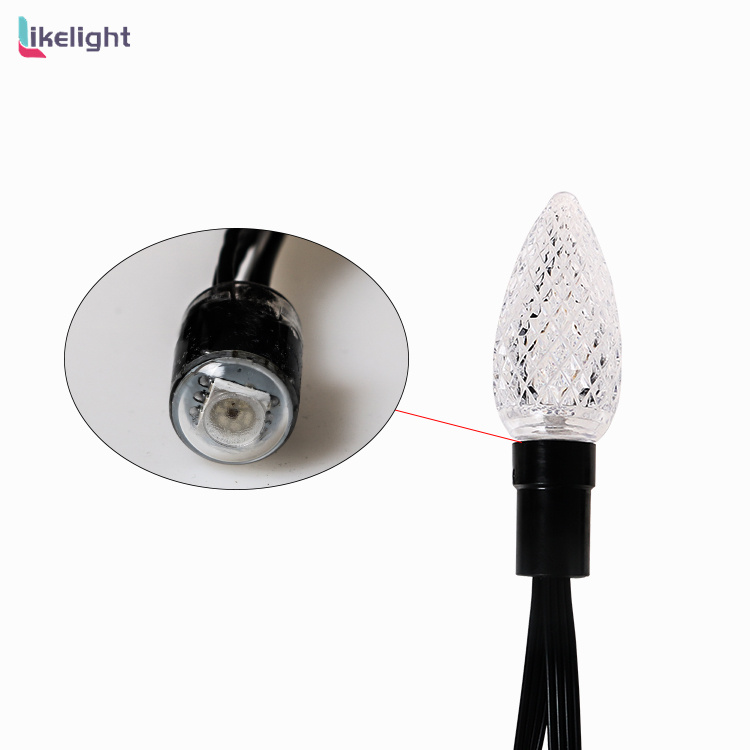
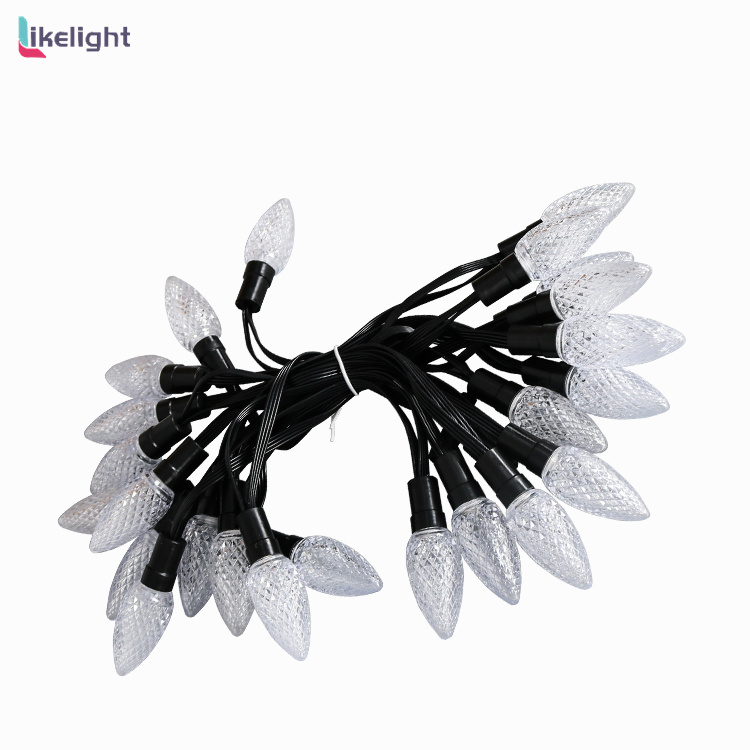
The current page lists model L-C-C9-8208: 23 mm RGB C9 points with one SMD5050 LED each, GS8208, DC12V, 0.3 W per point, a 270° angle and IP67 for the light. It lists 50 points per string or customization. The 12 cm pitch above is the buyer's example input and must be confirmed for the order.
It fits a roofline or festive installation that needs a familiar bulb silhouette and individual colour movement. It is not proof of overall string length, socket interchangeability, controller capacity or maximum feed distance. A short joined sample can settle appearance and the joint gap before a bulk quantity is fixed.
| Parameter | Page value |
|---|---|
| Point form | 23 mm C9; one RGB SMD5050 LED |
| Control and voltage | GS8208; DC12V |
| Listed consumption | 0.3 W per point |
| String quantity | 50 points per string or customized |
| View and light protection | 270°; IP67 light body |
| Ends | Page separately describes IP68 waterproof connectors |
What to send for a useful quote
- Roofline drawingGive straight lengths, corners and the desired first/last light positions; this determines point count.
- Effect and controllerState whether you need a chase and name the controller, if already selected; this decides data compatibility.
- InstallationShow the existing socket or fixing method and outdoor exposure; this determines whether a joined sample and connection detail are needed.
These three inputs let LIKELIGHT quote a point arrangement and connection plan rather than guessing from a nominal string length. A useful LIKELIGHT quotation should return the exact SKU and valid pitch/quantity options; dimensional and wiring drawings; a BOM including controller, power supplies, cable and connectors; a complete installed-system quotation; a joined sample plan and acceptance points; spares and lead time.
Frequently asked questions
Is a 50-light string exactly six metres?
No. If the buyer orders 12 cm spacing, 49 internal gaps add to 5.88 m between the first and last light centres; cable ends are additional and unspecified here.
Will two strings keep 12 cm at the joint?
That cannot be inferred from the page. Measure a joined sample or use an approved drawing.
Does 30 W mean 100 lights may use one feed?
No. It is the listed lamp-load estimate; cable losses, supply margin and loaded voltage still need a circuit design.
Does IP67 cover the whole installed run?
No. Mated connectors, tails and drainage need an installation-specific check.
Copy-ready roofline inquiry
Please quote L-C-C9-8208 for a commercial roofline. Straight runs and corners: [ ]. Requested spacing and first/last light positions: [ ]. Desired RGB effect and existing controller: [ ]. Destination country: [ ]. Please return the exact SKU and option matrix, point and connection drawing, wiring and controller plan, full system BOM and price, representative joined sample proposal with acceptance points, spares and lead time.