


35mm UCS1903 Pixel Light: Freeze the 12V/24V Power Version Before Circuit Design
The page lists two voltages and two power values without pairing them. Keep the load as a 1.44-2.16W range per point, then freeze the approved voltage-power version before calculating current, circuits and controller commissioning.
The commercial risk is not choosing 12V instead of 24V. It is releasing drawings, cable sizes and power supplies before one approved sample establishes which published power value belongs to the ordered voltage version.
Published product facts
| Published item | Value |
|---|---|
| Model | L-D-359-N12V/24V |
| Point format | 35mm full color ICRGB |
| Control IC | UCS1903 |
| Voltage options | DC12V / DC24V |
| Listed power values | 1.44W / 2.16W; version pairing not published |
| Protection | IP66 |
| Operating temperature | -40°C to +60°C |
| Published documents | CE and RoHS |
| Warranty | 2 years |
Use a configuration-freeze gate before electrical release
Treat the web page as a list of available characteristics, not as a complete version matrix. The purchase specification needs one line that binds model, voltage, measured sample power, connector pinout and controller file.
A drawing can proceed with a load envelope, but procurement should not release cable gauges, supply quantities or branch protection from an assumed pairing. Record the measured full-output load of the approved sample and make that record the reference for production inspection.
| Release gate | Evidence required |
|---|---|
| Concept layout | 35mm body, proposed pitch and viewing-distance mock-up |
| Electrical budget | 144-216W per 100 points as an unpaired planning range |
| Golden sample | Approved voltage, measured load, pinout and color order |
| Bulk release | Production label and branch test match the golden sample |
Do not turn two voltage and two power entries into an invented matrix
The page identifies model L-D-359-N12V/24V, UCS1903 control, DC12V/DC24V choices and 1.44W/2.16W values. It does not publish a row saying 12V equals one power and 24V equals the other, so neither association is a confirmed product fact.
The order freeze should therefore name the exact voltage and record the sample's measured load under the agreed test pattern. Voltage selection affects current and cable loss; it does not by itself prove brightness, pixel spacing or animation quality.
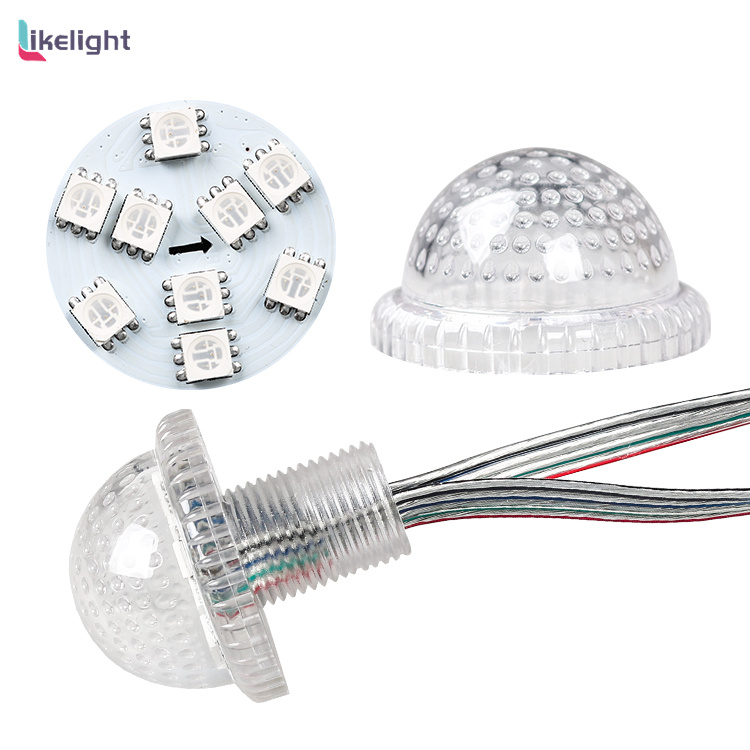
Use four boundary calculations to expose the decision, not to guess the version
For 100 points, the published values create a 144-216W envelope. The four mathematical boundaries are 12-18A at 12V and 6-9A at 24V. These are scenario limits from P ÷ V, not claims that any one boundary is the shipped configuration.
This envelope is useful for reserving cabinet space and comparing circuit strategies. Final fuses, cable cross-section, injection points and supply loading must use the approved sample value plus cable and connector losses, followed by an end-of-branch voltage test under the intended effect.
Plan UCS1903 as a cascade-pixel system
UCS1903 indicates cascade-pixel control. Plan pixel count, data direction, output-port allocation, mapping order and branch layout; do not describe each point as requiring an individually set DMX address unless the upstream controller explicitly maps the pixels into DMX or Art-Net channels.
A control segment is not automatically a cutting or removable unit. For a point-light system, serviceability depends on connectors, branch boundaries and physical access. Confirm the controller, signal output, pinout and replacement method on the released wiring drawing.
Treat IP66 as one part of the outdoor installation
The page publishes IP66 for this model and an operating range of -40°C to +60°C. Those facts support evaluation for exposed ride and sign applications, but they do not automatically qualify every field connector, branch joint, cable exit or power enclosure.
Plan cable strain relief, connector orientation, drainage, vibration clearance and access to replace a point without dismantling a large panel. The page also lists CE, RoHS, a 50,000-hour value and a two-year warranty; certification documents and warranty scope should correspond to the final ordered configuration.
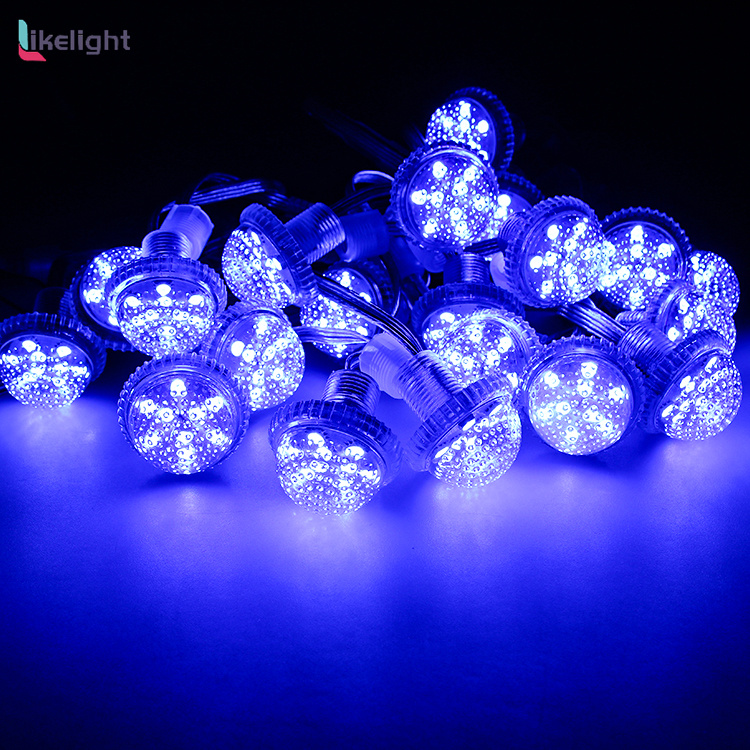
Start with viewing distance, not the 35mm body size
The 35mm dimension describes the point-light body, not the installation centre pitch. A 50mm pitch creates 20 points per linear metre, 75mm creates about 13.3, and 100mm creates 10; these are layout scenarios for mock-up comparison, not published mounting rules.
Closer spacing can make curves and letters read more smoothly at short range, but it also increases point count, data load, connectors and service work. Distant ride outlines may accept a wider pitch. Test a representative section against the actual background and normal viewing path before freezing the drilling pattern.
Where the LIKELIGHT 35mm RGB point light fits
Model L-D-359-N12V/24V can be evaluated for amusement-ride outlines, letter signs, logos and decorative point arrays that need visible full-color nodes and UCS1903 cascade control. The 35mm format offers a smaller point than large fairground bulbs, which can help tighter curves when the tested centre pitch and viewing distance support the design.
It is not the first choice for a continuous neon-like line, very high-resolution video or a project that cannot provide access to branches and connectors. Those applications should compare neon flex, a denser pixel format or a serviceable modular structure rather than relying on point count alone.
Suitable when
- Visible RGB nodes for rides, logos and exposed-letter layouts
- Projects that can zone power and data branches
- Layouts where a 35mm point is verified by a mock-up
Re-evaluate when
- Continuous neon-like light lines
- High-resolution video surfaces
- Installations with no access to connectors or branches
Information to send before quotation and sampling
Provide the ride or sign drawing, point quantity by zone, proposed centre pitch, closest viewing distance, target animation, DC12V or DC24V system preference, controller model, branch layout, connector direction, outdoor exposure, maintenance access, sample quantity and schedule.
These inputs let LIKELIGHT evaluate the point rhythm, total load range, data mapping and service zones together. The approved sample should record the exact voltage-power pairing, pinout, controller file and protection details before bulk production.
- Ride, sign or logo drawing
- Point quantity and centre pitch by zone
- Viewing distance and animation reference
- DC12V or DC24V system preference
- Controller, mapping and branch plan
- Connector direction, exposure, sample and schedule
Frequently asked questions
Does a 35mm light require 35mm centre spacing?
No. The housing size and centre pitch are separate; verify fixing clearance and visual rhythm.
Can the current be calculated from the page?
Not yet, because the page does not map 1.44W and 2.16W to the DC12V and DC24V versions.
Is UCS1903 the same as DMX512?
No. UCS1903 is cascade-pixel control; DMX or Art-Net only applies when an upstream system maps the pixels.
Does IP66 cover every field connection?
No. Joints, cable exits, branches and enclosures require their own complete protection plan.