


60mm E14 RGB Cabochon Retrofit: Verify Socket, Load and Control First
A 60mm cabochon can fit an opening yet remain electrically or operationally incompatible with an existing amusement-lighting field. This guide uses the published DC24V, 4.32W, 18-LED and IP66 facts to plan a controlled retrofit sample.
Why matching diameter and socket is not enough
Retrofit problems often appear after the lamp physically fits: the old circuit may use another voltage, pin arrangement, data method or common return. A 60mm face and E14 thread only resolve part of the interface.
Document thread engagement, panel thickness, rear clearance, cable exit and connector keying. Then trace the existing power and data conductors before energising a mixed old-and-new field.
Separate the luminous face from the control resolution
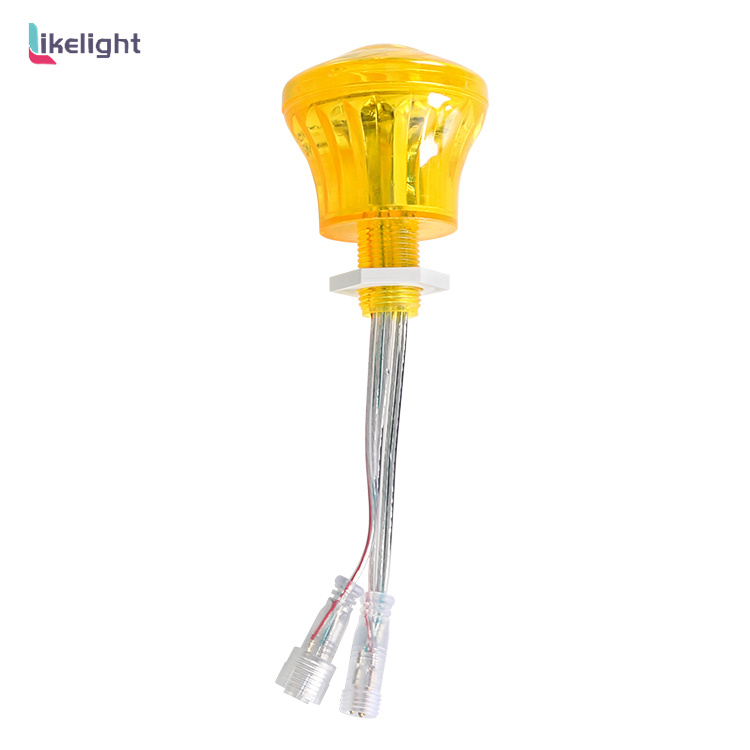
The page lists a yellow-cover 60mm housing with 18 SMD5050 LEDs and RGB output. The 18 emitters form the light engine inside one point; they do not prove 18 independently controlled pixels.
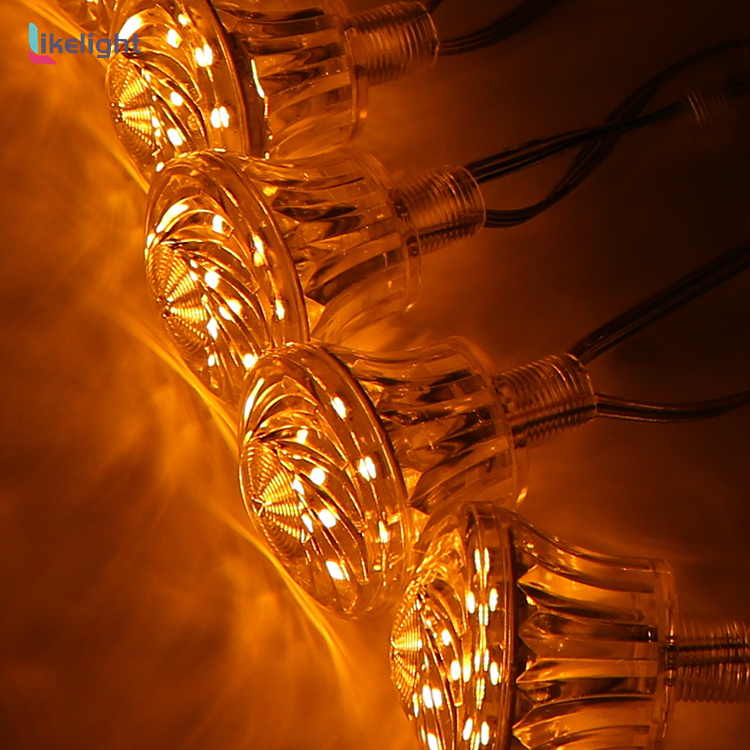
Spacing should be selected from viewing distance and the required pattern. The faceted yellow cover creates a decorative luminous object, so a sample must be judged both switched off in daylight and illuminated with the intended night sequence.
Convert 4.32W into a zone load before replacement
Published DC24V and 4.32W give 4.32 ÷ 24 = 0.18A per point theoretically. An illustrative 100 points total 432W and 18A. This is a load baseline, not permission for one circuit.
Existing sockets, branch conductors and connectors may have ageing or unequal resistance. Split the quantity into maintainable zones and verify the farthest lamp under the accepted simultaneous-output scene.
Voltage loss follows current multiplied by route resistance. Compare voltage at the supply, a middle branch and the remote end, and inspect connector temperature before approving the retrofit quantity.
Do not assume the control protocol from the word pixel
The product is described as an RGB pixel light, but the public facts used here do not identify an IC, addressing workflow or compatible controller. Calling it DMX512, SPI or another protocol without the final version would create a false wiring plan.
Use a production-intent sample to freeze interface, data direction, grouping, colour order, connector pinout and startup behaviour. Test a missing lamp and power-cycle recovery if the existing field must remain serviceable during operation.
IP66 and mechanical retention answer different risks
IP66 is published for the product, but retrofit acceptance must include the assembled cable exits and connectors. The rating does not establish thread retention, vibration performance or compatibility with an old gasket.
Support the cable so it does not turn or pull the E14 body, preserve drainage and leave access for one-lamp replacement. Approve the actual panel and gasket stack rather than using the 60mm diameter as a hole drawing.
Retrofit decision table
| Existing condition | Required verification |
|---|---|
| Existing E14 panel | Check thread engagement, gasket stack and rear clearance with the production part. |
| Unknown old voltage | Trace and measure the circuit; the new point is published for DC24V. |
| 100-point example | Start from 432W and 18A, then divide circuits by rated components and voltage tests. |
| Existing show controller | Confirm the supplied interface and mapping; pixel does not name a protocol. |
| Outdoor moving decoration | Verify cable support, retention and assembled sealing separately. |
| Fine graphics at close range | Prototype physical pitch; a 60mm decorative face favours bold patterns. |
LIKELIGHT case: replace a representative zone first
LIKELIGHT L-D-6018-Yellow Cover is published with a 60mm E14 format, 18 SMD5050 LEDs, RGB output, DC24V, 4.32W per point and IP66. It is a candidate for decorative amusement and cabochon fields where the yellow faceted appearance is intentional.
Before bulk replacement, build a zone with the existing panel, final harness and controller interface. Acceptance should cover daylight appearance, colour sequence, remote-end voltage, connector temperature, sealing and one-point service removal.
| Model | L-D-6018-Yellow Cover |
|---|---|
| Mechanical format | 60mm decorative face; E14 mounting format |
| Light engine | 18 × SMD5050; RGB |
| Electrical | DC24V; 4.32W; theoretical 0.18A per point |
| Illustrative 100 points | 432W and 18A; not one-circuit approval |
| Protection / control | IP66 published; IC and addressing method unconfirmed |
Inputs required before quotation
- Point quantity, pitch and zones to be replaced
- Existing voltage, conductor map and socket photos
- Controller model, interface and accepted sequence
- Panel thickness, E14 engagement and rear clearance
- Cable exits, connectors, gasket and exposure
- Sample-zone acceptance tests and required delivery date
These inputs connect the existing socket field, electrical load, control interface and sealing into one repeatable retrofit-zone test instead of approving an isolated lamp.
FAQ
Will every E14 cabochon fit the old panel?
No. Thread, panel, gasket, clearance and wiring must be checked together.
Do 18 LEDs mean 18 controllable pixels?
No. They describe the internal emitters; control grouping remains a version item.
Can 100 points share one 18A circuit?
Eighteen amperes is only the nominal total; circuit division depends on rated parts and measured voltage loss.
Does IP66 make the complete ride installation weatherproof?
No. The assembled connectors, cable exits, retention and maintenance method also require approval.


