


80mm DMX RGB Pixel Lights for Facades: Spacing, Channel and Power Planning Guide
How to turn an 80mm DC24V, 2.88W DMX RGB point light into a workable facade grid without confusing housing diameter, pixel pitch or universe capacity.
Quick answer
- The 80mm diameter is the physical housing, not the center-to-center pixel pitch; the facade drawing must define the grid separately.
- At the published 2.88W and DC24V, one point is a theoretical 0.12A load. One hundred points total 288W and 12A before losses and reserve.
- In a common three-channel RGB mode, 100 points would use 300 DMX channels, but the exact channel mode and addressing behavior must match the approved product and controller.
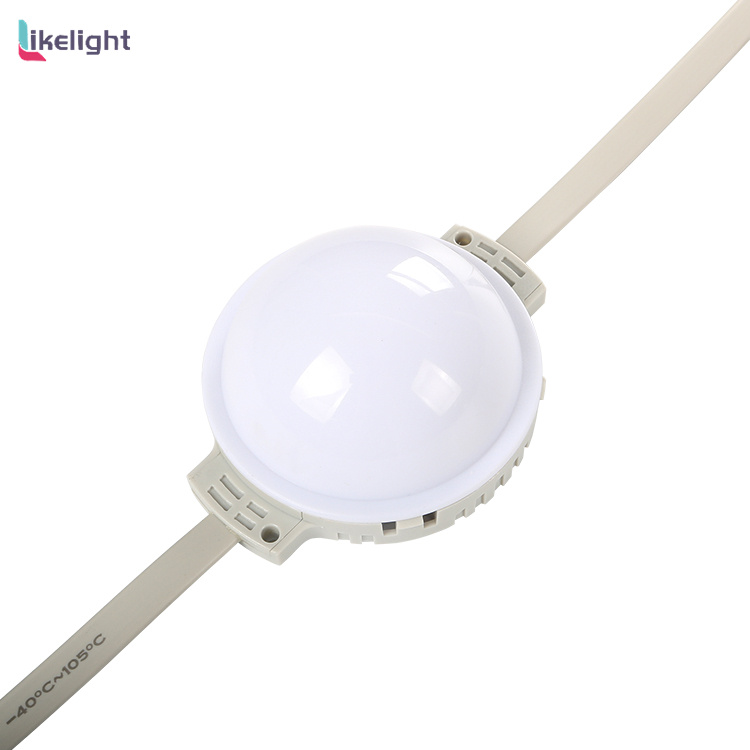
Published product evidence
| Model | L-D-8012-35 |
|---|---|
| Light source | 12 × SMD3535 RGB LEDs (page title) |
| Control | DMX |
| Input | DC24V |
| Rated power | 2.88W/point |
| Diameter | 80mm |
| Protection options | IP20 / IP65 |
| Certification shown | CE, RoHS |
Pixel pitch starts with viewing distance and content
A facade grid fails when the physical spacing is chosen from the lamp diameter instead of the intended image. The 80mm body only tells the installer how much space each point occupies; center-to-center pitch is a separate layout decision.
For a planning example, 200mm centers produce five points per linear meter and about 25 points per square meter on a square grid. At 400mm centers, those figures fall to 2.5 points per meter and about 6.25 points per square meter. The denser grid can show smaller visual steps but increases point count, channels, power and installation work. Approve both the nearest viewing distance and representative content before freezing pitch.
Translate the published point-light configuration into project value
The page identifies an 80mm RGB point with 12 SMD3535 LEDs, DC24V input, DMX control and 2.88W rated power. The 80mm body creates a visible architectural dot rather than a hidden strip pixel, which suits facades where the luminaire itself is part of the daytime and nighttime composition.
The published IP20/IP65 options must be matched to the environment. IP20 is for dry protected locations; IP65 can be evaluated for exposed installations, but the final system still includes cable exits, connectors, mounting holes and drainage.
Calculate total load, then divide it into serviceable zones
By the published rating, 2.88W ÷ 24V = 0.12A theoretically per point. One hundred points equal 288W and 12A; five hundred points equal 1,440W and 60A before cable loss, power-supply efficiency and design reserve.
Those totals are not a recommendation for one large feed. Divide the array by facade zone, controller location and service access. For each circuit, calculate conductor length and current, place power injection where needed, and verify loaded voltage at the farthest point. Zoning also lets maintenance isolate one elevation area instead of shutting down the complete facade.
Plan DMX channels from the confirmed operating mode
DMX is a channel-based protocol. In a common RGB mode, one point typically uses three channels, so 100 points would use 300 channels and fit within one 512-channel universe; 200 points would require 600 channels and therefore more than one universe. This is a planning example, not a published channel-mode claim for this model.
Before programming, confirm start-address behavior, channels per point, data direction, fixture order, controller output, repeater or splitter architecture and failure isolation. A correct electrical installation can still display the wrong content if the controller map does not match the physical point order.
Treat the 80mm body, mounting pitch and IP option separately
The mounting drawing should show center coordinates, orientation, cable route and replacement clearance for every 80mm body. When points sit close together, check that housings, connectors and tools still have enough space; when they sit far apart, verify the visual grid from the real viewing distance.
Use IP20 only in dry protected conditions. For wet, splash-prone or outdoor facades, evaluate the IP65 version together with sealed connectors, cable exits, drainage and mounting details. A fixture rating does not automatically transfer to a field-made joint.
Project decision table
| Project condition | Recommended direction | Why |
|---|---|---|
| Logo or detailed pattern at closer view | Test a denser center pitch | Housing diameter does not guarantee image resolution |
| Large color blocks at long view | Evaluate a wider pitch | Fewer points may deliver the intended visual effect |
| Dry protected installation | Evaluate IP20 | Avoid unnecessary enclosure cost |
| Wet or outdoor facade | Evaluate IP65 plus sealed interfaces | The complete connection system determines protection |
| Hundreds of points | Divide power and control by zones | Current, universe count and maintenance scale together |
| RGB three-channel mode | Budget three channels per point as an initial estimate | Final mode and address behavior require confirmation |
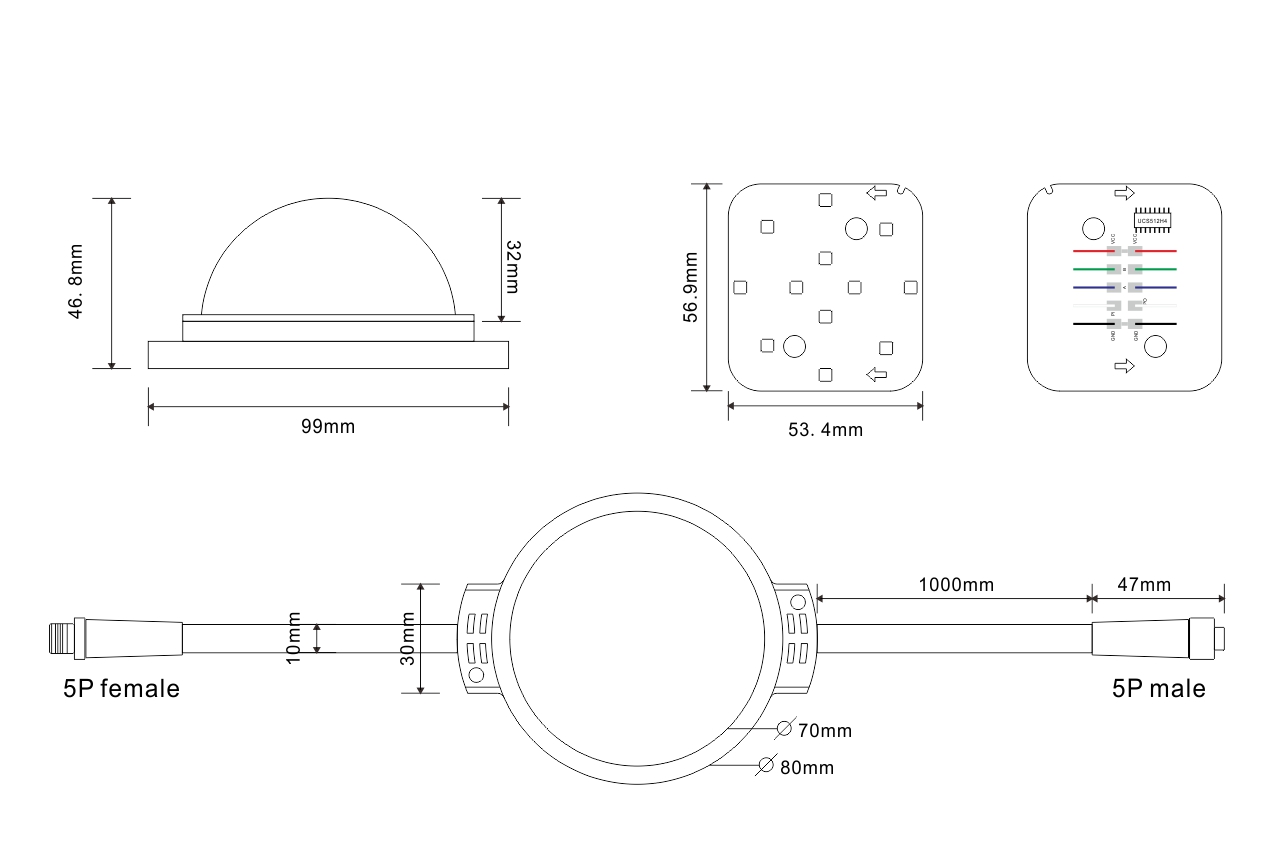
Where the LIKELIGHT 80mm DMX point fits
LIKELIGHT model L-D-8012-35 is a candidate for architectural dot grids, building outlines, entertainment facades and large decorative patterns that need a visible 80mm RGB point and professional DMX integration. DC24V and 2.88W provide a clear basis for circuit arithmetic, while IP20/IP65 lets the order match protected or exposed locations.
It is not automatically suitable for fine text, close-view video or projects that have not budgeted enough DMX universes and cable zones. Those uses require a pitch/content simulation and a confirmed control schedule before sampling.
Good fit when
- Large architectural dot grids and decorative patterns
- Projects with a documented DMX universe and physical mapping plan
- Installations where 80mm points are intentionally visible
Re-evaluate when
- Fine-pitch video or close-reading text without simulation
- Outdoor joints designed only from the fixture IP label
- Projects without zoned power and service access
Information needed for a project quote
- Facade elevation with every point coordinate
- Nearest and main viewing distances
- Target videos, logos or effect references
- Total point count and zones
- Controller model, DMX universes and cable route
- IP option, connector direction, sample and schedule
These inputs allow LIKELIGHT to evaluate pitch, point count, theoretical load, DMX mapping and installation interfaces together before the sample is approved.
FAQ
Does 80mm mean 80mm pixel pitch?
No. It is the point-light diameter. The project drawing sets center-to-center pitch.
How much current do 100 points require?
Using the published rating, the theoretical total is 288W ÷ 24V = 12A before losses and reserve.
How many DMX channels does one point use?
A common RGB mode uses three, but the exact product mode and controller configuration must be confirmed.
Can the IP20 version be installed outdoors?
IP20 is for dry protected conditions. Evaluate the IP65 option and the complete connector system for outdoor exposure.