

Flexible Silicone LED Wall Washer vs Rigid Fixture: How to Choose for Curved Facades
A buyer-focused guide to choosing a 16×16mm flexible silicone wall washer by surface geometry, LED spacing, segment length, optical mock-up and outdoor joint design.
Quick answer
- Choose flexibility for a surface that truly changes direction; a straight wall may be served more simply by a rigid fixture.
- The published 48 LEDs/m equals about 20.8mm between LED centers, but the final wash still depends on optics, mounting offset and wall texture.
- The page conflicts between IP65 in the page title and IP67 in the specification table, so protection must be frozen on the approved order and sample.
Published product evidence
| Model | L-W-10048-1616-2835 |
|---|---|
| Light source | Single color, SMD2835 LED package |
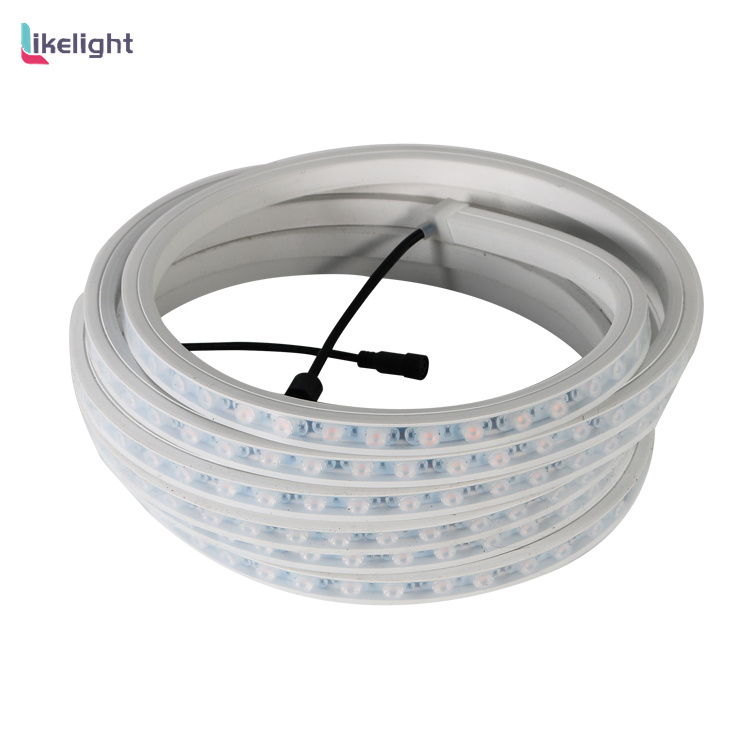
| Body size | 16×16mm silicone body |
| LED quantity | 48 LEDs/m |
| Published lengths | 0.5m, 1m, 1.5m, 2m |
| Protection evidence | Page title: IP65; specification table: IP67 |
| Certification shown | CE, RoHS |
Start with the surface, not the product name
The first decision is whether the illuminated line must follow a real curve, wrap a column or change direction along an architectural edge. Flexibility has value only when it solves that geometry; on a long straight elevation, a rigid wall washer may simplify alignment and mounting.
A wall-wash effect is not defined by LED count alone. Mounting offset, aiming direction, beam angle, wall texture and viewing distance determine whether the eye sees a smooth wash, a bright line or visible scallops. Because this page does not publish beam angle or photometric data, approve the effect with a sample on the actual material or a representative mock-up.
What 16×16mm and 48 LEDs/m tell the designer
The 16×16mm cross-section is a compact mechanical envelope. It must be checked against the recess, clip, channel, corner treatment and cable exit; the body size does not define the bending axis or minimum bend radius, which are not published.
At 48 LEDs/m, the theoretical center spacing is 1000mm ÷ 48 ≈ 20.8mm. This is useful for anticipating visual granularity, but the silicone optics and installation distance still control the final uniformity. The page also says the pixel pitch is customizable, so the quotation must define whether that wording refers to LED spacing, control segmentation or another option.
Use available segment lengths to reduce joints before calculating power
The page lists 0.5m, 1m, 1.5m and 2m lengths. For a 12m continuous contour, six 2m sections create fewer field interfaces than twenty-four 0.5m sections, although access points, curves and shipping constraints may justify a different mix.
Voltage and wattage are not published in the evidence used here, so power-supply current and voltage drop cannot be calculated responsibly. Obtain the approved voltage and rated W/m first, then divide the facade into serviceable circuits, size cable and measure loaded voltage at the far end. Segment planning should reduce unnecessary joints without hiding joints where they cannot be inspected.
Do not mistake SMD2835 for a control IC
SMD2835 identifies the LED package. It does not establish a pixel protocol, address method or controller requirement. The page describes a single-color light source, so the control question is normally on/off or dimming behavior through the selected driver, unless a separate control option is confirmed.
Before sampling, state the required color or CCT, dimming method, driver interface and circuit grouping. If dynamic pixels are required, this single-color configuration should not be treated as an addressable product merely because the source table places 2835 in an IC field.
Resolve bending and protection as an installed system
The page title contains IP65 while the parameter table contains IP67. That conflict is material for outdoor procurement and must be resolved in the signed specification, sample label and order. Do not promote the higher number until the exact version is confirmed.
The final outdoor result also depends on end caps, cable exits, connectors, field joints, drainage and mounting stress. Confirm the allowed bending direction and radius with the approved drawing; silicone flexibility does not mean the body may be twisted or bent freely in every plane.
Project decision table
| Project condition | Recommended direction | Why |
|---|---|---|
| Close-view premium wall wash | Build a material mock-up | 20.8mm LED spacing alone cannot prove a smooth wash |
| Curved column or shaped edge | Evaluate the flexible 16×16mm body | Geometry is the main reason to choose silicone |
| Straight indoor wall | Compare a rigid fixture | Simpler alignment may outweigh flexibility |
| Outdoor facade | Freeze the exact IP version and joint method | The page contains an IP65/IP67 conflict |
| Long continuous contour | Combine 0.5–2m sections around access points | Fewer hidden joints improve serviceability |
| Pixel animation required | Choose a confirmed addressable model | SMD2835 is an LED package, not a protocol |

Where the LIKELIGHT 16×16mm configuration fits
This LIKELIGHT model is a practical candidate for single-color architectural contours, curved facade details and shaped edges where a rigid bar cannot follow the geometry cleanly. Its listed 0.5m to 2m lengths support layout by modules, while 48 LEDs/m provides a known starting point for the optical mock-up.
It is a weaker fit when the brief requires pixel animation, a published narrow beam, quantified illuminance or a protection rating that cannot be resolved before order. In those cases, select another configuration or obtain the missing evidence before approving the sample.
Good fit when
- Curved or segmented single-color architectural contours
- Projects that can approve a full-scale optical sample
- Layouts that benefit from 0.5m, 1m, 1.5m and 2m modules
Re-evaluate when
- Projects requiring confirmed pixel animation
- Specifications requiring an unresolved IP rating
- Designs that need photometric guarantees without a mock-up
Information needed for a project quote
- Dimensioned facade drawing and curve direction
- Total length and length of every zone
- Wall material, mounting offset and viewing distance
- Required color or CCT and dimming method
- Indoor/outdoor exposure, joint and drainage plan
- Cable exits, connectors, sample quantity and deadline
These inputs let LIKELIGHT evaluate module lengths, optical sampling, circuit layout and connection details as one project rather than quoting only a meter price.
FAQ
Is 48 LEDs/m automatically dot-free?
No. The theoretical 20.8mm LED spacing is only one input; optics, offset, wall texture and viewing distance determine the visible result.
Is this an addressable wall washer?
The reviewed page describes a single-color source and does not publish an addressable protocol. SMD2835 is the LED package.
Is the product IP65 or IP67?
The page title and specification table conflict. Confirm the exact ordered version in the drawing, sample and quotation.
Can every 16×16mm silicone washer bend the same way?
No. The approved drawing must state bending direction and minimum radius; neither can be inferred from body size alone.