


2024-01-23
Intelligent control lamp with high and low level off lighting method
Intelligent control lamp with high and low level off lighting method
Urban road lighting is increasingly using LED lighting technology instead of traditional lighting technology, the purpose of which is to reduce the consumption of electricity. Because the LED uses low-voltage DC power supply, it is easy to attach detection and control circuits, which brings convenience to the intelligent management of the street lamp network and further energy saving and consumption reduction. For the management and control of the street lamp network, power carrier communication technology can be used, and the rapid development of technology can also make short-range wireless communication technology superior to power carrier communication technology in application cost, reliability and communication rate, such as Zigbee short-range wireless communication technology. This paper proposes a solution that uses short-range wireless communication technology to build a wireless sensor network of LED street lights, which can switch on and dimmer any single or multiple lights or all lights in the LED street light network, and detect luminous brightness and current parameters, so as to realize intelligent management of the LED street light network. As a wireless sensor network, its architecture should contain four basic levels: physical layer and data link layer, network layer and application layer. LED street light wireless sensor network adopts IEEE 802.15.4 standard as the technical standard of its physical layer and data link layer, the network layer and the application layer are integrated together, and the single hop, double hop and variable hop three relay communication modes are used as the basis of the network protocol. This paper focuses on the architecture of LED wireless sensor network, based on the network topology and the composition of communication nodes, discusses the protocol package format of the network layer, the working principle of routing, and the design flow of node communication.
1. Network System
The network system of LED wireless sensor network is the basis of network layer routing, including node composition and network topology.
1.1 Composition of sensor network nodes of LED street lights
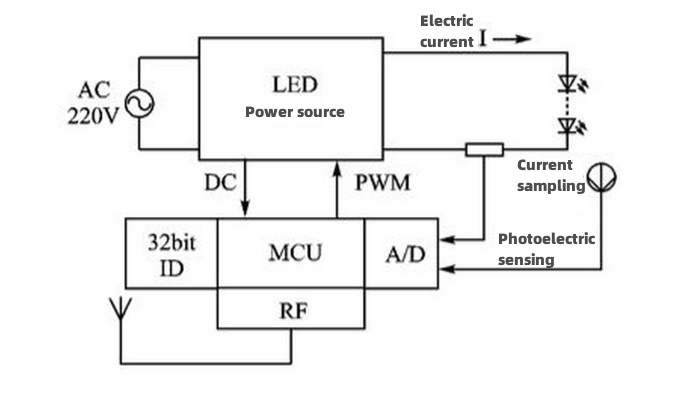
The LED street light network consists of a number of evenly spaced street lights, and each LED street light is a communication node of the network to build a wireless sensor network. As shown in Figure 1, in order to build the composition of the wireless sensor network LED street lamp node, in addition to the circuit of the lighting part, there are also additional circuits such as LED current sampling, LED luminance detection, and PWM control of LED luminance. Each LED street light is both a sensor node and a network routing node; Each node contains a microcontroller (MCU, such as cc2530), which has RF communication function, which can both send and receive signals; Each node has a 32bit (bit) unique ID number. Through the use of IEEE 802.15.4 protocol standards in the physical layer and MAC layer, combined with the protocol of the network layer and the application layer, all these nodes are organically combined together to form a wireless sensor network of LED street lights. Because some existing network layer and application layer protocols such as Zigbee, RF4CE, etc., are not very suitable for LED street light sensor network applications, it is necessary to redesign the network layer and application layer protocols.
1.2 Network Topology
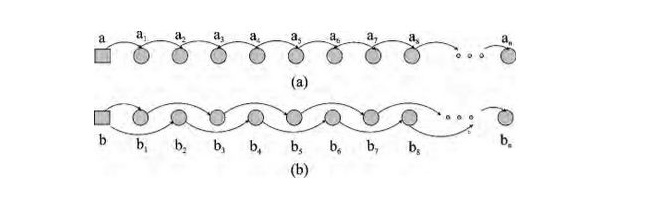
According to the distribution law of LED street lights, each LED street light constitutes a wireless communication network as a network node, and its topology is shown in Figure 2. (a) is the topology diagram of signal point-by-point (single hop) relay transmission, and (b) is the topology diagram of signal separation point (double hop) relay transmission. To facilitate the design and discussion of the following network application protocols, the following definitions are made:
(1) All nodes can be divided into 2 categories, that is, LED street lamp nodes (referred to as LED nodes, such as a1 a2... an, b1, b2... bn) and street light controller nodes (referred to as control nodes, such as a, b);
(2) The distance between adjacent nodes is L, and the wireless signal coverage radius of each node is greater than or equal to 2L;
(3) According to the relative position of the node, the node can be divided into precursor node and successor node. The predecessor node is near the controller, and the successor node is far away from the controller. For example, a1 is the precursor node of a2, and a3 is the successor node of a2. Similarly, b2 is the precursor node of b4, b6 is the successor node of b4, and so on.
(1) All nodes can be divided into 2 categories, that is, LED street lamp nodes (referred to as LED nodes, such as a1 a2... an, b1, b2... bn) and street light controller nodes (referred to as control nodes, such as a, b);
(2) The distance between adjacent nodes is L, and the wireless signal coverage radius of each node is greater than or equal to 2L;
(3) According to the relative position of the node, the node can be divided into precursor node and successor node. The predecessor node is near the controller, and the successor node is far away from the controller. For example, a1 is the precursor node of a2, and a3 is the successor node of a2. Similarly, b2 is the precursor node of b4, b6 is the successor node of b4, and so on.
4) Between the control node and the LED node, the LED node between each other, as long as the wireless signal can be covered, can communicate with each other, there is no need to set up a base station or a special routing coordination device.
(5) The 32bit unique ID number of each node consists of two parts, namely the network ID and the node address (number), both of which are 16bit. The network ID of all nodes in the same street lamp network is the same; Starting from the controller node, node addresses are arranged in ascending order.
(5) The 32bit unique ID number of each node consists of two parts, namely the network ID and the node address (number), both of which are 16bit. The network ID of all nodes in the same street lamp network is the same; Starting from the controller node, node addresses are arranged in ascending order.


