


2024-02-20
LED five dimming control methods
LED five dimming control methods
1: cutting edge control dimming
Front dimming is the use of thyristor circuit, starting from AC phase 0, input voltage chopper, until the thyristor conduction, there is a voltage input.
The principle is to adjust the conduction Angle of each half wave of alternating current to change the sinusoidal waveform, so as to change the effective value of alternating current, so as to achieve the purpose of dimming.
The principle is to adjust the conduction Angle of each half wave of alternating current to change the sinusoidal waveform, so as to change the effective value of alternating current, so as to achieve the purpose of dimming.
The leading dimmer has the advantages of high adjustment accuracy, high efficiency, small size, light weight, easy remote control, etc. In the market, most manufacturers' products are this type of dimmer.
2: back edge phase control dimming
The back edge tangential phase control dimmer is made of field-effect transistor (FET) or insulated-gate bipolar transistor (IGBT) device. The back edge tangent dimmer generally uses MOSFET as a switching device, so it is also called MOSFET dimmer, commonly known as "MOS tube".
MOSFET is a fully controlled switch, which can be controlled both on and off, so there is no phenomenon that the thyristor dimmer can not be completely turned off.
The other MOSFET dimming circuit is more suitable for capacive-load dimming than thyristor, but because of the high cost and the dimming circuit is relatively complex, not easy to do stability and other characteristics, so that the MOS tube dimming method has not been developed, thyristor dimmer still occupies the vast majority of the dimming system market.
3:1-10V dimming
1-10V dimming device has two independent circuits, one is an ordinary voltage circuit, used to turn on or off the power supply to the lighting equipment, the other is a low-voltage circuit, which provides a reference voltage, tell the dimming level of the lighting equipment, 0-10V dimming controller used to dimming control of fluorescent lamps, now, Because a constant power supply is added to the LED driver module and there is a special control line, the 0-10V dimmer can also support a large number of LED lights.
However, the disadvantages of the application are also very obvious, and the low voltage control signal needs to add an additional set of lines, which greatly improves the requirements for construction.
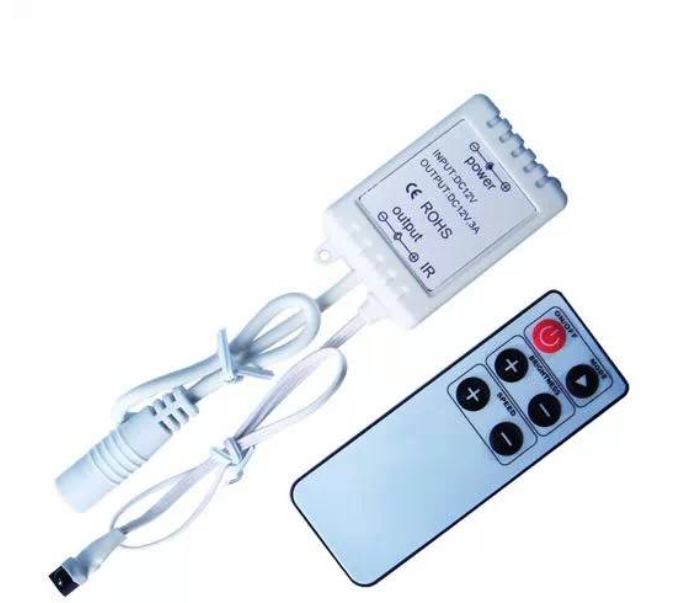
4: DALI(Digital Addressable Lighting Interface)
The DALI standard has defined a DALI network, consisting of a maximum of 64 units (which can be individually addressed), 16 groups, and 16 scenes. Different lighting units on the DALI bus can be flexibly grouped to achieve different scene control and management.
In practical applications, a typical DALI controller controls up to 40 to 50 lights, which can be divided into 16 groups, while being able to process some actions in parallel. In a DALI network, 30 to 40 control instructions can be processed per second. This means that the controller needs to manage 2 dimming instructions per second for each lighting group.
In practical applications, a typical DALI controller controls up to 40 to 50 lights, which can be divided into 16 groups, while being able to process some actions in parallel. In a DALI network, 30 to 40 control instructions can be processed per second. This means that the controller needs to manage 2 dimming instructions per second for each lighting group.
5: DMX512 dimming
The DMX512 protocol was first developed by the USITT (American Theatre Technology Association) as a standard digital interface from the console to the control dimmer. DMX512 surpasses analog systems, but it cannot completely replace them. DMX512's simplicity, reliability (assuming it can be installed and used correctly), and flexibility make it a protocol of choice if funds allow.
In practical applications, the control mode of DMX512 is generally designed together with the power supply and controller. The DMX512 controller controls 8 to 24 lines, directly driving the RBG line of the LED lamp, but in the building lighting project, due to the weak DC line, it is required to install a controller at about 12 meters, and the control bus is in parallel mode, therefore, the controller is very much, and many occasions can not even be constructed.


