


Single Color or RGB? How to Select 80mm LED Point Lights for Fairground Rides
Fairground rides, exposed letters and large signs do not always need RGB pixels. If a project needs a stable brand color, a readable outline or zoned flashing, full-color control can add wiring, commissioning and programming work without adding equal visual value.
This article uses LIKELIGHT's published 80mm, 24×SMD2835, DC24V, single-color and 5.76W configuration to define the decision boundary and calculate theoretical loads for 100 and 500 points.
Published product facts
Published facts are separated from theoretical calculations.
| Published item | Value |
|---|---|
| Model / body | L-D-80WW / 80mm |
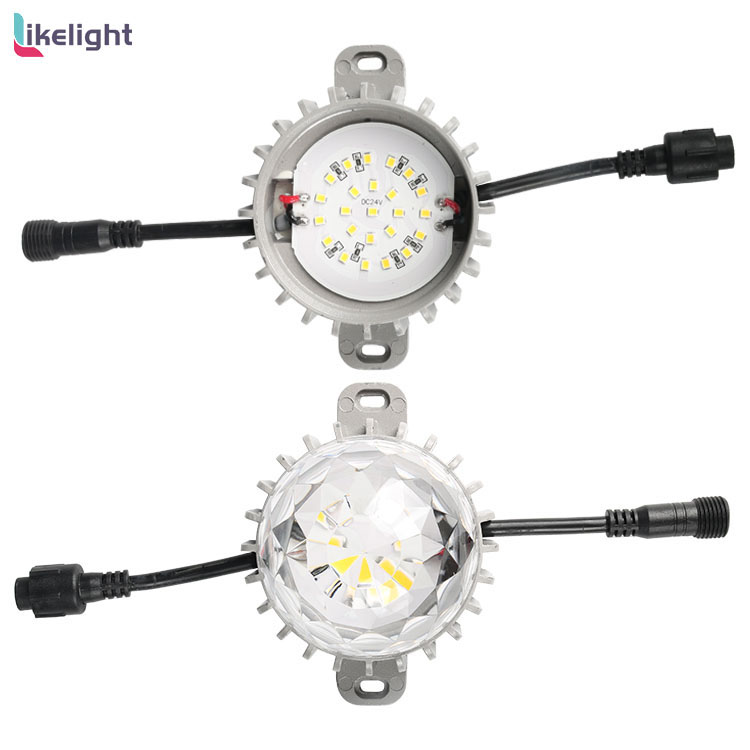
| Light source | 24 × SMD2835 |
| Color / PCB | Single color / white |
| Electrical | DC24V / 5.76W |
| Protection options | IP65 / IP67 |
| Published documents | CE / RoHS |
Start with the visual task: single color or RGB
Fixed brand colors, continuous outlines, distant recognition and regular flashing do not always need color changes at every point. Single color reduces color variables and makes acceptance criteria clearer, although zoning and the final interface still depend on the system.
Choose RGB or programmable pixels when the project genuinely needs multicolor chases, gradients, scheduled themes or music-linked content. The correct choice depends on how the venue will use the effects, not on maximizing color capability.
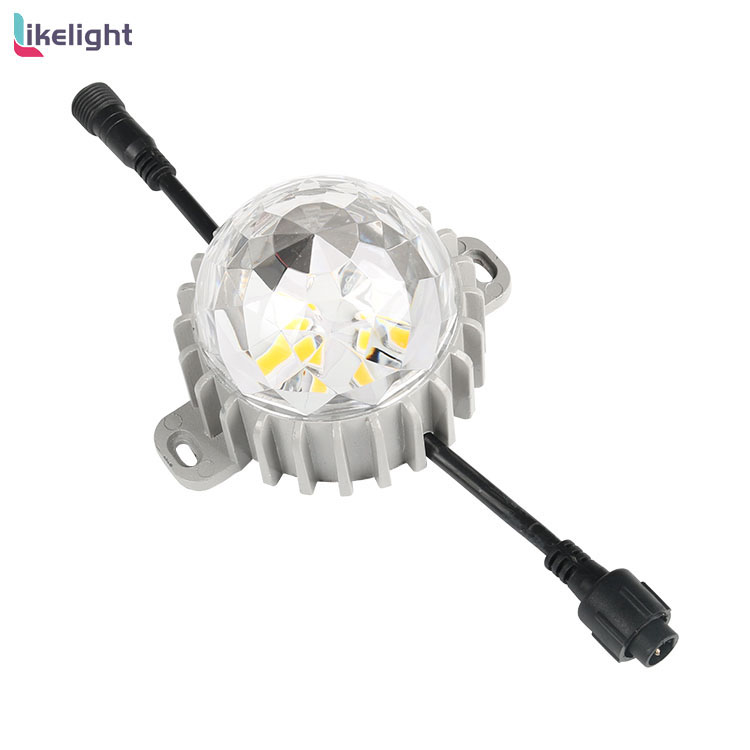
What do an 80mm body and 24 SMD2835 LEDs mean?
The page title identifies an 80mm body, while the specifications list 24 SMD2835 LEDs and a white PCB. A large visible point can support a clear dot rhythm, but no lumen output or photometric curve is published, so viewing distance cannot be promised from LED count alone.
The 80mm body is not the installation pitch. Center spacing must also leave room for the housing, fixing structure, cable exit and service access; mark it on the ride or sign drawing and test the actual color against the background.
Calculate theoretical load for 100 and 500 points
At the published 5.76W and DC24V, theoretical current is 5.76W ÷ 24V = 0.24A per point. One hundred points equal 576W and 24A; five hundred equal 2880W and 120A.
These are planning values from the published rating, not permission to use one supply or one circuit. Divide the installation into serviceable zones, include cable and connector loss plus project margin, and measure end-of-run voltage under the intended operating state.
Project selection table
Use the table as a decision aid; finalize from the project drawing.
| Project need | Recommended direction | Reason |
|---|---|---|
| Stable brand color or outline | Single color | Fewer color variables |
| Per-point multicolor animation | Programmable RGB | Color changes are essential |
| 100 points | 576W / 24A | Divide by service zone |
| 500 points | 2880W / 120A | Use multiple service zones |
| Outdoor installation | Select IP65 or IP67 option | Design complete connections |
Plan circuits, service and the control boundary
Moving from 100 to 500 points increases more than watts. Branch connectors, cable identification, fault finding, power boxes and the maintenance outage area all grow. Zoning by ride component, sign stroke or facade area usually improves serviceability.
The page lists T-1000S, T-200K online and DMX controller options but does not publish this single-color version's wiring, channel use or port capacity. Define steady, zoned flashing or programmed effects first, then confirm the final interface instead of treating a controller name as a complete architecture.
Match IP65 or IP67 options to the installation
The page offers IP65 and IP67 configurations. Select the final version from rain exposure, cleaning, possible standing water, mounting orientation and the confirmed order; do not assume every delivery has the higher rating.
The point-light rating does not cover ends, branches, cable exits or power boxes. Rides also require vibration, moving-part clearance and service access checks; signs need drainage, concealed wiring and replacement access.
Where the LIKELIGHT 80mm single-color point light fits
Model L-D-80WW uses 24 SMD2835 LEDs, a white PCB, DC24V and single color, with a published 5.76W rating plus CE, RoHS and IP65/IP67 options. It can suit ride outlines, logos, billboards, exposed letters and decorative dot layouts that need a fixed recognition color.
If the selling point is per-point full-color animation, complex gradients or frequent theme changes, evaluate a programmable RGB product instead. When a clear, uniform fixed color is the goal, single color usually makes the acceptance target easier to define.
Prioritize single color when
- Ride outlines, logos and exposed letters
- A stable recognition color is the visual goal
- Circuits and connectors can be serviced by zone
Choose RGB or reassess when
- Per-point multicolor animation is required
- Theme colors change frequently
- No circuit zoning or service access
Information required before quotation
Send point quantity, zones, center spacing, ride or sign drawing, target color, steady or flashing logic, DC24V feed positions, cable and connector direction, protection target, exposure, service method, sample needs and schedule.
These inputs allow visual layout, theoretical load, circuit zoning, control and mounting to be assessed together. LIKELIGHT can then confirm final color, wiring, controller compatibility and protection version for a representative sample.
- Point quantity and zones
- Center spacing and drawing
- Target color and effect logic
- DC24V feed positions
- Cable, connector and protection target
- Exposure, service, sample and schedule
Frequently asked questions
Does an 80mm body mean 80mm installation pitch?
No. The center spacing must also allow for fixing, cable exits and service access.
How much rated load do 100 points represent?
Using 5.76W per point gives a theoretical 576W and 24A at DC24V.
Is single color always simpler than RGB?
It removes color-programming variables, but circuit zoning and effect control still need a defined design.
Are all units IP67?
No. The page lists IP65 and IP67 options; the ordered version and complete connections determine project protection.
When should a buyer choose RGB instead?
Choose programmable RGB when per-point color changes, gradients or changing themes are required.


