


2025-03-07
The reflector plays a key role in UVC leds
The reflector plays a key role in UVC leds
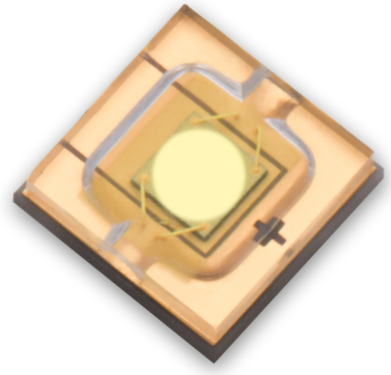
The reflector plays a key role in UVC leds, which can improve the efficiency of light extraction. The following is a detailed anatomy of the UVC LED reflector:
1. The role of the reflector
- Light reflection: The UVC light generated inside the chip is reflected to the direction of the outgoing light to improve the optical output efficiency.
- Thermal management: Some reflector materials have good thermal conductivity to help dissipate heat.
2. Reflector material
- Aluminum (Al) :
Advantages: high reflectivity (about 90%), low cost, easy processing.
Disadvantages: easy oxidation, poor long-term stability.
- Silver (Ag) :
Advantages: high reflectivity (about 95%), good electrical conductivity.
Disadvantages: high cost, easy to vulcanize black.
- Dielectric mirror:
Material: Multi-layer dielectric film (e.g. SiO₂/TiO₂).
Advantages: high reflectivity, good stability, not easy to oxidize.
Disadvantages: high cost and complex process.
3. Structure of the reflector
- Single-layer reflector:
Material: Commonly used aluminum or silver.
Structure: Single layer metal film, located on the bottom or side of the chip.
Advantages: Simple structure, low cost.
Disadvantages: relatively low reflectivity, easy oxidation.
- Multilayer reflectors:
Material: Commonly used dielectric film (such as SiO₂/TiO₂).
Structure: Multi-layer films are alternately stacked to form a high reflectivity mirror.
Advantages: high reflectivity, good stability.
Disadvantages: high cost and complex process.
4. Manufacturing process of reflector
- Evaporation process:
Steps: The metal material is steamed onto the chip surface in a vacuum environment.
Function: Form a uniform metal reflector.
- Sputtering process:
Steps: The material is sputtered onto the surface of the chip by bombarding the target with high-energy particles.
Function: To form a high quality dielectric reflector.
- Lithography process:
Steps: Gluing, exposure, development, etching.
What it does: Precisely form the reflector pattern.
5. Optimal design of the reflector
- Reflectivity: Improve reflectivity and reduce light loss by optimizing materials and structures.
- Angle design: Design the Angle of the reflector to ensure that the light is effectively reflected to the direction of the light.
- Thermal management: Select materials with good thermal conductivity to help the chip dissipate heat.
6. Protection of the reflector
- Passivation layer:
Material: Commonly used silicon nitride (Si₃N₄) or silicon dioxide (SiO₂).
Function: Protect the reflector, prevent oxidation and corrosion.
- Packaging material:
Material: commonly used silica gel or epoxy resin.
Function: Further protect the reflector and improve durability.
In SUMMARY:
The reflector structure of UVC LED includes a single reflector and a multi-layer reflector, and the material is commonly used in aluminum, silver or dielectric film. The design and manufacturing process of the reflector has a significant impact on light extraction efficiency and heat dissipation performance, requiring optimization of reflectivity, Angle design and thermal management, and protection through passivation layers and packaging materials.
The reflector structure of UVC LED includes a single reflector and a multi-layer reflector, and the material is commonly used in aluminum, silver or dielectric film. The design and manufacturing process of the reflector has a significant impact on light extraction efficiency and heat dissipation performance, requiring optimization of reflectivity, Angle design and thermal management, and protection through passivation layers and packaging materials.
If you are not sure which LED fixture is best for your project or need help with layout configuration, contact us LIKLEIGHT, we are a professional manufacturer of LED lamps in China;we have engineers and 24 hours customer service for you.Phone:+86-755-23328395, Email :contact@like-light.com,Wechat/WhatsApp:86-132-66666-320.


