


2025-03-24
The thermal characteristics of leds are one of the key factors affecting their performance and life
The thermal characteristics of leds are one of the key factors affecting their performance and life
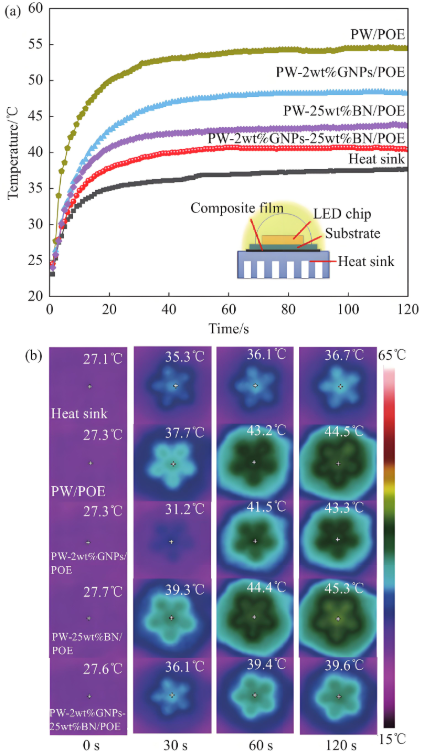
The thermal characteristics of leds are one of the key factors affecting their performance and life. Because the LED will generate heat at work, if the heat is not effectively distributed, it will lead to reduced light efficiency, wavelength offset and even damage. The following is a detailed analysis of the thermal characteristics of LED:
1. Heat generation
Heat source:
- When the LED is working, not all of the electrical energy is converted into light energy, and some of the electrical energy will be dissipated in the form of heat.
- Heat generation mainly comes from the following aspects:
- Non-radiative recombination: When electrons and holes recombine, some of the energy is released as heat.
- Joule heat: Heat generated due to resistance when the current passes through the LED.
- Phosphor heating: In white leds, phosphor absorption of blue light and conversion will also generate heat.
Thermal power calculation:
- The thermal power (P_heat) can be estimated by the following formula:
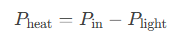
Among them,PinIt's the input electrical power,Plight Yes optical power.
2. Thermal resistance and heat dissipation
Thermal Resistance:
- Thermal resistance indicates the ease with which heat is transferred from the LED chip to the environment and is measured in °C/W.
- The smaller the thermal resistance, the better the heat dissipation performance.
- Composition of thermal resistance:
- Chip to Substrate Thermal resistance (Rjc) : The thermal resistance between the chip and the substrate.
- Baseboard-to-radiator thermal resistance (Rcs) : The thermal resistance between the baseboard and radiator.
- Heat sink to Environment Thermal resistance (Rsa) : The thermal resistance between the heat sink and the environment.
Total thermal resistance (Rja) :
- The total thermal resistance is the total thermal resistance of the chip to the environment, and the formula is:

Junction temperature calculation:
-
Junction temperature (Tj) is the temperature of the LED chip, which can be calculated by the following formula:

Among them,Ta is the ambient temperature.
3. The effect of temperature on LED performance
Light efficiency decline:
- The increase in temperature will cause the light efficiency of the LED to decrease, because the non-radiation recombination increases and the photon production efficiency decreases.
- The change of light efficiency with temperature can be expressed as a temperature coefficient, usually -0.2% to -0.5%/°C.
Wavelength offset:
- The increase in temperature will cause the emission wavelength of the LED to shift in the direction of the long wave (redshift).
- The wavelength offset is usually 0.1 nm/°C to 0.3 nm/°C.
Shortened life span:
- The increase in temperature will accelerate the aging of the LED, resulting in accelerated light decay.
- Empirical formulas show that for every 10°C increase in junction temperature, the life of an LED may be reduced by half.
4. Heat dissipation design
Heat dissipation material:
- Commonly used heat dissipation materials include aluminum, copper, ceramics, etc., with high thermal conductivity.
- Thermal interface materials (such as thermal grease and thermal gaskets) are used to fill the space between contact surfaces to improve thermal conductivity efficiency.
Radiator:
- Heat sinks improve the efficiency of heat dissipation by increasing the surface area, and common forms include fin radiators and heat pipe radiators.
Active heat dissipation:
- For high power leds, active cooling methods such as fans or liquid cooling may be required.
5. Test and evaluation of thermal characteristics
Junction temperature measurement:
- Use an infrared thermal imager or thermocouple to measure the junction temperature of the LED.
Thermal resistance test:
- Thermal resistance is calculated by measuring temperature difference and thermal power.
Thermal simulation:
- Thermal simulation software (such as ANSYS, FloTHERM) is used to simulate the heat distribution and heat dissipation performance of leds.
If you are not sure which LED fixture is best for your project or need help with layout configuration, contact us LIKLEIGHT, we are a professional manufacturer of LED lamps in China;we have engineers and 24 hours customer service for you.Phone:+86-755-23328395, Email :contact@like-light.com,Wechat/WhatsApp:86-132-66666-320.


