


120mm Fairground RGB Pixel Lights: Integrate 27W Loads and UCS2903 Control
A large RGB point can be bright in a bench test yet fail as a ride system when power zones and controller interfaces are assumed. This guide uses the published 120mm, DC24V, 27W UCS2903 configuration to define an acceptance path.
Why one bright sample does not prove a ride installation
An isolated point receives short cables and little connector loss. A full decorative panel adds shared wiring, joints and simultaneous colour loads, so the remote behaviour can differ from the bench sample.
Build the acceptance sample with the intended spacing, mounting surface, connector count and a representative group of points. Run fixed colours, full output and the actual animation while recording voltage and control order.
Separate the 18 LEDs from the controlled position
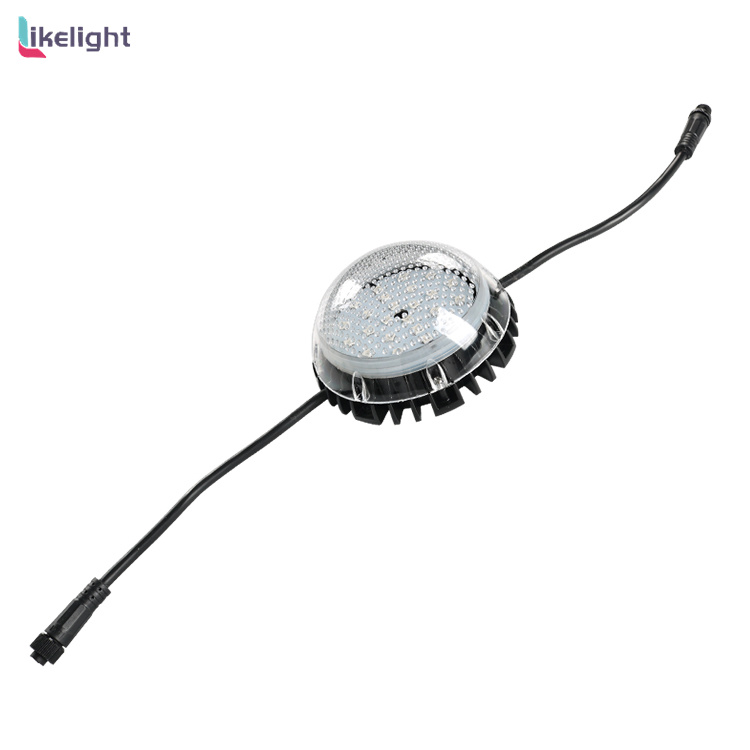
The page lists a 120mm body, 18 SMD5050 RGB LEDs and UCS2903. Eighteen emitters describe the light engine inside one housing; they do not establish 18 addresses or 18 independent pixels.
A larger luminous face can suit bold decorative effects viewed from a distance. It does not automatically suit fine text or video; physical pitch and viewing distance still define visible detail.
Design zones from 27W, not from lamp count alone
Published DC24V and 27W give 27 ÷ 24 = 1.125A per point theoretically. An illustrative ten points total 270W and 11.25A. These are nominal load estimates, not an approved feed quantity.
Higher current magnifies voltage loss through cable and contacts. Divide the layout into serviceable power zones, calculate each route, and measure the farthest point under the same high-output scene used for acceptance.
Actual animation consumption varies. Supply margin, cable rating, connectors, overcurrent protection and the moving or fixed structure must be established by the project electrical design.
Resolve UCS2903, DMX and controller references before ordering
The page identifies UCS2903 and also names T-1000S, T-200K online and DMX controllers. Those references do not prove that all connect directly to one supplied version or share the same addressing workflow.
Freeze the final receiver or interface, data direction, colour order, grouping, connector pinout and controller file on a production-intent sample. Use DMX address language only if the supplied interface actually exposes DMX addressing.
Protection and retention are separate acceptance items
The page lists IP65/IP67 options. Select one production version and verify its complete cable and connector assembly; neither rating demonstrates vibration resistance, retention strength or repeated flexing.
For a fairground panel, support external cables, prevent connector loads from pulling the housing and preserve access to one point. Approve the 120mm opening and fixing on a sample panel rather than using diameter as a drilling drawing.
Integration decision table
| Project condition | Acceptance decision |
|---|---|
| One point works, group flickers | Compare near and far voltage under the same full-output scene. |
| Animation order is wrong at every load | Verify data direction, grouping and controller file before changing power. |
| Ten-point example zone | Start from 270W and 11.25A, then size circuits from rated components. |
| Existing DMX system | Confirm the supplied interface exposes compatible DMX addressing. |
| Moving decorative panel | Verify retention, strain relief and vibration separately from IP rating. |
| Fine text or video | Prototype physical pitch and viewing distance; 120mm points favour bold effects. |
LIKELIGHT case: freeze a reproducible ten-point zone
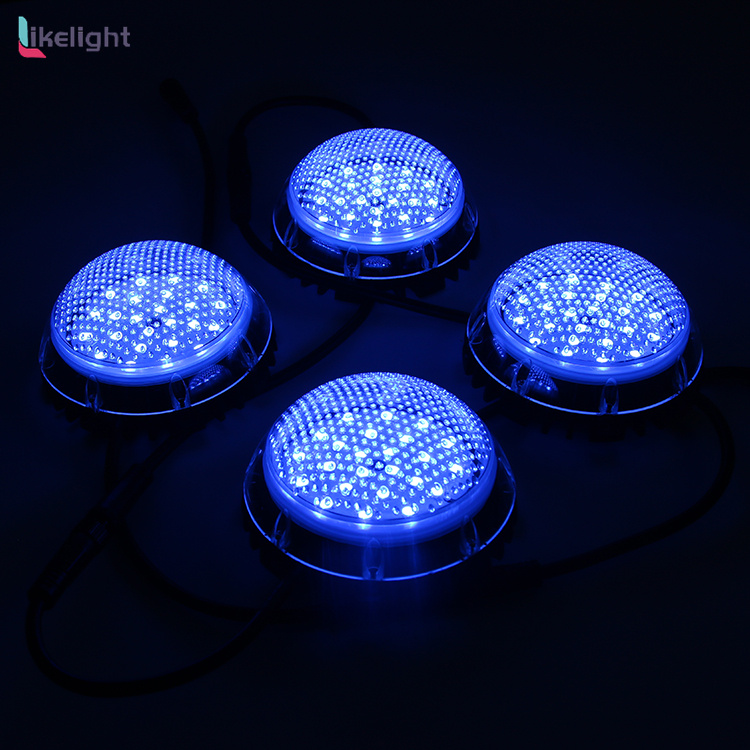
LIKELIGHT L-D-120-DMX512 is published with DC24V, 27W, 18 SMD5050 RGB LEDs, UCS2903 and IP65/IP67 options. It is a candidate for bold programmable fairground decoration where a large illuminated point is intentional.
It is not a controller-capacity promise or a complete ride-safety approval. Freeze the exact control interface, power zone, protection version and mechanical retention together before bulk production.
| Model | L-D-120-DMX512 |
|---|---|
| Light engine | 120mm; 18 × SMD5050 RGB |
| Control | UCS2903; final controller interface requires confirmation |
| Electrical | DC24V; 27W; theoretical 1.125A per point |
| Protection choices | IP65 / IP67 |
| Illustrative ten points | 270W and 11.25A; not a feed limit |
Inputs required before quotation
- Point count, physical spacing and service zones
- Controller model, interface and accepted program
- Supply positions, cable routes and connector types
- Protection option and exposure
- Panel opening, retention and movement conditions
- Sample acceptance scenes and delivery date
These inputs combine load, control interface, physical layout and retention into one repeatable zone test instead of approving a single lamp on a short cable.
FAQ
Do 18 LEDs mean 18 controlled pixels?
No. Confirm grouping and the relationship between controller positions and housings.
Can ten points use one 11.25A feed?
That is only a nominal estimate; cable, connector, protection and margin determine the circuit.
Is UCS2903 the same as DMX512?
No. Confirm how the supplied receiver or controller maps the UCS2903 chain to the project system.
Does IP67 cover a moving ride panel?
It addresses ingress for the confirmed assembly, not vibration, retention or complete-machine safety.


