


57.6W/m RGBW Addressable Strip: Freeze Power and Control Before Ordering
A high-output RGBW strip can pass a short test and still fail on a long run when current, heat and the control version are left unresolved. This guide turns published DC12V, 57.6W/m and 60 LEDs/m data into a procurement and sample-approval method.
Why a five-metre reel is not one electrical load block
The product page publishes 57.6W/m at DC12V. A short sample may look correct because its cable and copper path are short, while a longer run accumulates current through conductors and joints. Approving colour alone therefore does not approve the installation.
Start with the actual route, feed positions and simultaneous RGBW scene. Divide the system into serviceable zones and test the farthest point in each representative zone rather than treating the reel length as a permitted feed length.
Read RGBW and 60 LEDs/m without inventing pixels
The page lists SMD5050 RGBW and 60 LEDs/m with a 120-degree viewing angle. RGBW adds a dedicated white component, but the white quality, channel behaviour and colour mixing still depend on the ordered circuit and controller mapping.
Sixty emitters per metre give a nominal 1000 ÷ 60 = 16.7mm LED pitch. That helps compare optical spacing, but it does not establish controlled positions: one controller position may drive one or several emitters depending on the final circuit.
Calculate current first, then verify voltage and heat
Published power gives 57.6 ÷ 12 = 4.8A per metre theoretically. An illustrative 5m totals 288W and 24A. These values are calculation baselines, not approval for one feed or one connector.
Actual demand changes with colour mix, dimming and animation, but wiring must be evaluated against the demanding accepted scene. Cable cross-section, PCB copper, connector rating, supply margin and overcurrent protection determine the practical zoning.
Voltage loss follows current multiplied by route resistance. Measure voltage and temperature at the input, a joint and the remote end after thermal stabilisation; do not compensate for an undersized route only by raising supply voltage.
Addressable is not a complete controller specification
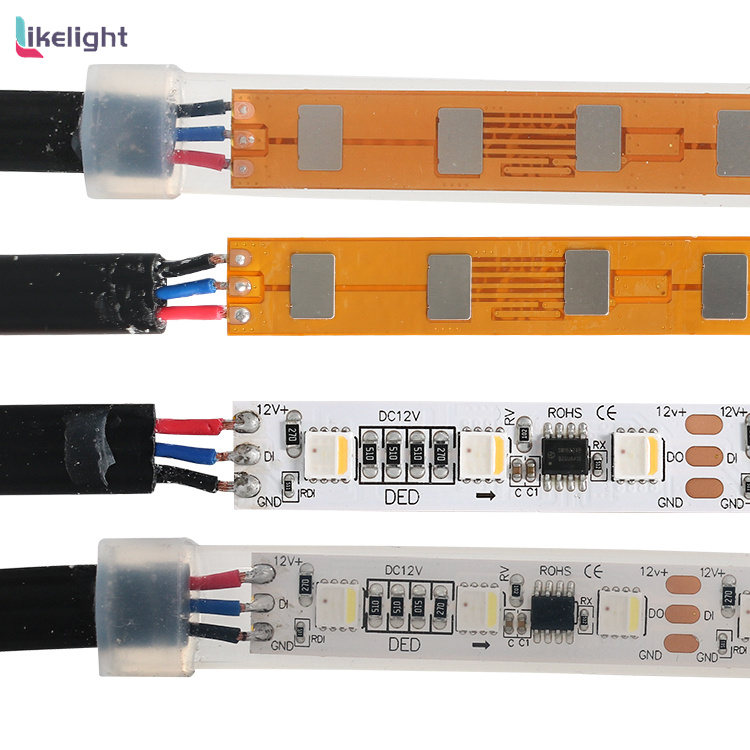
The title identifies the product as programmable and addressable, but the public evidence used here does not name the control IC, timing, pixel grouping or data-backup architecture. Those details cannot be borrowed from another strip that looks similar.
Freeze IC, voltage, pixels per metre, LEDs per pixel, data direction, colour order, cut marks, connector pinout and controller file together. A sample is accepted only when the same record reproduces the intended RGBW scene after power cycling.
Thermal and protection construction belong to the order
At the published maximum, 57.6W/m is a meaningful thermal load. The mounting surface and aluminium profile, adhesive interface, ambient temperature and enclosure influence operating temperature; brightness alone is not a thermal acceptance test.
The evidence record does not establish a protection grade or PCB width, so neither should be inferred from the photographs. Select the exact bare, coated, sleeved or sealed construction and verify profile fit, bend transitions, cut ends and service access on that version.
Specification-freeze table
| Project condition | Decision before order |
|---|---|
| Long architectural run | Create multiple calculated and serviceable power zones; do not feed by reel length. |
| White is a key design colour | Approve the dedicated white-channel behaviour and RGB-to-white transition on the final controller. |
| Fine visible stepping | Use the 16.7mm emitter pitch as an optical starting point, then view through the actual diffuser. |
| Existing pixel controller | Match IC timing, grouping, colour order and pinout before ordering. |
| Enclosed profile | Run a stabilised temperature test at the accepted high-load scene. |
| Wet or exposed location | Specify and test a published protection construction; the current evidence does not establish one. |
LIKELIGHT case: approve a powered production-intent segment
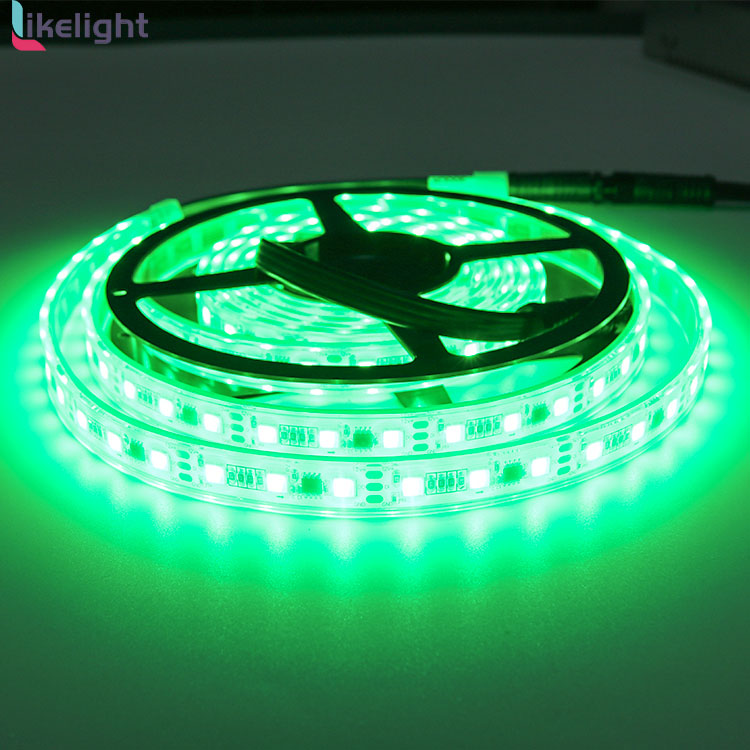
LIKELIGHT model L-S-10060-16824-RGBW-12V is published as DC12V, 57.6W/m, 60 SMD5050 RGBW LEDs/m and a 120-degree viewing angle. It is relevant where controllable RGBW output and close emitter spacing are required.
It is not yet a complete project specification. A useful approval segment includes the selected control version, actual profile, planned feed cable and connector, one cut/join and the demanding programme used for electrical and thermal acceptance.
| Model | L-S-10060-16824-RGBW-12V |
|---|---|
| Electrical | DC12V; 57.6W/m published |
| Light engine | 60 SMD5050 RGBW LEDs/m; 120° |
| Direct calculations | 4.8A/m; illustrative 5m = 288W and 24A |
| Nominal emitter pitch | About 16.7mm; not confirmed pixel pitch |
| Unconfirmed order items | IC, grouping, PCB width and protection construction |
Inputs required before quotation
- Installed lengths and each power-zone length
- Supply locations, cable sizes and connector plan
- Controller model, IC requirement and accepted programme
- Pixels/m, grouping, colour order and cut interval
- Profile, diffuser, ambient and protection construction
- Sample quantity, acceptance scene and delivery schedule
These inputs connect optical intent, control mapping, power zoning and thermal construction into one reproducible sample approval rather than treating a reel as a complete system.
FAQ
Does 60 LEDs/m mean 60 pixels/m?
No. LED density and controlled-position density are separate until grouping is confirmed.
Can a 5m reel use one 24A feed?
The 24A figure is only a nominal calculation; the approved circuits depend on cables, connectors, protection and measured voltage loss.
Does RGBW guarantee a specific white appearance?
No. Approve the white channel, mixing and controller mapping on the final sample.
Can the photographs confirm waterproofing?
No. Protection construction must be stated for the ordered version and tested with its ends and connectors.


