


90° RGBW Wall Washer: Setback and Overlap Before DMX Programming
A broad wall washer can leave hot bands, dark seams or flat-looking texture when aiming and spacing are chosen after installation. This guide uses the published 90° optic, 96W RGBW load and DMX control to establish a mock-up before fixing positions.
The common failure: asking a broad beam to graze texture
Wall washing seeks broad, reasonably even coverage; grazing places a narrower beam close to the surface to reveal relief and shadow. A published 90° beam is a broad starting point, so moving it very close may create intense bands rather than controlled texture.
Define whether the project wants uniform colour, visible stone texture or a deliberate scallop. Photograph the same wall sample at candidate offsets and aiming angles before repeating the bracket line.
Turn 90° into a starting geometry, not a promise
For a simplified symmetric 90° beam, nominal span equals 2 × throw × tan45°. At a 1m throw this is about 2m. Real usable coverage is smaller or differently shaped because lenses, aiming, mounting height and surface reflectance modify the distribution.
Fixture spacing should therefore be decided from overlap on the actual plane. Mark beam centres, compare RGBW colours and white, and judge vertical and horizontal uniformity from the primary viewing position.
Plan the 96W branch before the DMX address list
Each listed fixture is 96W; an illustrative ten fixtures represent 960W nominal connected load. This multiplication is useful for branch grouping, but it does not provide cable size, breaker size or maximum linked quantity.
The page lists AC85–277V at 50/60Hz. Actual input current depends on selected mains voltage, driver efficiency and power factor, so branch design must use the final nameplate and applicable electrical rules rather than 96W ÷ voltage alone.
Separate power groups so one service action does not darken the entire elevation. Record connector type, junction location, protective device and measured input under the demanding accepted scene.
DMX and RGBW still require a mode sheet
DMX is published, and RGBW contains four colour components, but the page does not establish channel mode, address footprint, RDM support or per-section resolution. Do not assume one four-channel address block without the final manual.
Freeze personality or mode, start address, universe allocation, data direction, termination and controller file on the mock-up. Test all-white, saturated colours, fades and power recovery before copying addresses across the facade.
IP65 is the start of the outdoor assembly review
The product title identifies IP65, while the page lists aluminium alloy and tempered glass. Outdoor performance still depends on gland orientation, mating connectors, junction boxes, bracket penetrations and drainage in the installed assembly.
Aim and lock the brackets without loading the cable. Preserve access to glass, fasteners and one fixture; then wet-test the representative connection arrangement instead of judging only the sealed luminaire body.
Facade mock-up decision table
| Design condition | Decision method |
|---|---|
| Uniform broad facade colour | Prototype the 90° optic with overlap at the intended setback. |
| Strong stone texture and shadow | Compare a narrower grazing optic; do not force the broad beam close to the wall. |
| Ten-fixture bay | Use 960W as nominal load, then size branches from final nameplate data. |
| Existing DMX network | Confirm mode, footprint, universe, termination and recovery behaviour. |
| Mixed fixture lengths | Verify whether power and optics change with each listed length. |
| Exposed outdoor junctions | Approve glands, connectors, boxes and drainage as an IP65 assembly. |
LIKELIGHT case: approve one repeatable facade bay
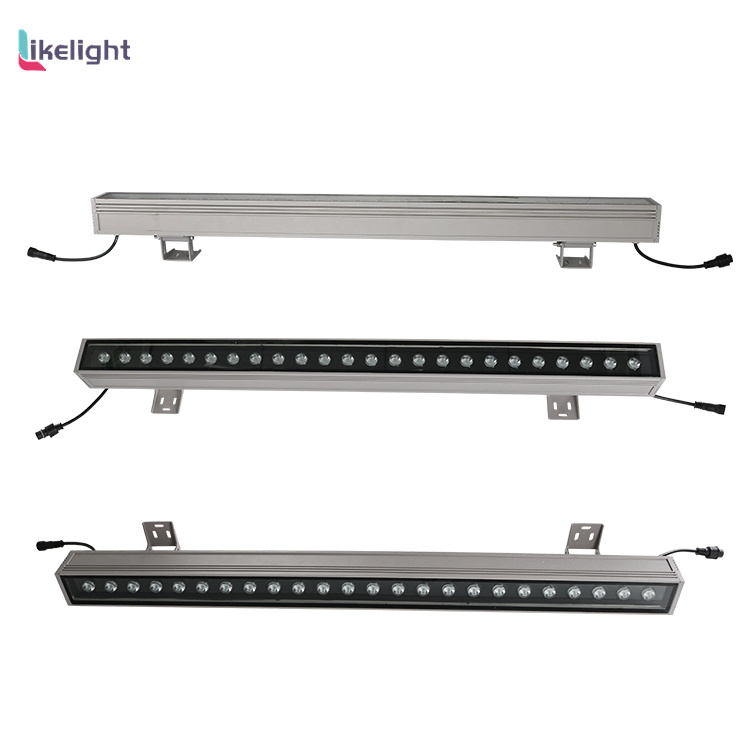
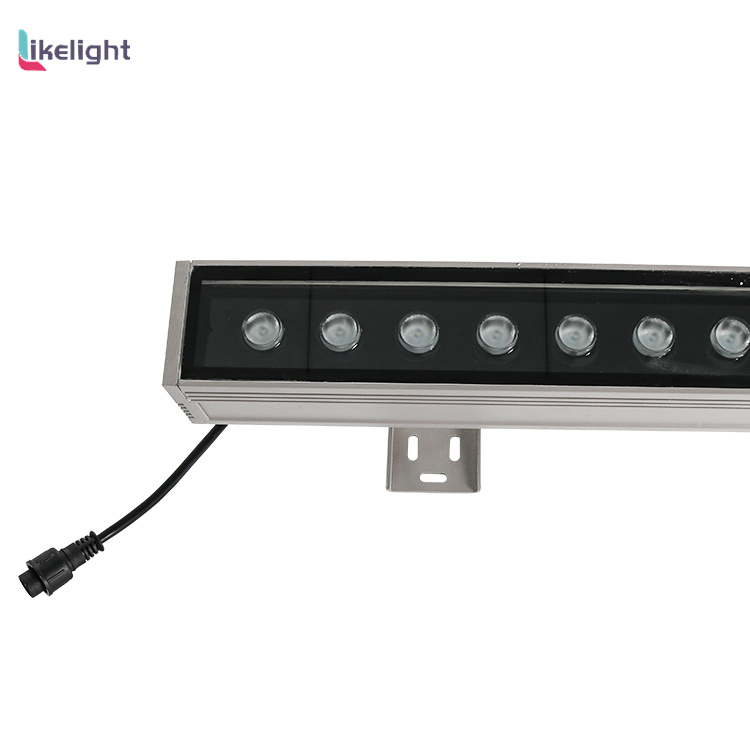
LIKELIGHT L-W-10024-DMXRGBW-96W is published with 24 LEDs, DMX, RGBW, 96W, AC85–277V 50/60Hz, a 90° beam, aluminium alloy and tempered glass; the page lists 0.5m, 1m, 1.5m and 2m lengths.
It is a candidate for broad colour washing where a facade bay proves setback and overlap. Before production, freeze the exact length/version, DMX mode, input rating, bracket aim and complete IP65 connection method together.
| Model | L-W-10024-DMXRGBW-96W |
|---|---|
| Light / control | 24 LEDs; RGBW; DMX |
| Electrical | 96W; AC85–277V, 50/60Hz |
| Optic | 90° published beam |
| Construction | Aluminium alloy and tempered glass; title identifies IP65 |
| Listed lengths | 0.5m / 1m / 1.5m / 2m; exact version must be frozen |
Inputs required before quotation
- Facade drawing, surface and target visual effect
- Mounting height, setback, spacing and aiming
- Fixture length/version and quantity per branch
- Mains voltage, distribution and junction locations
- DMX controller, mode, universes and cable route
- Connection sealing, mock-up scenes and delivery date
These inputs turn the optical target, branch load, DMX map and outdoor connection into one repeatable facade-bay approval before bracket holes are multiplied.
FAQ
Is a 90° wall washer suitable for wall grazing?
It favours broad coverage; test a narrower optic if pronounced texture and shadow are the goal.
Do ten fixtures draw exactly 960W?
960W is the nominal sum of ten 96W ratings; measured input and branch design use the final driver and mains conditions.
Does RGBW always use four DMX channels?
Not necessarily. The fixture personality and controlled resolution determine the footprint.
Does IP65 cover every outdoor connection?
No. Glands, plugs, junctions, mounting and drainage must be reviewed as the installed assembly.


