


DMX512 Linear Lights: Budget Universes and DC24V Circuits Separately
A facade can pass its animation test yet fail at scale when DMX channels and power branches are treated as the same limit. This guide calculates both for the LIKELIGHT 8 pixels/m RGB linear light.
The scaling failure: one drawing, two different budgets
A DMX universe budgets control channels; a power branch budgets watts, current and voltage drop. Reaching one limit does not prove that the other is acceptable, so both schedules must reference the same fixture sequence.
Start from the viewing task. Eight pixels per metre creates 125mm controlled steps for colour flow and segmented chases; it is not intended to become close-view video resolution merely by adding more metres.
Calculate the universe only after confirming fixture mode
If the final fixture uses ordinary RGB with three channels per pixel, 8 pixels/m × 3 = 24 channels/m. Twenty-one full metres use 504 channels, leaving 8 channels in a 512-channel universe; a twenty-second metre would cross that boundary.
This is a conditional planning result, not a claim that every mode uses three channels. Confirm personality, start address and any service channels, then reserve addresses by physical facade zone rather than filling universes blindly.
Build DC24V branches from 11.52W/m
The published maximum is 11.52W/m at DC24V, giving 11.52W ÷ 24V = 0.48A/m nominal. An illustrative 20m totals 230.4W and 9.6A.
Actual input changes with colour, brightness, programme and driver losses. The 20m example is a load comparison, not permission for one cable, one connector chain or one supply output.
Voltage drop follows current × circuit resistance. Divide long elevations into maintainable power zones, calculate cables and connectors, and record loaded voltage at the end of each zone during the demanding accepted scene.
Commission the DMX map before repeating the one-metre bar
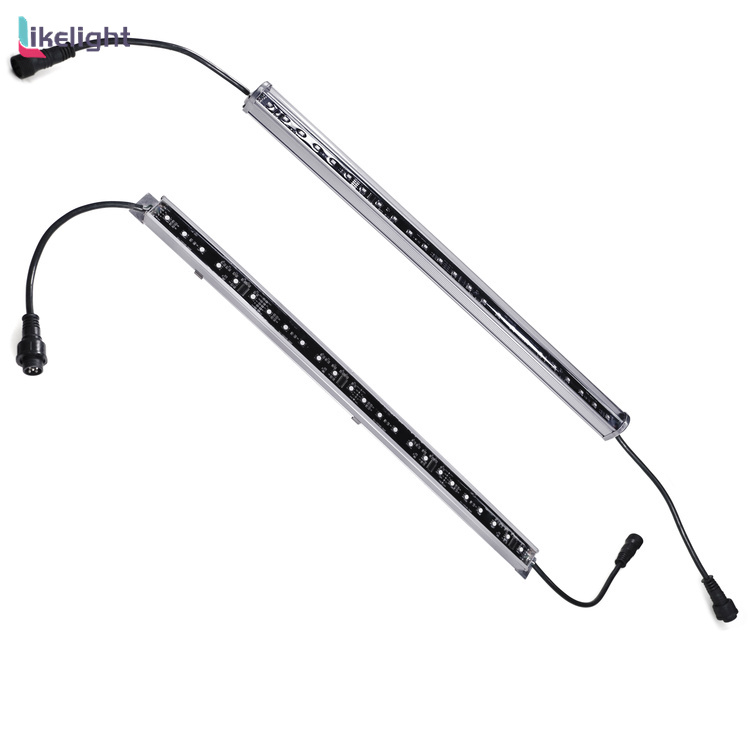
The published bar is 1000×50×45mm with 48 SMD5050 LEDs/m, 8 pixels/m, DMX512 and a 180° beam. Match bar numbers, addresses and physical direction before brackets are multiplied across the facade.
Test all pixels, colour order, fades, blackout, controller restart and data termination. A spreadsheet address can be correct while one reversed bar or misplaced connector makes the visible sequence wrong.
Mechanical continuity and protection need their own release
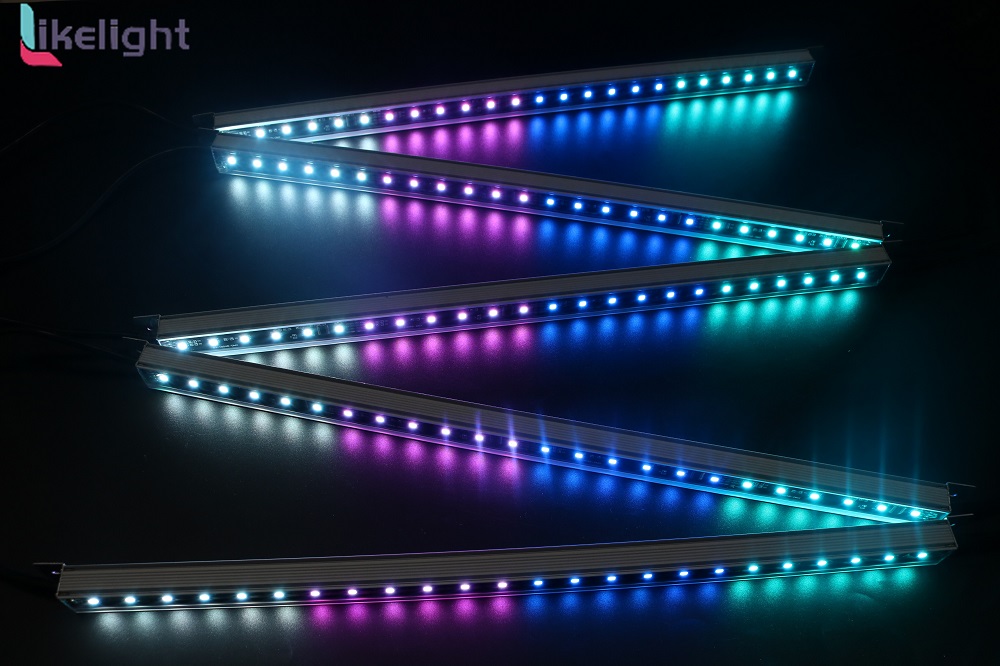
One-metre modules simplify quantity planning, but joint gaps, cable exits, corners and bracket tolerances determine whether the luminous line appears continuous. Approve a repeated two- or three-bar bay from the real viewing distance.
The page lists CE and RoHS but does not publish the final installation protection rating. For exposed work, obtain the confirmed version and review ends, connectors, drainage and service access as one assembly.
DMX and power decision table
| Project condition | Engineering decision |
|---|---|
| Medium-distance colour flow | Evaluate 125mm control steps on a facade mock-up. |
| Three-channel RGB mode confirmed | Budget 24 channels/m and up to 21 full metres per universe. |
| Mode includes extra channels | Recalculate from the actual footprint before addressing. |
| Illustrative 20m power zone | Start from 230.4W and 9.6A, then engineer cable and margin. |
| Repeated one-metre joints | Approve alignment, gap, cable exit and service access. |
| Exposed installation | Confirm protection version; CE and RoHS do not define weather sealing. |
LIKELIGHT case: one coordinate sheet for control and power
LIKELIGHT L-R-10048-DMX publishes DC24V, DMX512, 48 SMD5050 LEDs/m, 8 pixels/m, 11.52W/m maximum, 180° and a 1000×50×45mm body.
It fits medium-distance facade colour flow where 125mm control steps are acceptable. It is not the first choice for close-view detailed graphics, and it should not be released until the universe map, 0.48A/m load, physical sequence and protection method agree.
| Model | L-R-10048-DMX |
|---|---|
| Control / light | DMX512; RGB; 48 SMD5050 LEDs/m |
| Pixel structure | 8 pixels/m; nominal 125mm controlled step |
| Electrical | DC24V; 11.52W/m maximum; 0.48A/m nominal |
| Body / optic | 1000×50×45mm; 180° |
| Published / unknown | CE and RoHS listed; protection configuration unlisted |
Information required before quotation
- Elevation drawing, bar count and physical sequence
- Main viewing distance and animation reference
- Fixture mode, channel footprint and universe allocation
- DC24V supplies, zone lengths, cable and connectors
- Bracket positions, joints, exits and protection target
- Commissioning scenes, sample bay, quantity and schedule
These inputs align the visible fixture order, DMX universe map, DC24V power zones and mechanical joints on one released drawing so programming and installation use the same coordinates.
FAQ
Do 8 pixels/m always consume 24 DMX channels?
Only when the confirmed RGB mode assigns three channels to each pixel.
Can 21m always share one universe?
Only under that 24-channel-per-metre mode and without extra channels.
Can 20m share one power feed?
230.4W and 9.6A are comparison values, not a feed approval.
Is the bar confirmed for outdoor use?
The current facts do not publish the final protection configuration; verify the ordered assembly.


