

RGB LED Wall Washer Beam Angles: Compare 30°, 60°, 90° and 120° Before Choosing Spacing
A different lens on a 24W RGB wall washer changes more than footprint width. Compare published 30°–120° options, mounting geometry and a wall mock-up to judge uniformity, spill and electrical demand.
Choose a smooth wash or a deliberate texture first
A bar close to a wall can exaggerate stone relief and joints; moving it away may send light towards windows or pedestrians. The decision is not merely 30° versus 120°, but where light belongs, which areas must remain dark and where observers stand.
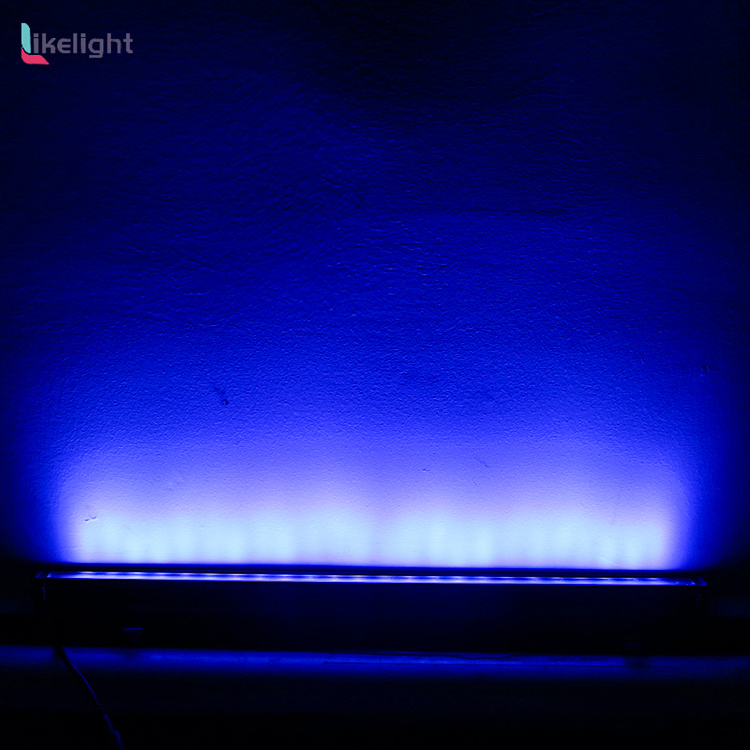
Keep brightness and aiming comparable while testing lenses and setback on the actual finish. For an even colour background, look for dark seams between bright bands. For texture, check that the shadows support the design rather than expose construction defects.
A 120° source field does not choose the final lens
This model's page contains a 120° lighting-angle field as well as 30°, 60°, 90° and 120° lens choices. The order needs the final optical configuration; one 120° field does not mean every supplied version produces the same distribution.
At equal output and comparable optical efficiency, narrower distributions usually concentrate light into a smaller angle while wider ones spread it. Without photometry and installation geometry, neither angle nor 24W establishes illuminance, useful height or uniformity, and a narrow lens cannot guarantee longer useful throw.
Use beam geometry to shortlist, not to set installation spacing
For a simplified small source and a plane perpendicular to its axis at distance d, compare width with w = 2d × tan(θ/2). At an illustrative d = 1m, 30°, 60°, 90° and 120° give approximately 0.54m, 1.15m, 2.00m and 3.46m respectively.
This angular geometry contains no illuminance threshold, real lens intensity distribution or surface reflectance. A one-metre linear source at close range, an oblique wall and overlapping adjacent bars depart from that assumption. The numbers are neither installation spacing nor recommended wall setback.
First reject an angle that clearly spills beyond the target; then compare narrow-beam dark seams against wide-beam brightness and glare on a mock-up. Final quantity and aiming come from photometric calculation or testing, not a trigonometric formula alone.
Optics, electrical load and control are separate choices
Published maximum power of 24W at DC24V gives 1A theoretically. An illustrative ten bars at that maximum total 240W and 10A before line loss and supply margin. Changing a lens does not eliminate this electrical demand, nor does it mean every colour scene consumes the same power.
The page title says DMX but the IC field says 2903, leaving the supplied receiver and control configuration unresolved. This example therefore assigns no DMX addresses or cascade limit. Establish the interface from wiring documentation and a sample before choosing a controller, and divide power and data by facade zones.
Bar ends and brackets also shape the night-time result
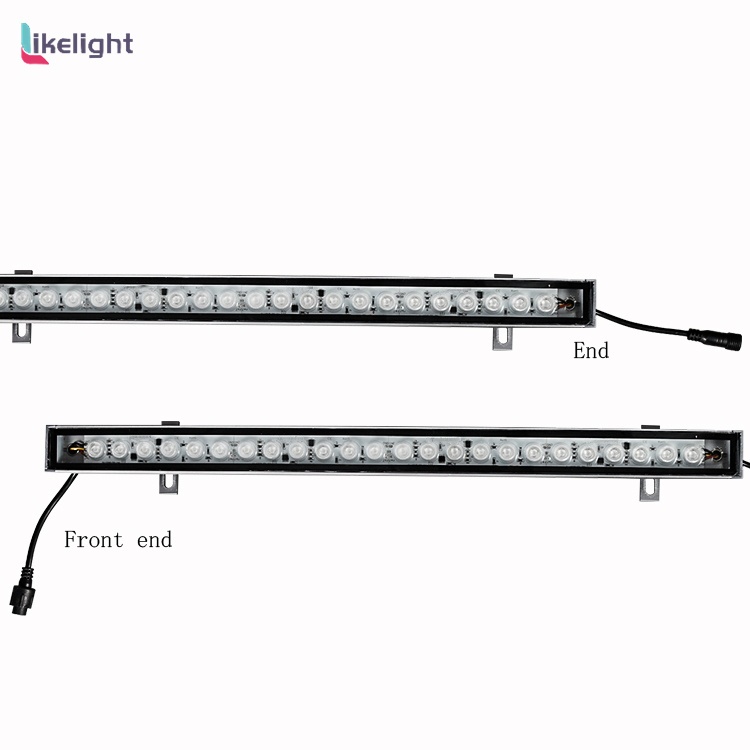
The published dimensions are 1000×32×25mm with IP65. End gaps, bracket angles and obstructions can leave brightness seams between bars; filling a run with physical length does not guarantee a continuous wash. Include a joint and the actual bracket position in the mock-up.
An IP65 housing does not automatically rate field connectors, junction boxes or supplies, and it is not an immersion approval. Allow drainage, cable bends and single-bar replacement. Accessible service joints reduce the need to dismantle and re-aim the installation later.
Optical and mounting decision table
| Design condition | Candidate decision |
|---|---|
| Sideways spill must be limited | Begin with a narrower candidate and check dark seams in a mock-up. |
| Broad target at short distance | Evaluate wider optics while checking reduced intensity and glare. |
| Strongly textured stone | Compare setback and aiming before changing wattage. |
| Long continuous installation | Mock up bar joints, bracket shadows and service connectors. |
| Illustrative ten bars | Start at 240W and 10A; verify zoned feeds instead of routing all current through the first connector. |
| Existing control system is mandatory | Resolve the DMX title versus 2903 field before selecting the controller. |
LIKELIGHT case: freeze the optical sample before the order
LIKELIGHT L-W-10048-DGL-24V is an aluminium RGB bar with DC24V, 24W maximum, one-metre length, IP65 and published 30°–120° lens options. It is a candidate for coloured linear lighting with a defined target wall and adjustable installation geometry.
The 24W figure cannot promise high-rise reach, unverified control compatibility or immersion use. Once the lens, real-wall mock-up and interface are settled, compare quantity, wiring and procurement cost rather than unit price alone.
| Model | L-W-10048-DGL-24V |
|---|---|
| Electrical | DC24V; 24W maximum; theoretical 1A per bar |
| Dimensions and protection | 1000×32×25mm; IP65 |
| Lens choices | 30° / 60° / 90° / 120° |
| Illustrative geometry at 1m | 0.54m / 1.15m / 2.00m / 3.46m; not installation spacing |
| Control clarification | DMX title; 2903 IC field; final wiring and sample govern |
Optical and installation inputs before quotation
- Target wall dimensions, finishes and site photographs
- Available mounting positions and wall setback
- Required brightness, colour scenes and spill limits
- Lens mock-up results and bracket aiming conditions
- Control interface, power zones and connector layout
- Bar quantity, sample needs and delivery date
These inputs connect the target footprint, actual wall effect, installation joints and electrical configuration so lens selection follows the mock-up and exposes spill, dark seams or interface mismatches before bulk procurement.
FAQ
Is 120° always more uniform than 30°?
No. A wider angle spreads light, but wall distance, incidence, material and overlap jointly determine uniformity.
Is 0.54m the correct spacing for a 30° bar?
No. It is a small-source geometric width at a 1m perpendicular plane, excluding intensity, bar length and oblique-wall geometry.
How high can a 24W bar illuminate?
Power alone cannot establish this. The final lens photometry, position, wall material and target illuminance are needed.
Can it connect directly to an existing DMX controller?
The title is insufficient. Clarify the 2903 field and verify the receiver and interface using wiring documents and a sample.