

RGB Amusement Pixel Lights Fail at Full Output? Separate Power Faults from Mapping Errors
A chase can work at low brightness yet flicker at high output. Use a DC24V, 4.32W UCS2903 point-light case to separate load-related faults from data order and installation problems.
Why a low-brightness demonstration can miss the fault
Testing only a dim chase before opening does not represent the electrical demand of a full-output scene. When several RGB channels illuminate together, circuit current can rise, changing voltage losses through the same cable and connectors. Distant lamps may show symptoms before the nearest ones.
Compare a low fixed colour, a higher-output fixed colour and the original animation, recording where symptoms appear. Stay within the circuit's verified ratings; reproducing a fault is not a reason to keep an unknown connector or supply overloaded.
Eighteen LEDs do not establish eighteen mapped positions
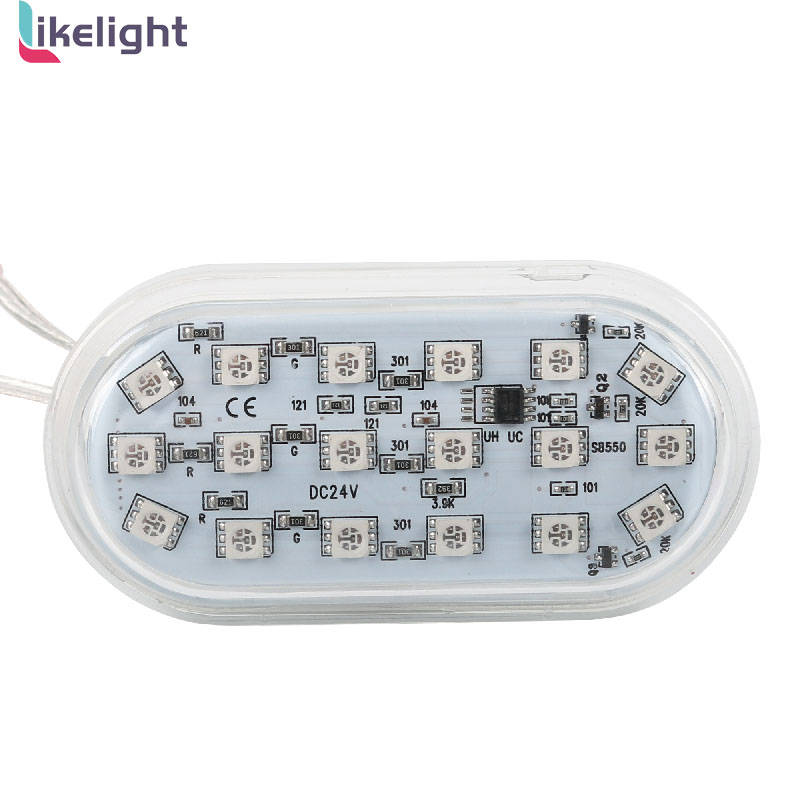
This point light is published as 100×50mm with 18 LEDs and UCS2903 control. LED count describes the emitters inside the housing, not automatically 18 independent pixels in the controller. The supplied grouping needs a position-by-position test.
Number the physical lamps, then advance one programmed position at a time and record which housing responds. This separates a shifted sequence from a missing colour. A UCS2903 cascade follows data order; assigning an independent DMX address to every lamp is not a valid default assumption.
Put nominal load beside measured voltage
Using the published DC24V and 4.32W gives 4.32 ÷ 24 = 0.18A per lamp theoretically. An illustrative 25 lamps total 108W and 4.5A; 100 lamps total 432W and 18A. These are estimates, not fixed operating consumption or a circuit capacity.
Line voltage drop can be understood as current multiplied by circuit resistance. Longer cables, smaller conductors and poor contacts increase loss. Measure supply-end and remote-end voltage in the same scene and compare with the supplied acceptable input range. Split serviceable zones instead of routing the entire 18A through the first connector.
Actual consumption varies with brightness, RGB combinations and animation; supply input also includes efficiency and losses. A flicker that disappears when dimmed does not prove an IC fault: dimming may simply relieve a power bottleneck.
Use controlled comparisons to narrow the fault
If fixed colours work but animation runs backwards, inspect the numbering map, controller output and data direction first. If symptoms always begin after one joint across several output states, inspect that joint and downstream wiring. This is a location clue, not proof that a particular component has failed.
With power disconnected, substitute a verified short chain of the same configuration for the suspect section, then repeat the identical program. Change one variable at a time and retain wiring and settings records. The page supplies no maximum cascade count, signal distance or controller capacity; invented limits cannot replace diagnosis.
IP67 does not resolve strain, vibration or access
IP67 is the published housing rating, not a shared rating for field splices, supply and controller. The 100×50mm outline is not a drilling drawing either. Fixing details, connector clearance, drainage and replacement access must match the supporting structure.
For amusement decoration, moving parts need separate verification of vibration, strain relief and fixing retention; IP67 cannot establish these properties. Let cable supports carry external forces and keep connectors accessible, so replacing one lamp does not require dismantling an entire decorative panel.
Choose the next test from the symptom
| Symptom or condition | First action |
|---|---|
| Fault only at higher output | Within verified ratings, compare near and far voltages and inspect cable/contact losses. |
| Same wrong sequence at every brightness | Check physical numbering against programmed positions before enlarging the supply. |
| Persistent fault after one joint | Disconnect power, inspect the joint and substitute a verified short chain. |
| Illustrative 25-lamp zone | Start with 108W and 4.5A, then design circuits from length and component ratings. |
| Moving decorative panel | Verify fixing, strain relief and vibration separately from IP67. |
| Fine text or video | Test controlled positions and viewing effect; eighteen LEDs do not imply eighteen pixels. |
LIKELIGHT case: make sample acceptance reproducible
LIKELIGHT L-D-10018-RGB is published with UCS2903, DC24V, 4.32W, 18 LEDs, a 100×50mm body and IP67. It is a candidate for amusement decoration requiring programmable colour nodes, not automatically for fine text or video imagery.
Approve appearance, individual-position mapping and representative-load testing before freezing controller settings, connectors and circuit drawings. One attractive animation cannot demonstrate power margin; eighteen emitters cannot establish pixel resolution.
| Model | L-D-10018-RGB |
|---|---|
| Electrical | DC24V; nominal 4.32W; theoretical 0.18A |
| Construction | 100×50mm; 18 LEDs per lamp |
| Control | UCS2903; verify grouping against supplied configuration |
| Protection | IP67 housing |
| Illustrative loads | 25 lamps: 108W, 4.5A; 100 lamps: 432W, 18A |
Inputs for quotation and sample testing
- Total lamp count and count per service zone
- Actual viewing positions and intended scenes
- Controller model, program and colour order
- Supply positions, cable lengths and conductor specification
- Mounting structure, movement and connector arrangement
- Sample test states, symptom records and delivery date
These inputs bring load, data order and mechanical connections into one system review, allowing the sample test to be repeated on site and a fault to be traced to a circuit or joint instead of quoting only a lamp quantity.
FAQ
Does a full-output fault always mean voltage drop?
No. Measure voltage and inspect supply and connections first, then use controlled comparisons to separate data, configuration and component faults.
Do 100 lamps simply need one 18A supply?
18A is a nominal total-load estimate. Supply margin, environment, protection and connector ratings still need design; it does not establish a single-supply layout.
Can eighteen LEDs show eighteen independent colours?
LED count cannot answer that. Verify control grouping and test the relationship between controller positions and physical housings.
Does IP67 qualify a lamp for every moving ride?
No. An ingress rating does not verify vibration, fixing strength, repeated cable flexing or complete-machine safety.